
Water parameters
Overview
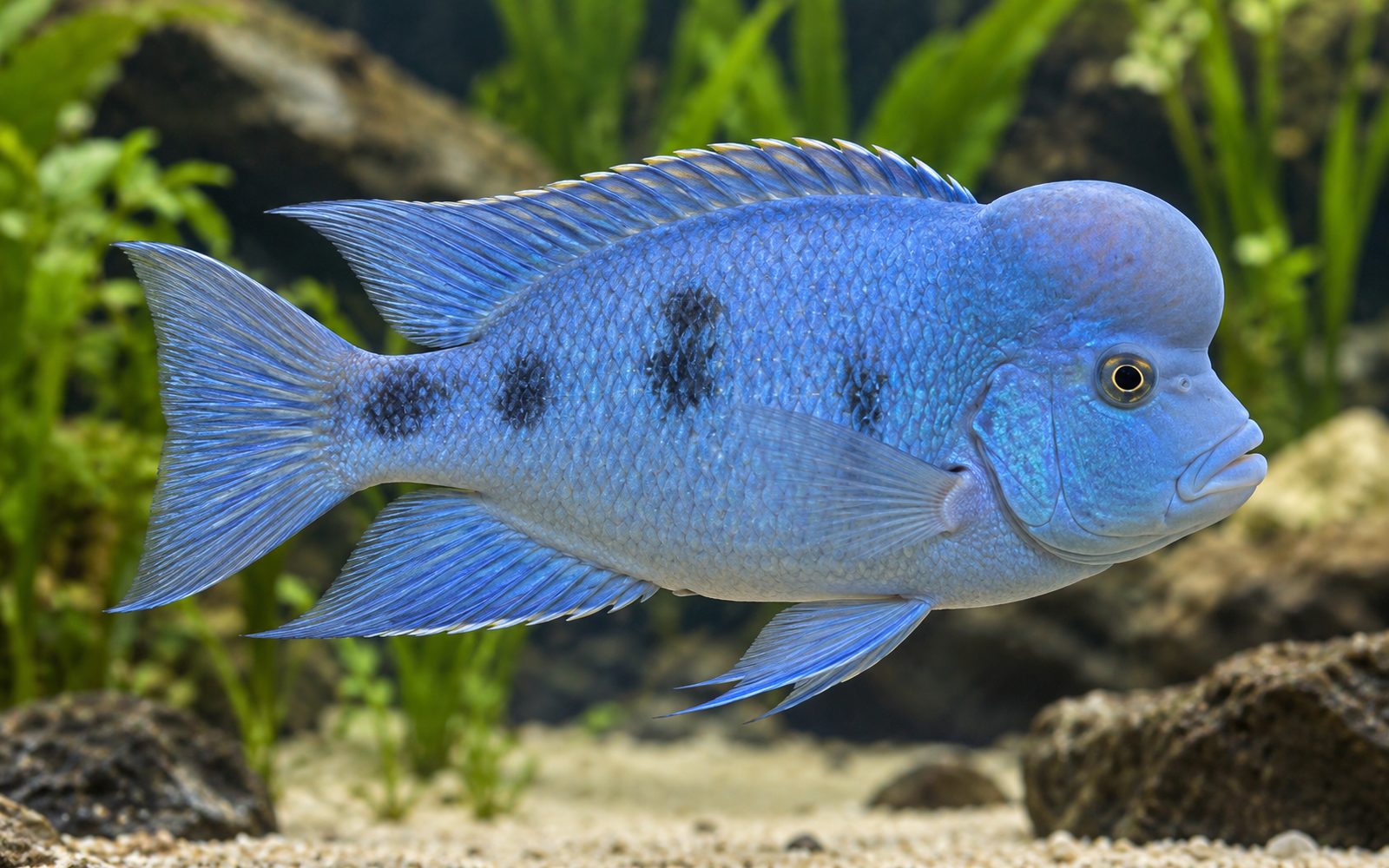
With the fatty hump that grows on its forehead and its plain blue color from head to tail, the blue dolphin is one of the most easily recognized Malawi cichlids in aquariums. The hump is present in both sexes but more pronounced in older males. A few dark blotches occasionally appear on the flanks.
It is a calm species among the Malawi haps and rarely attacks other fish. Because of its size of up to 20 cm and its slow growth, it is a long-term aquarium fish; under suitable conditions it can live for more than 10 years.
Natural Habitat
It lives along the sandy shores of Lake Malawi. Its way of feeding in the wild is interesting: it follows large fish that take sand into their mouths and sift it, picking up the small invertebrates they stir up. The water is hard, alkaline and clear.
Tank Setup
- Volume: at least 450 liters and 150 cm in length for a group.
- Layout: A wide sandy area with rock groups along the sides; open swimming space is important.
- Water: Hard and alkaline (pH 7.8–8.5); aragonite substrate or Malawi salt.
- Maintenance: Strong filtration, weekly 30–50% water changes.
Diet
Omnivorous; in the wild it feeds mostly on small invertebrates. A quality cichlid pellet should be the staple; it is varied with frozen mysis, brine shrimp and krill. Spirulina-based foods can also be added. Mammalian meat and bloodworms can cause digestive problems.
Behavior and Compatibility
A calm and somewhat shy fish. Males defend a small area during courtship, but fights are rarely serious. Kept with aggressive mbuna, it comes under pressure and stays away from food. It may eat small fish that fit in its mouth.
Good companions: electric blue ahli, Copadichromis borleyi, red empress, Placidochromis electra, Aulonocara species, large but calm haps such as venustus and livingstoni, Synodontis catfish suited to hard water.
Avoid: aggressive mbuna, small fish that fit in its mouth, community fish, shrimp and snails.
Group and Colony Structure
- Harem: 1 male and 3–4 females; thanks to its calm temperament, more than one male can also be kept in a large aquarium.
- Group: In the wild it roams in loose groups; in the aquarium too, a group of 4–6 fish brings out more natural behavior.
- Because sexing is difficult, the group is usually started from juveniles.
Breeding
A mouthbrooder. The male courts on a flat rock or an area he has cleared in the sand; the female picks up the eggs in her mouth and fertilization is completed inside the mouth. The female carries 20–50 eggs for about 3 weeks. The fry grow slowly; in the first weeks they are fed brine shrimp and finely crushed food.
Health and Common Problems
- Malawi bloat: wrong food and stress.
- Hole in the head: associated with insufficient water changes; the humped forehead area should be watched carefully.
- Weakening under pressure: seen in fish that cannot eat because of aggressive tankmates.
Sexing
Sexing is difficult because both sexes are blue and carry the hump. Mature males are usually larger, with a more prominent forehead hump and slightly brighter colors. Reliable sexing is done by examining the genital papilla or by watching courtship behavior.
Tank mates
This list is calculated automatically from the species profile and grows as new species are added to the catalog. Try it in the planner for a definite answer.
Usually compatible
 Yellow Regal Peacock
 Firemouth Cichlid
 Rainbow Cichlid
 Pearl Cichlid
 Redhead Cichlid
 Red Hump Eartheater
 Pundamilia nyererei
 Pundamilia pundamilia
 Yellow Tail Acei
 Butterfly Goodeid
Should not be kept together





Hobbyist notes
Things you won't find in books, learned by trial and error. The most helpful ones are on top.
Change history and contributors
- Page created · October 16, 2026