

Water parameters
Overview
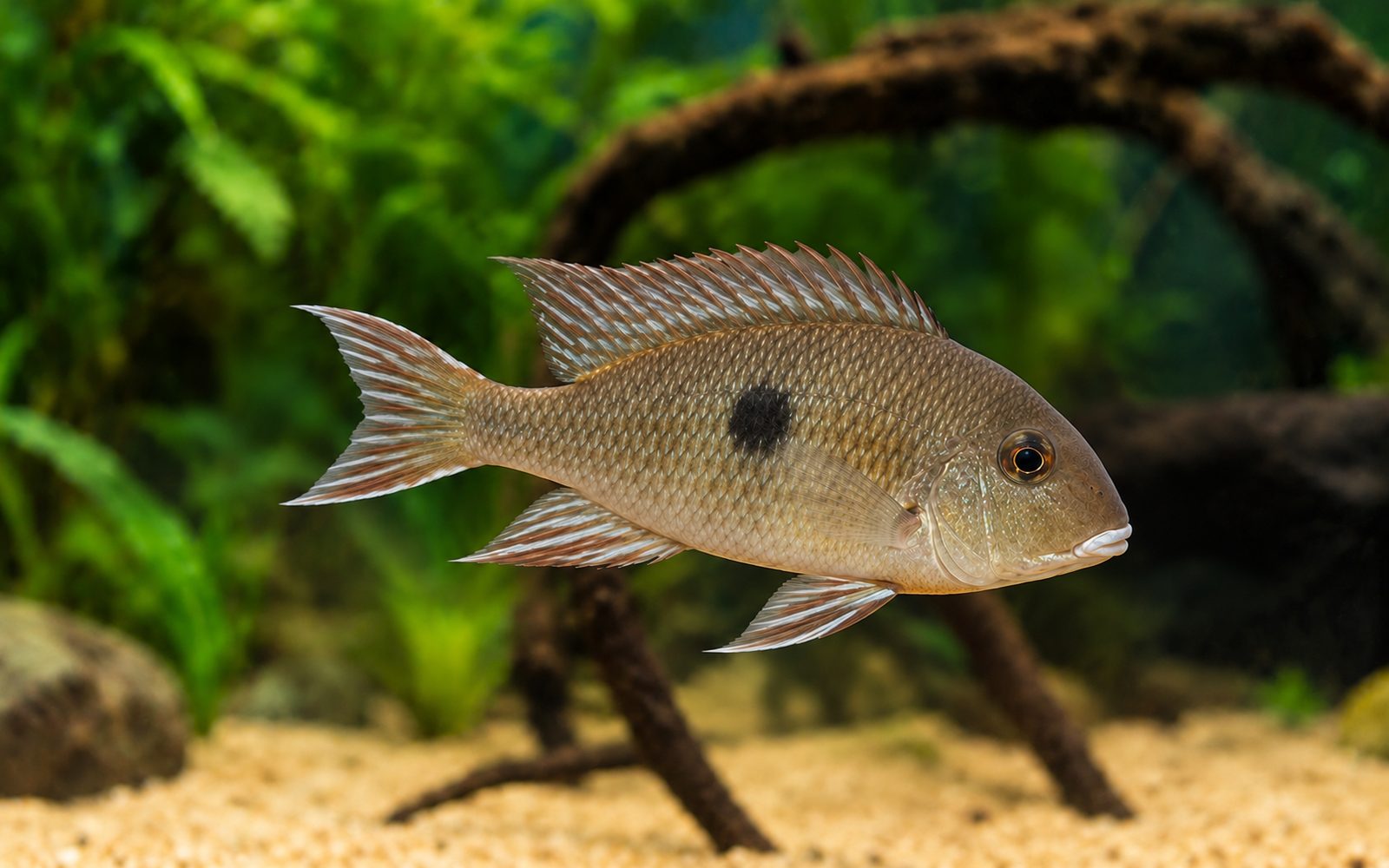
The most striking feature of this species is the bright red-orange hump that develops on the forehead of mature males. The body is olive-bronze, with blue-green reflections on the scales and a dark blotch in the middle of the body. Females are smaller, plainly colored and have no hump.
Unlike the large Geophagus of the surinamensis group, it stays smaller, adapts to harder water and is a mouthbrooder that takes its eggs into its mouth as soon as they are laid. The male, on the other hand, does not care for the fry; this is why it is kept in a harem.
Natural Habitat
It lives in the rivers of the Magdalena River basin in Colombia and the Lake Maracaibo basin on the Venezuela–Colombia border. It feeds by sifting sand in waters with sandy and stony bottoms and moderate current.
Tank Setup
- Volume: At least 200 liters and 100–120 cm of length for one male and 2–3 females.
- Substrate: Fine sand is essential.
- Decor: Stones, roots and obstacles that break up lines of sight; there should be areas where the females can get away from the male. Plants attached to roots and hard-leaved plants hold up.
- Water: Moderately hard, neutral to slightly alkaline water; a 30% water change every week.
Diet
Omnivorous. Use small sinking granules and tablets as the staple; vary the diet with frozen bloodworms, brine shrimp and mysis. A brooding female does not eat for a few weeks; she should be well fed before this period.
Behavior and Compatibility
Males are aggressive toward each other; more than one male in the same tank is only possible in a very large layout. Toward other species it is generally moderate.
Good companions: Medium-sized tetras and barbs, Ancistrus, corydoras, festivum, mild cichlids such as the firemouth.
Avoid: Very small shrimp, large aggressive cichlids, a second male (in a small tank).
Group and Colony Structure
A harem setup is recommended: 1 male and 2–3 females. A single female becomes worn out under the male's constant attention. During breeding the male claims a small area of sand and invites the females there.
Breeding
The male prepares a pit or a flat stone and invites the female. The female takes the eggs into her mouth as soon as she lays them; fertilization takes place in and around the mouth. The female carries the eggs and fry in her mouth for about 2–3 weeks, and then guards the free-swimming fry for a while. The fry grow easily on brine shrimp nauplii.
Health and Common Problems
Hardy. In poor water conditions, hole-in-the-head disease (HLLE) and bacterial fin problems occur. Females disturbed during brooding may swallow or spit out the eggs.
Sexing
Easy: mature males are larger and have a prominent red hump on their forehead. Females are smaller; they do not develop a hump and their colors are plain. In young, non-dominant males the hump may develop late.
Tank mates
This list is calculated automatically from the species profile and grows as new species are added to the catalog. Try it in the planner for a definite answer.
Usually compatible
 Yellow Regal Peacock
Glass Tetra
Yellow Regal Peacock
Glass Tetra
 Emerald Betta
 Firemouth Cichlid
 Buffalohead Cichlid
 Chocolate Cichlid
 Festivum
 Geophagus surinamensis
 Rainbow Cichlid
 Gymnogeophagus balzanii
Should not be kept together




Hobbyist notes
Things you won't find in books, learned by trial and error. The most helpful ones are on top.
Change history and contributors
- Page created · October 16, 2026