

Water parameters
Overview
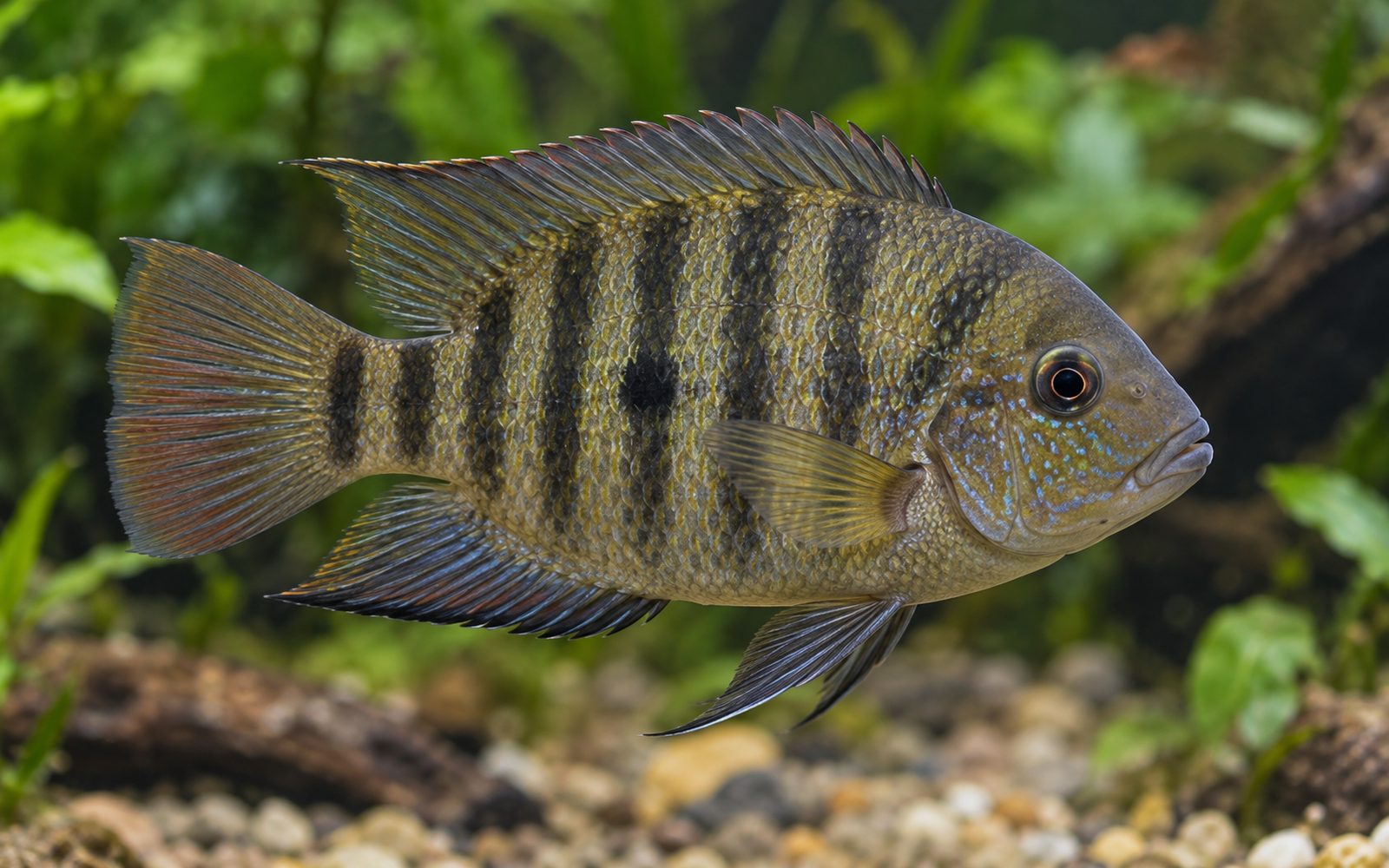
Geophagus surinamensis is one of the oldest and best-known eartheater names in the aquarium hobby. Its yellowish-olive body has fine red-orange lines running along the scale rows, a dark spot in the middle of the body and red and blue patterns on the dorsal fin. In mature fish the tips of the dorsal and tail fins grow out into threads.
An important note: scientific studies have shown that the true G. surinamensis lives only in Suriname and French Guiana. Most fish sold in stores as "surinamensis" are G. altifrons, G. proximus or other Amazon species from the same group. Their care is almost identical, but color and size may differ.
Natural Habitat
It lives in groups in the rivers of Suriname and French Guiana that flow to the coast, in sections with sandy bottoms and moderate current. It takes sand into its mouth and sifts it, eating insect larvae, small crustaceans and plant debris.
Tank Setup
- Volume: At least 400 liters and 180 cm of length for a group of 4–6.
- Substrate: Fine, rounded sand is a must; the open sand area should be kept large.
- Decor: Roots and rounded stones along the edges. Hard-leaved plants and epiphytes attached to roots are suitable.
- Water: Soft to moderately hard, slightly acidic and very clean water; a 30–50% water change every week.
Diet
Omnivorous. Use small sinking granules and tablets as the staple; vary the diet with frozen bloodworms, brine shrimp, mysis and vegetable-based foods. 2–3 small meals a day are recommended.
Behavior and Compatibility
Peaceful and social. Showy squabbles with spread dorsal fins occur within the group, but injuries are rare. Because of its calm nature, it may fall behind in the competition for food when kept with fast, greedy fish; keep an eye on it during feeding.
Good companions: Severum, uaru, festivum, angelfish, Satanoperca species, large tetras, plecos, corydoras.
Avoid: Aggressive Central American cichlids, coarse substrate, small shrimp.
Group and Colony Structure
Kept as a group of at least 4, preferably 6. The larger the group, the more natural and showy its behavior. A pair ready to breed temporarily defends a small area.
Breeding
It is a delayed mouthbrooder. The eggs are laid on a cleaned stone and guarded in the open for a while; then the larvae are taken into the parent's mouth. The free-swimming fry still take refuge in the mouth at night or when danger threatens. The fry are fed brine shrimp nauplii.
Health and Common Problems
- Hole-in-the-head disease (HLLE): With high nitrate and poor water conditions.
- Gill irritation: From coarse substrate.
- Bacterial infection: After transport stress; quarantine newcomers.
Sexing
There is no reliable way to tell the sexes apart from the outside. Males are usually slightly larger with longer fin extensions. A reliable distinction is made by the papilla.
Tank mates
This list is calculated automatically from the species profile and grows as new species are added to the catalog. Try it in the planner for a definite answer.
Usually compatible
 Flame Tetra
Glass Tetra
Flame Tetra
Glass Tetra
 Blackfin Corydoras
 Polystictus Corydoras
 Emerald Betta
 Emerald Cory
 Porthole Catfish
 Altum Angelfish
 Keyhole Cichlid
 Firemouth Cichlid
Should not be kept together




Hobbyist notes
Things you won't find in books, learned by trial and error. The most helpful ones are on top.
Change history and contributors
- Page created · October 16, 2026