

Water parameters
Overview
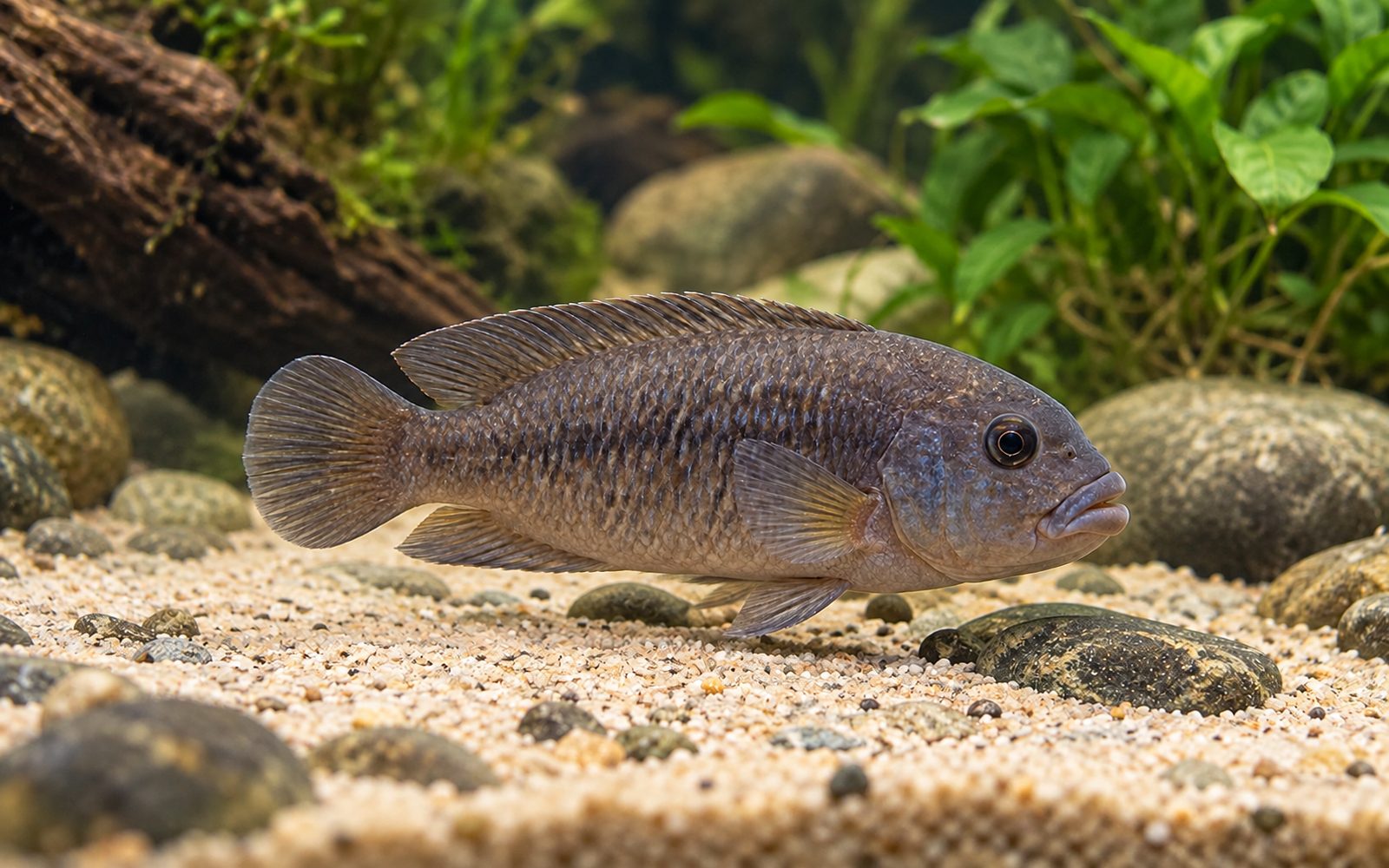
The buffalohead cichlid takes its name from the large fatty hump that grows with age on the males' forehead; casuarius in its scientific name also refers to the cassowary, a bird that wears a helmet on its head. Its body is plain, somewhere between bluish gray and brown; its real appeal lies more in its behavior than its looks. Males reach around 12 cm, while females stay smaller.
Because it has adapted to the fast-flowing parts of the Congo River, its swim bladder is reduced: instead of hovering in midwater, it moves along the bottom in short hops. With its lifelong pair bond and devoted parenting, it is a delightful species to watch.
Natural Habitat
It lives in the rocky, rapid-filled and very fast-flowing stretches of the Lower Congo River. The gaps between rocks serve as both hiding and nesting places. The water is constantly moving and very rich in oxygen; the temperature stays high all year round.
Tank Setup
- Volume: 100 liters and 80–100 cm of length for a pair; floor area matters.
- Caves: Rock caves, groups of split stones or clay pots; a hiding place for every fish.
- Flow and oxygen: A strong filter outlet plus extra flow or aeration; this mimics the current of its natural habitat.
- Water: pH 6.5–7.8, soft to moderately hard water; a 25–30% water change every week.
- Plants: It digs around its cave; plants attached to rocks, such as Anubias, are suitable.
Diet
Omnivorous. Use sinking granules and tablets as the staple; vary the diet with frozen bloodworms, brine shrimp, mysis and spirulina-based foods. Since it feeds on the bottom, make sure the food reaches the substrate.
Behavior and Compatibility
Calm outside of breeding, but territorial around its cave toward other bottom-dwelling fish. When it has fry, it determinedly chases away any fish that approaches its territory.
Good companions: Robust fish that live in the middle and upper water: large characins such as Congo tetras, barbs, Synodontis catfish (given a large floor area).
Avoid: Other cichlids that claim territories on the bottom (in a small tank), small bottom fish, shrimp, very slow and delicate fish.
Group and Colony Structure
- Kept as a pair; the pair bond is long-lasting, often for life.
- Raise 5–6 juveniles together and choose a pair that forms naturally; remove the others.
- In a tank with a large floor area, two pairs can be kept, each given its own group of caves.
Breeding
The pair spawns inside a cave and narrows the entrance by digging out sand. The female tends the eggs while the male guards the surroundings. The eggs hatch within a few days; the fry leave the cave after about a week. The parents protect the fry together for a long time; the young are fed newly hatched brine shrimp and powdered food.
Health and Common Problems
- Hardy; problems usually come from stagnant, oxygen-poor water.
- Breathing difficulty: Rapid breathing occurs when flow and aeration are insufficient.
- Fight injuries: Caused by clashes with bottom fish when there are too few caves.
Sexing
Easy in adults: males are noticeably larger and their forehead humps are much bigger. Females have a small hump or none at all. Juveniles are hard to tell apart.
Tank mates
This list is calculated automatically from the species profile and grows as new species are added to the catalog. Try it in the planner for a definite answer.
Usually compatible
 Emerald Betta
 Firemouth Cichlid
 Cupid Cichlid
 Chocolate Cichlid
 Festivum
 Geophagus altifrons
 Geophagus surinamensis
 Rainbow Cichlid
 Gymnogeophagus balzanii
Should not be kept together




Hobbyist notes
Things you won't find in books, learned by trial and error. The most helpful ones are on top.
Change history and contributors
- Page created · October 16, 2026