
Water parameters
Overview
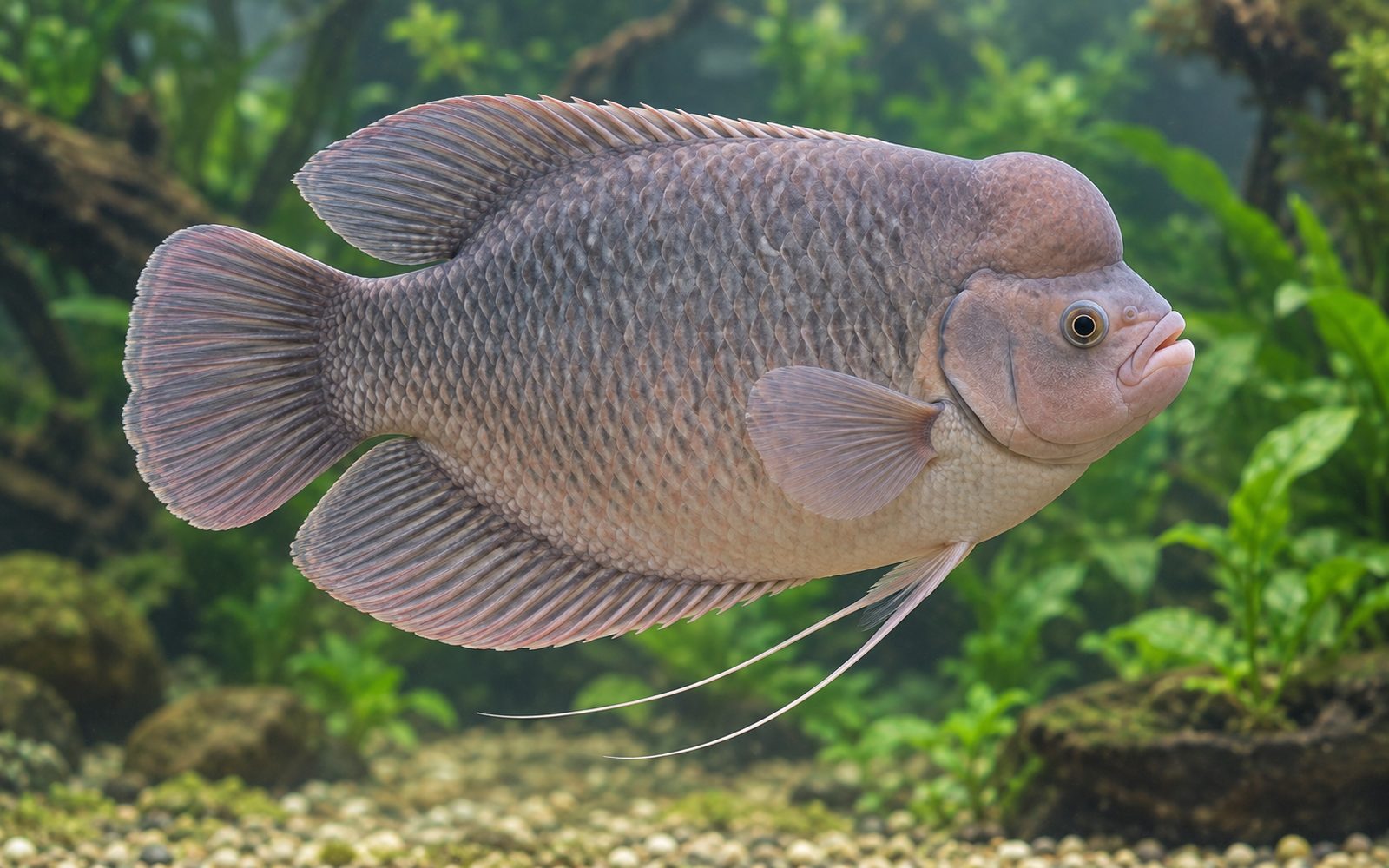
The giant gourami is the largest of the labyrinth fish. In stores it is sold as 5–8 cm juveniles with a pointed snout, dark vertical bands on the body and a dark spot on the caudal peduncle. These juveniles exceed 40 cm within a few years; adults turn into giant gray-pinkish fish with thick lips and a forehead raised into a prominent hump. It is an important food fish in Southeast Asia.
It is long-lived and becomes tame enough to recognize its owner and take food from the hand. However, keeping it is a serious responsibility: it needs an aquarium of 1000 liters or more or a large heated pond. Releasing a fish that has outgrown its tank into the wild harms both the fish and nature; never release it into the wild.
Color and Fin Varieties
- Golden giant gourami: a yellow-gold selected form; its care and size are the same as the wild form.
- Albino giant gourami: a form with a pink-white body and red eyes.
Natural Habitat
In the wild it lives in slow-flowing stretches of large rivers, in lakes and in swamps. Because it is farmed in ponds and rice paddies in many countries of the region, its true natural range is hard to determine. It copes with warm, still, oxygen-poor water thanks to its labyrinth organ.
Tank Setup
- Volume: at least 1000 liters for an adult; a tank approaching 2 meters in length or a large indoor pond.
- Water: 22–28°C is ideal; pH 6.5–8, adapts to a wide range of hardness.
- Filter: very powerful filtration and weekly water changes of 30% or more; its waste load is high.
- Decor: sturdy and sparse; large roots and rocks. Soft plants get eaten.
- Lid: a sturdy lid; when startled it splashes water with powerful thrashing.
Diet
Omnivorous and very fond of plant matter. Granules and pellets for large fish should be the staple; supplement with vegetables and fruit such as zucchini, cucumber, spinach, peas and banana. Frozen shrimp and mussels can be added. Juveniles are fed twice a day, adults once a day; overfeeding quickly ruins water quality.
Behavior and Compatibility
Peaceful and curious when young; as it grows it can become territorial and grumpy, especially toward its own species. It eats fish, shrimp and snails that fit in its mouth, and uproots and eats plants.
Good companions: robust fish close to its own size: large plecos, silver arowana, large South American cichlids (oscar), clown loaches (large groups), giant barbs.
Avoid: small fish and shrimp, slow and long-finned species, planted setups.
Group and Colony Structure
Adults are usually kept singly. In very large ponds they can live in groups, but in an aquarium two adult males get into territorial fights. Juveniles can be raised in a group for a while; they may need to be separated as they grow.
Breeding
The male weaves a ball-shaped nest from plant pieces and fibers near the surface. The female lays eggs in the nest, and the parents guard the nest and the fry for a while. Breeding in the aquarium is almost never seen because of the space required; breeding is done in ponds.
Health and Common Problems
Generally hardy. Fish kept in small aquariums show stunted growth, fin rot and chronic stress. Overfeeding leads to obesity, and high nitrate leads to loss of appetite and bacterial infections. Sufficient volume and regular water changes are the best prevention.
Sexing
In adults the male's forehead hump is more prominent and the dorsal and anal fins are more pointed. Females have a flatter forehead, rounder fins and a fuller belly. Sex cannot be reliably determined in juveniles; the differences become clear once the fish exceeds 20–25 cm.
Tank mates
This list is calculated automatically from the species profile and grows as new species are added to the catalog. Try it in the planner for a definite answer.
Usually compatible
 Chocolate Cichlid
 Jack Dempsey
 Redhead Cichlid
 Red Devil Cichlid
 Cryptocoryne Parva
Adonis Pleco
African Brown Knifefish
Cryptocoryne Parva
Adonis Pleco
African Brown Knifefish
 Weeping Moss
 Flame Moss
 Alternanthera Reineckii 'Mini'
Should not be kept together









Hobbyist notes
Things you won't find in books, learned by trial and error. The most helpful ones are on top.
Change history and contributors
- Page created · October 16, 2026