

Water parameters
Overview
The red devil is a large, powerful cichlid from the great lakes of Nicaragua. It takes its name from the thick, fleshy lips on its pointed snout (labiatus) and its undeniable aggression. In the wild most individuals are gray-brown and banded; the orange, red and white colors seen in the aquarium became widespread through selecting color forms that are less common in wild populations.
It is often confused with the midas cichlid (Amphilophus citrinellus), and hybrids of the two are common in the trade. The red devil has a more pointed snout and thicker lips; the midas has a deeper body and a more prominent forehead hump.
In the aquarium it exceeds 20–25 cm. Before buying one, plan for an aquarium of 300 liters or more and, most likely, a single-fish setup.
Natural Habitat
It lives along the rocky shores of Lakes Nicaragua and Managua. With its thick lips it sucks insect larvae, crustaceans and small fish out from between the stones. The water is warm and slightly alkaline.
Tank Setup
- Volume: At least 300 liters for a single adult, 450 liters or more for a pair.
- Decor: Few but large and firmly set stones; it digs in the substrate and moves anything light. Keeping plants is not practical.
- Equipment: A strong canister filter, a heater with a guard or placed in the sump, and a heavy, tight-fitting lid.
- Water: A 30–40% water change every week; it is a large fish with a big appetite.
Diet
Omnivorous and insatiable. Use a large cichlid granule as the staple; vary the diet with frozen shrimp, mysis, mussel meat and vegetables. Do not give live feeder fish. Adults are fed once a day.
Behavior and Compatibility
It recognizes its owner and comes to the front of the glass, but attacking and biting hands is normal. It considers everything in the tank its own territory.
Good companions: It is best kept alone. Only in a very large aquarium (600 liters or more), and only large, robust fish: big plecos, large Central American cichlids.
Avoid: Almost all community fish, shrimp, snails, calm Amazon cichlids, plants.
Group and Colony Structure
Keeping it alone is recommended. A pair is only possible when juveniles are raised together and pair up naturally, and in a tank of 450 liters or more. Even in bonded pairs it is common for the male to kill the female; a spare tank or a perforated divider should be ready.
Breeding
The pair lays 600–1000 eggs on a stone next to a pit it has dug. Both parents fiercely guard the eggs and fry. The fry are fed brine shrimp nauplii. Most breeders pay attention to the species identity of the parents to prevent hybridization.
Health and Common Problems
- Hole-in-the-head disease (HLLE): In poor water quality.
- Injuries: From crashing into decor and glass, and from fighting.
- Bloat and constipation: With overfeeding.
Sexing
The male is larger, with longer and more pointed dorsal and anal fins; in mature males the forehead hump becomes prominent. The female is smaller. A reliable distinction is made by the papilla.
Tank mates
This list is calculated automatically from the species profile and grows as new species are added to the catalog. Try it in the planner for a definite answer.
Usually compatible
 Banded Jewel Cichlid
 Spotted Tilapia
 Flowerhorn
 Jack Dempsey
 Jaguar Cichlid
 Red Terror Cichlid
 Convict Cichlid
 Cryptocoryne Parva
 Wolf Cichlid
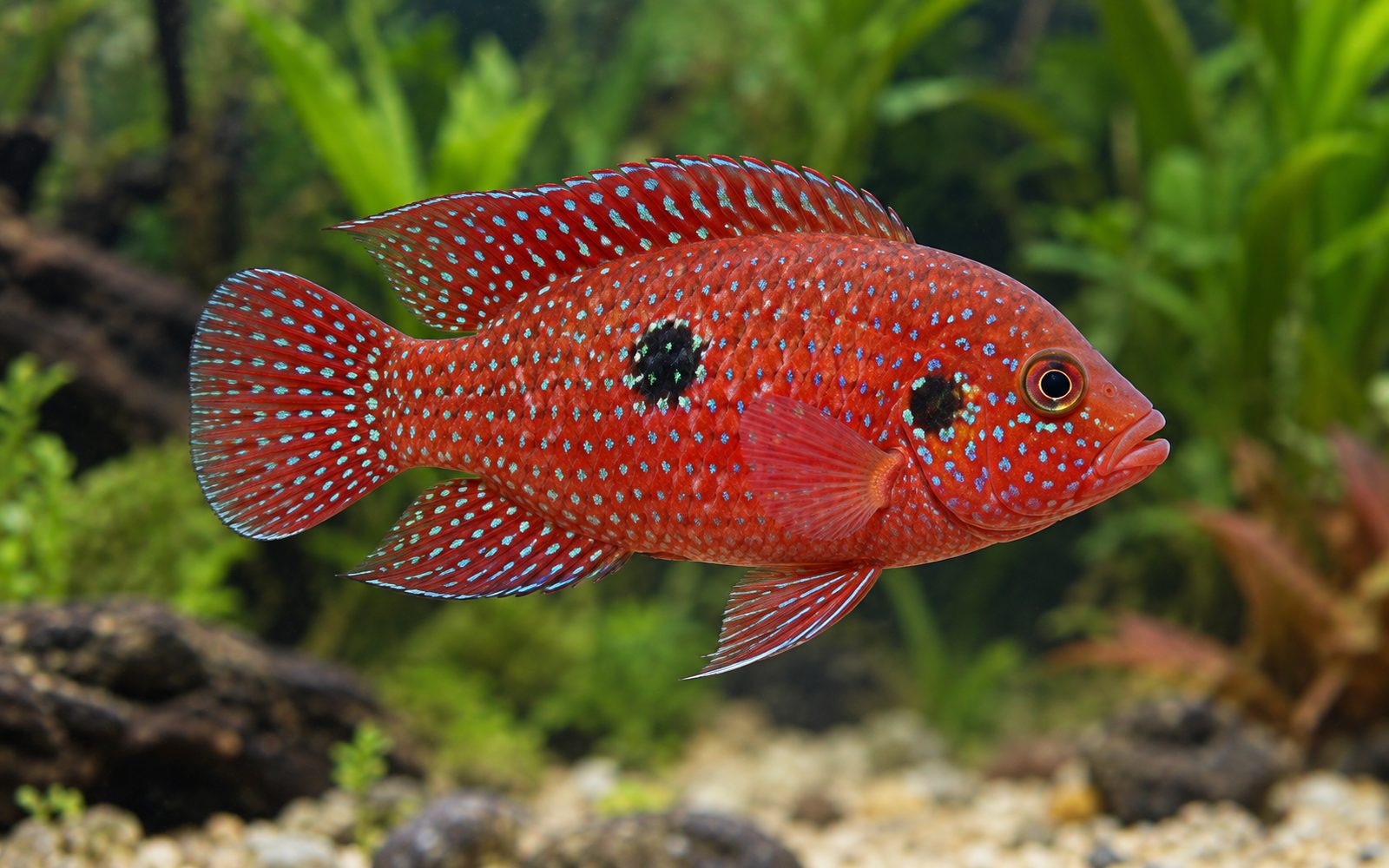 Jewel Cichlid
Should not be kept together








Hobbyist notes
Things you won't find in books, learned by trial and error. The most helpful ones are on top.
Change history and contributors
- Page created · October 16, 2026