
Water parameters
Overview
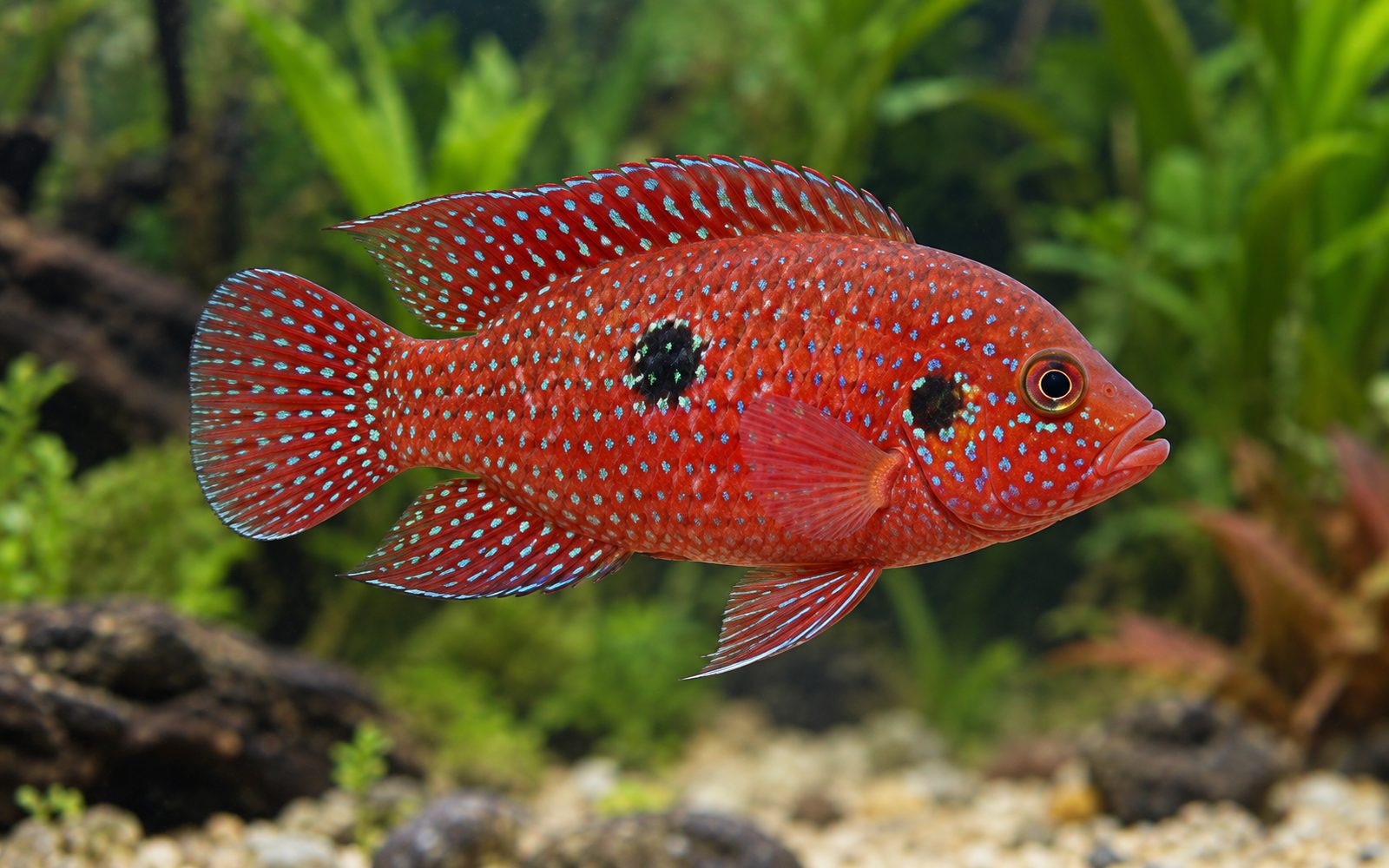
The jewel cichlid earns its name with the bright red that covers its whole body during breeding and the sparkling blue-green spots sprinkled over that red. There is a dark blotch in the middle of the body and another on the gill cover; bimaculatus (two-spotted) in its scientific name comes from these. Outside the breeding period the colors turn paler, to yellowish-brown tones.
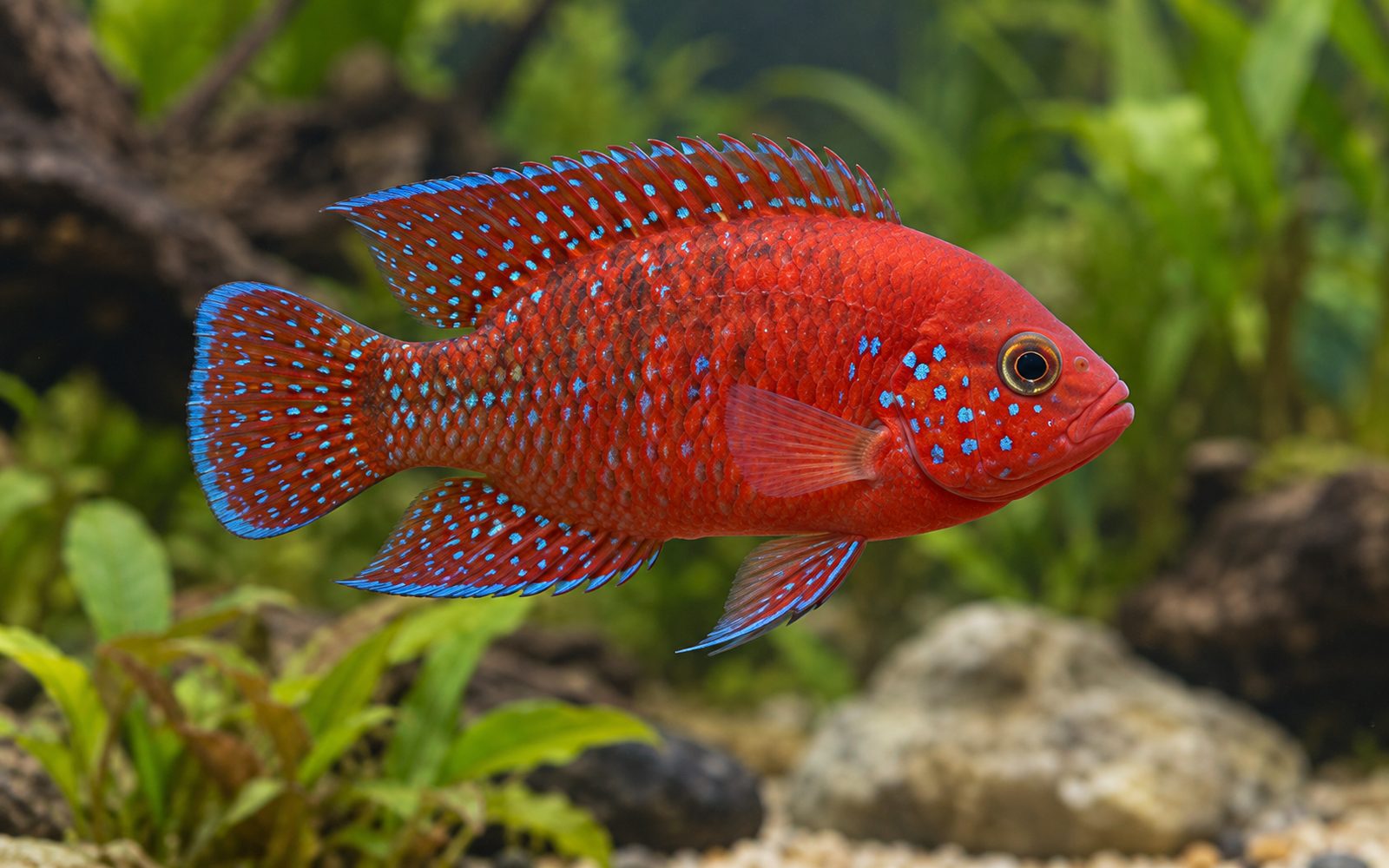
Some of the fish sold in the trade as "jewel cichlids" are actually closely related species (e.g. Hemichromis guttatus, H. lifalili); their care requirements are similar, but their levels of aggression differ. They are model parents and lead their fry around together for weeks; the same devotion means a fierce defense against any fish that approaches the nest.
Natural Habitat
It lives in rivers, streams and lakes near the coast of West Africa. It is usually found in shallow, slow-flowing stretches with plants, roots and accumulated branches. The water is warm, soft to moderately hard and slightly acidic to neutral.
Tank Setup
- Volume: 100 liters for a pair on its own; 200 liters or more and a length of 100 cm or more with other species.
- Decor: Caves, flat stones and roots; zones that break up lines of sight reduce fighting.
- Plants: It likes to dig; hardy plants attached to rock, such as Anubias and Java fern, are preferred.
- Water: pH 6.5–7.8, soft to moderately hard water; a 25–30% water change every week.
- Substrate: Fine sand; it digs pits for its nest.
Diet
An omnivore leaning toward meaty foods. Use a quality cichlid granule as the staple; vary the diet with frozen bloodworms, mysis, brine shrimp and krill. Spirulina or vegetable-based food can be given now and then. Color-enhancing foods keep the red vivid.
Behavior and Compatibility
Territorial even outside of breeding; when it has eggs or fry, it attacks every fish that enters its territory. It preys on fish small enough to fit in its mouth.
Good companions: Robust, fast fish of similar size: large characins (such as Congo tetras), Synodontis catfish and, in a large tank, hardy medium-sized cichlids.
Avoid: Small fish, dwarf cichlids, shrimp, slow and long-finned fish (such as angelfish and bettas), delicate plants.
Group and Colony Structure
- Kept as a pair. The safest way to form a pair is to raise 5–6 juveniles together and choose the two that pair up naturally.
- An adult male and female put together at random can fight to the death if they are incompatible. In that case a clear divider is placed in the tank so the fish can get used to each other side by side for a few days.
- Juveniles other than the bonded pair should be removed; two pairs in the same tank are only possible in a very large volume.
Breeding
The pair lays a few hundred eggs on a flat stone or slab of rock that they have cleaned. The eggs hatch in 2–3 days; the parents move the larvae into pits they dig in the sand. The fry become free-swimming after about a week and are fed newly hatched brine shrimp. The parents lead and guard the school of fry together for weeks. During this period both parents take on their most intense red.
Health and Common Problems
- Generally hardy; problems mostly come from poor water and fight injuries.
- White spot and fin rot: Appear with sudden temperature changes and high nitrate.
- Fight injuries: Seen in incompatible pairs and overcrowded tanks; an injured fish should be removed immediately.
Sexing
Difficult from the outside. Males are usually slightly larger with more pointed fins. Since both parents turn deep red during breeding, color alone is not a sign of sex; a reliable distinction is made by the genital papilla.
Tank mates
This list is calculated automatically from the species profile and grows as new species are added to the catalog. Try it in the planner for a definite answer.
Usually compatible
 Banded Jewel Cichlid
 Chocolate Cichlid
 Jack Dempsey
 Red Devil Cichlid
 Convict Cichlid
 Cryptocoryne Parva
 Lifalili Jewel Cichlid
 Teleogramma brichardi
 Zebra Obliquidens
Adonis Pleco
Zebra Obliquidens
Adonis Pleco
Should not be kept together








Hobbyist notes
Things you won't find in books, learned by trial and error. The most helpful ones are on top.
Change history and contributors
- Page created · October 16, 2026