
Water parameters
Overview
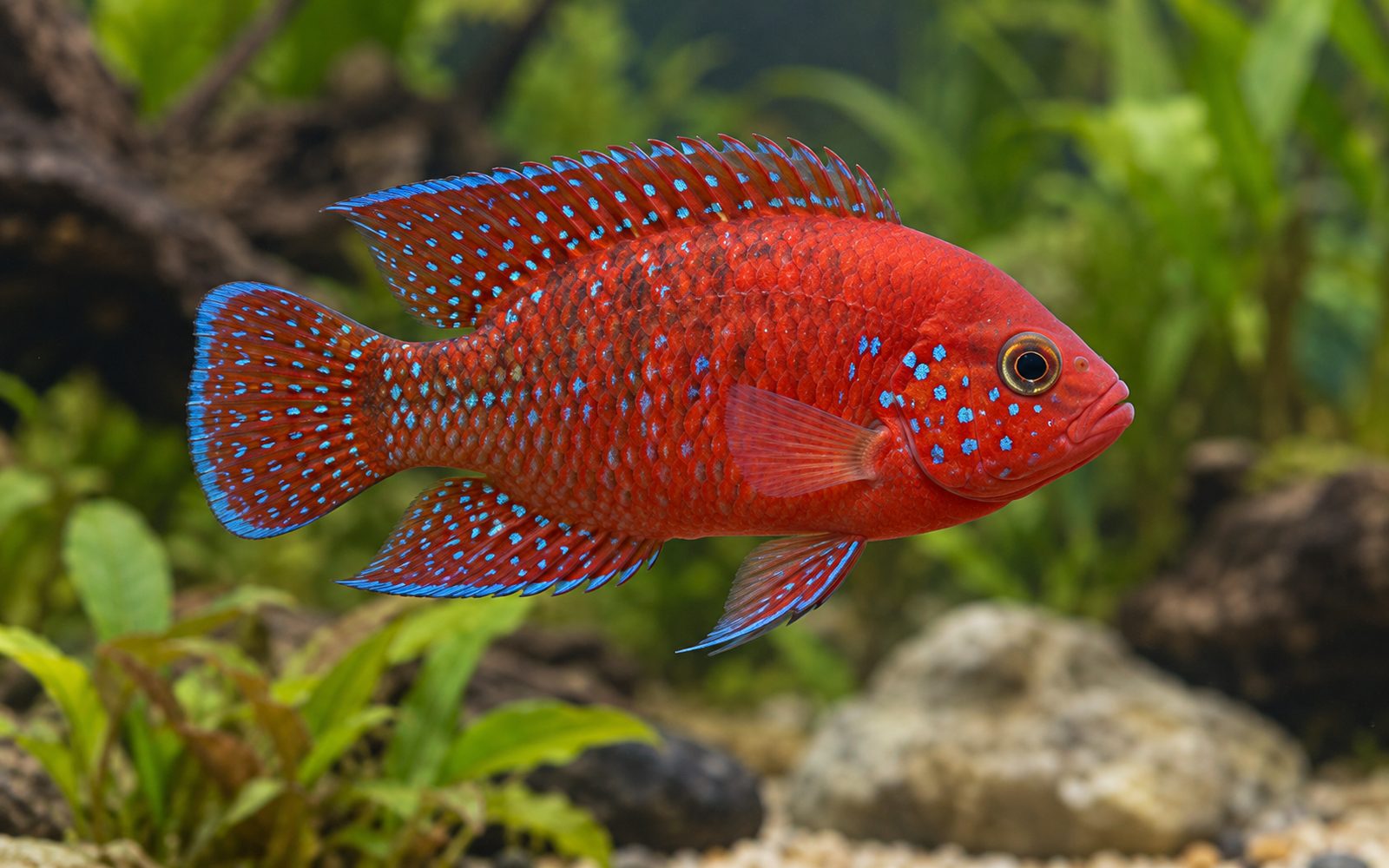
Hemichromis lifalili comes from the Congo basin and is known as the most intensely red member of the jewel cichlids. In adults the head and body are blood red; the dorsal, anal and tail fins and the gill cover are decorated with tiny, glittering blue spots. It reaches about 10 cm and is considered one of the calmest jewel cichlids.
Still, it is a Hemichromis: during breeding it defends its nest even against fish larger than itself, and it preys on small fish. Its red color can fade when it is stressed or outside the breeding period; it reaches its brightest in a peaceful setting with the right diet.
Natural Habitat
It lives in slow-flowing tributaries of the Congo River basin, along banks full of plants and tree roots. These waters are soft, slightly acidic and warm; leaf and root debris collects on the bottom.
Tank Setup
- Volume: 100 liters for a pair; 150–200 liters with other species.
- Decor: Roots, caves and flat stones; zones that break up lines of sight.
- Plants: Hardy plants attached to rock or wood (Anubias, Java fern); floating plants soften the light.
- Water: pH 6–7.5, soft to moderately hard water; a 25% water change every week.
- Substrate: Fine sand; a dark substrate brings out the red.
Diet
An omnivore leaning toward meaty foods. Use a quality cichlid granule as the staple; vary the diet with frozen bloodworms, brine shrimp, mysis and cyclops. Carotenoid-rich foods support the red color.
Behavior and Compatibility
Relatively calm outside of breeding, but it chases fish that enter its territory. Its aggression rises markedly when it has eggs or fry. It eats fish small enough to fit in its mouth.
Good companions: Fast, robust fish of similar size: large characins, Synodontis catfish and, in a large tank, hardy medium-sized West African cichlids.
Avoid: Small fish, dwarf cichlids, shrimp, slow and long-finned fish, other Hemichromis species (they can hybridize).
Group and Colony Structure
- Kept as a pair; the pair bond is strong.
- Raise 5–6 juveniles together and choose a pair that forms naturally.
- With randomly paired adults, the male can seriously injure the female; introducing them with a divider is recommended.
- Small and medium-sized tanks should hold only one pair.
Breeding
The pair cleans a flat stone and lays a few hundred eggs. The eggs hatch in 2–3 days; the larvae are moved into pits in the sand. After about a week the free-swimming fry are fed newly hatched brine shrimp. The parents guard the school of fry for weeks.
Health and Common Problems
- Hardy; problems mostly come from poor water, sudden temperature changes and fight injuries.
- Fading color: A sign of stress, hard and alkaline water or a poor diet.
- White spot: Common after transport; quarantine is recommended.
Sexing
Difficult from the outside. Males are usually slightly larger with longer fins; females look plumper during the breeding period. A reliable distinction is made by the genital papilla.
Tank mates
This list is calculated automatically from the species profile and grows as new species are added to the catalog. Try it in the planner for a definite answer.
Usually compatible
 Banded Jewel Cichlid
 Pearl Cichlid
 Threadfin Acara
 Convict Cichlid
 Cryptocoryne Parva
 Jewel Cichlid
 Teleogramma brichardi
Adonis Pleco
Teleogramma brichardi
Adonis Pleco
 Weeping Moss
 Flame Moss
Should not be kept together








Hobbyist notes
Things you won't find in books, learned by trial and error. The most helpful ones are on top.
Change history and contributors
- Page created · October 16, 2026