

Water parameters
Overview
The Jack Dempsey bears the name of the famous boxer of the 1920s; it got this name because of its rugged facial features and pugnacious temperament. In adults the body, between dark brown and black, is covered with shiny turquoise and gold spots; the edge of the dorsal fin is red. Juveniles are paler and banded, and the color darkens with age.
It is sold in stores as 4–5 cm juveniles and reaches 20–25 cm within a few years. At this size it eats every fish that fits in its mouth and fiercely chases smaller cichlids that enter its territory.
Color and Fin Varieties
- Electric blue (Electric blue Jack Dempsey): Bright sky-blue body. It stays smaller (about 15 cm) and is usually more docile. If kept in the same tank as the normal form, it can be bullied.
Natural Habitat
It lives in warm, slow-flowing and often murky waters on the Atlantic slope from southern Mexico to Guatemala, Belize and Honduras. Swamps, canals and river tributaries with muddy or sandy bottoms are its main habitats.
Tank Setup
- Volume: At least 250 liters and 120 cm of length for a single adult or a pair; 400 liters or more with other large cichlids.
- Decor: Large stones, caves and roots. It digs in the substrate and knocks over light decor; plants get uprooted.
- Filter: A strong canister filter; a 30% water change every week.
- Heater: It should have a guard.
Diet
An omnivore leaning toward meaty foods. Use large cichlid granules as the staple; vary the diet with frozen shrimp, mysis, earthworms and bloodworms. Live feeder fish are not recommended; they carry disease. One meal a day is enough for adults.
Behavior and Compatibility
Territorial and dominant. It can live with fish of similar size and temperament in a large tank; but a breeding pair claims half the aquarium.
Good companions: Robust cichlids of the same size (green terror, Texas cichlid, severum in a very large tank), large plecos, silver dollars.
Avoid: Small community fish, shrimp, snails, slow and long-finned species such as angelfish, planted tanks.
Group and Colony Structure
It can be kept alone. A pair forms when juveniles are raised together; since the bonded pair becomes aggressive toward the others, the extra fish need to be removed. Putting a random male and female together, especially if the male is much larger, can end in death.
Breeding
The pair cleans a flat stone and lays 500–800 eggs. The eggs hatch after about 3 days; the larvae are moved into dug-out pits. The parents fiercely guard the fry for weeks. The fry grow quickly on brine shrimp nauplii and powdered food.
Health and Common Problems
- Hole-in-the-head disease (HLLE): With poor water quality and vitamin deficiency.
- Injuries: From territorial fights and broken heaters.
- Sensitivity of the electric blue form: This form is genetically weaker; fry losses are high, and it is more sensitive to water quality.
Sexing
The male is larger; his dorsal and anal fins are longer and more pointed, and the shiny spots on his gill covers and body are denser. The female is smaller and stockier, with sparser spots. A reliable distinction is made by the papilla.
Tank mates
This list is calculated automatically from the species profile and grows as new species are added to the catalog. Try it in the planner for a definite answer.
Usually compatible
 Banded Jewel Cichlid
 Spotted Tilapia
 Flowerhorn
 Jaguar Cichlid
 Red Devil Cichlid
 Red Terror Cichlid
 Convict Cichlid
 Cryptocoryne Parva
 Wolf Cichlid
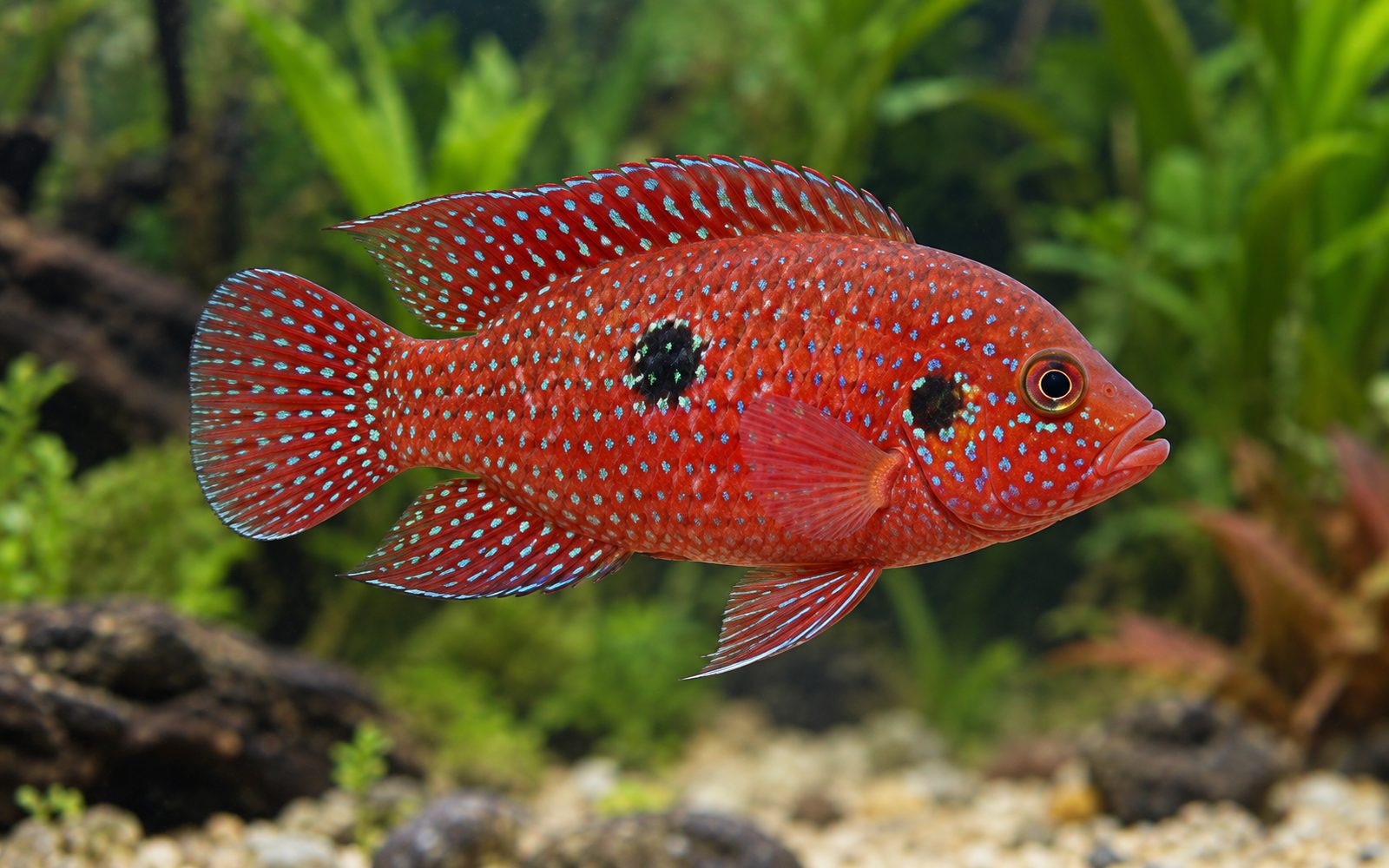 Jewel Cichlid
Should not be kept together








Hobbyist notes
Things you won't find in books, learned by trial and error. The most helpful ones are on top.
Change history and contributors
- Page created · October 16, 2026