
Water parameters
Overview
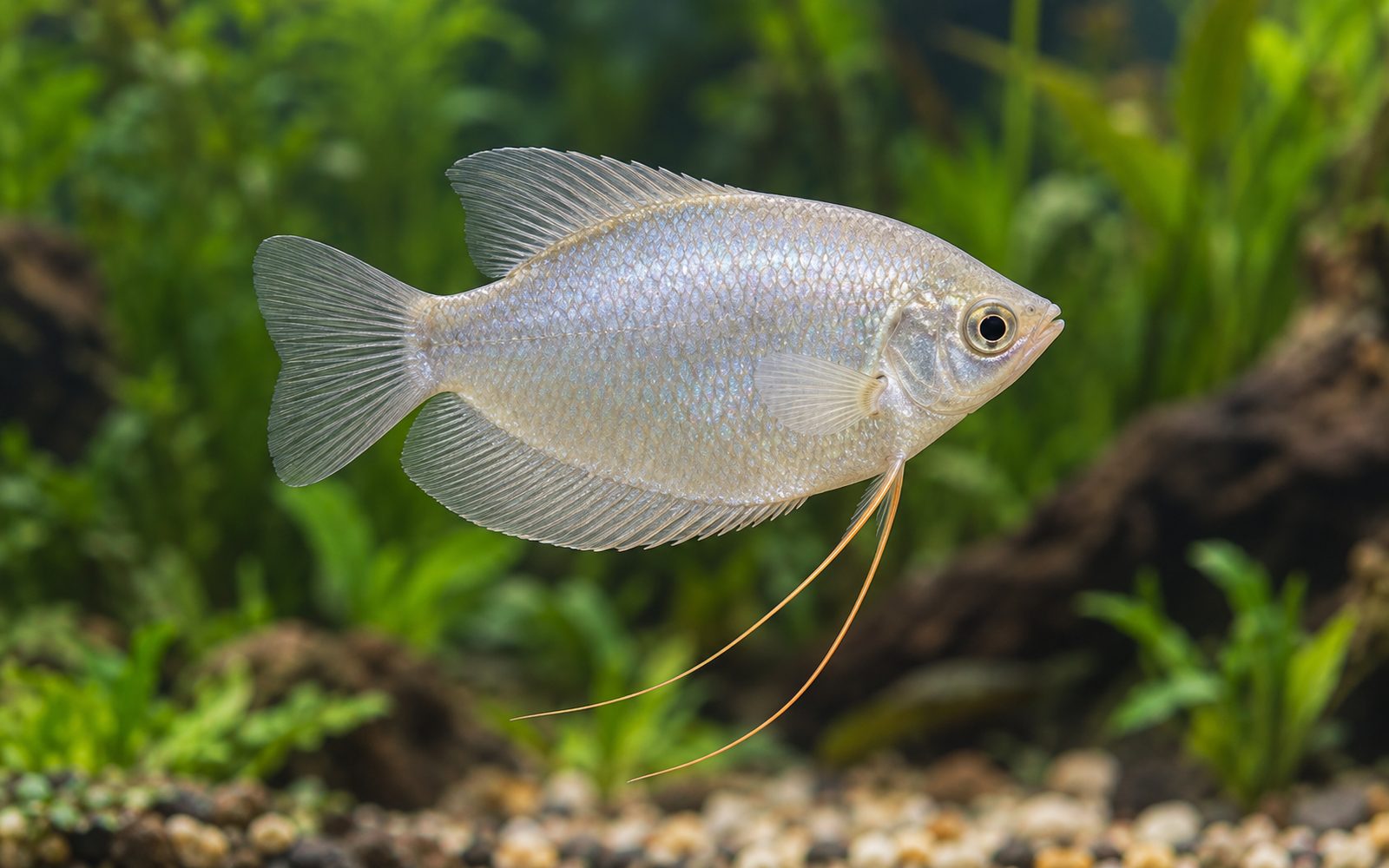
Thanks to the very small scales covering its body, the moonlight gourami has a smooth, silky silver sheen; under light it gives off faint greenish or purple reflections. Its plain, patternless look sets it apart from other gouramis. It reaches about 12–14 cm and has a deep, laterally compressed body and a slightly upturned mouth.
Its nature is calm but shy: it flees at sudden movements and hides in crowded, busy aquariums. In a dimly lit, planted aquarium it gains confidence over time and shows itself by swimming near the surface.
Natural Habitat
It lives in lowland swamps, lakes and wetlands of Thailand, Cambodia and Vietnam. These waters are shallow, heavily vegetated, warm and still; in the rainy season it spreads into flooded areas.
Tank Setup
- Volume: at least 150 liters for one male and two females, with a length of 100 cm or more.
- Water: 25–29°C, pH 6–7.5, soft to moderately hard water.
- Light and plants: Dim light, floating plants and densely planted edges reduce shyness.
- Flow: Weak; leave still areas at the surface.
- Lid: It may jump when startled; use a lid and leave warm air between the water and the lid.
Diet
Omnivorous. Flakes and granules should be the staple; supplement with frozen brine shrimp, daphnia, bloodworms and foods containing spirulina or vegetables. In the wild it feeds on algae and small invertebrates. Feed small amounts 1–2 times a day.
Behavior and Compatibility
Peaceful and timid. Males defend the area around the nest in the breeding season but cause no problems at other times. Next to fast, greedy and pushy neighbors it may go hungry and become stressed.
Good companions: medium-sized calm tetras, rasboras, corydoras, kuhli loaches, bristlenose plecos, pearl gouramis, kissing gouramis.
Avoid: fin nippers (they bite the pelvic fins), aggressive cichlids, very active schools, male three spot gouramis.
Group and Colony Structure
It can be kept alone, as a pair or as 1 male and 2 females. In a large aquarium (200 liters or more) it also lives as a small group; tension between males is low outside the nesting period. In a group it behaves less shyly.
Breeding
The male builds a large nest at the surface, adding plant pieces to the foam. During the embraces hundreds, sometimes more than a thousand, small eggs are released; the male carries them to the nest and guards them jealously. The female should be removed after spawning. The eggs hatch in 1–2 days; the fry are very small and need infusoria in the first days. Shallow water and a temperature of 28–30°C are suitable for breeding.
Health and Common Problems
It is sensitive to sudden water changes and stress; bacterial infections and fin rot appear in stressed individuals. Keep new fish in a calm quarantine tank for 2 weeks, limit water changes to 20–25% a week and match the temperature.
Sexing
The male's dorsal fin is long and pointed, the female's short and rounded. In adult males the threads of the pelvic fins are orange-red, while in females they are yellowish or colorless. When females are carrying eggs, the belly area becomes noticeably fuller.
Tank mates
This list is calculated automatically from the species profile and grows as new species are added to the catalog. Try it in the planner for a definite answer.
Usually compatible
 Flame Tetra
Glass Tetra
Flame Tetra
Glass Tetra
 Blackfin Corydoras
 Polystictus Corydoras
 Emerald Betta
 Emerald Cory
 Porthole Catfish
 Keyhole Cichlid
 Cupid Cichlid
 Buffalohead Cichlid
Should not be kept together






Hobbyist notes
Things you won't find in books, learned by trial and error. The most helpful ones are on top.
Change history and contributors
- Page created · October 16, 2026