
Water parameters
Overview
The peaceful betta is one of the closest relatives of the Siamese fighting fish (Betta splendens). Its Latin name "imbellis" means "not warlike"; its males are not as aggressive towards each other as the Siamese fighting fish. It lacks the long fins of bred bettas; like a wild fish it has short, sturdy fins, and it grows to about 5 cm.
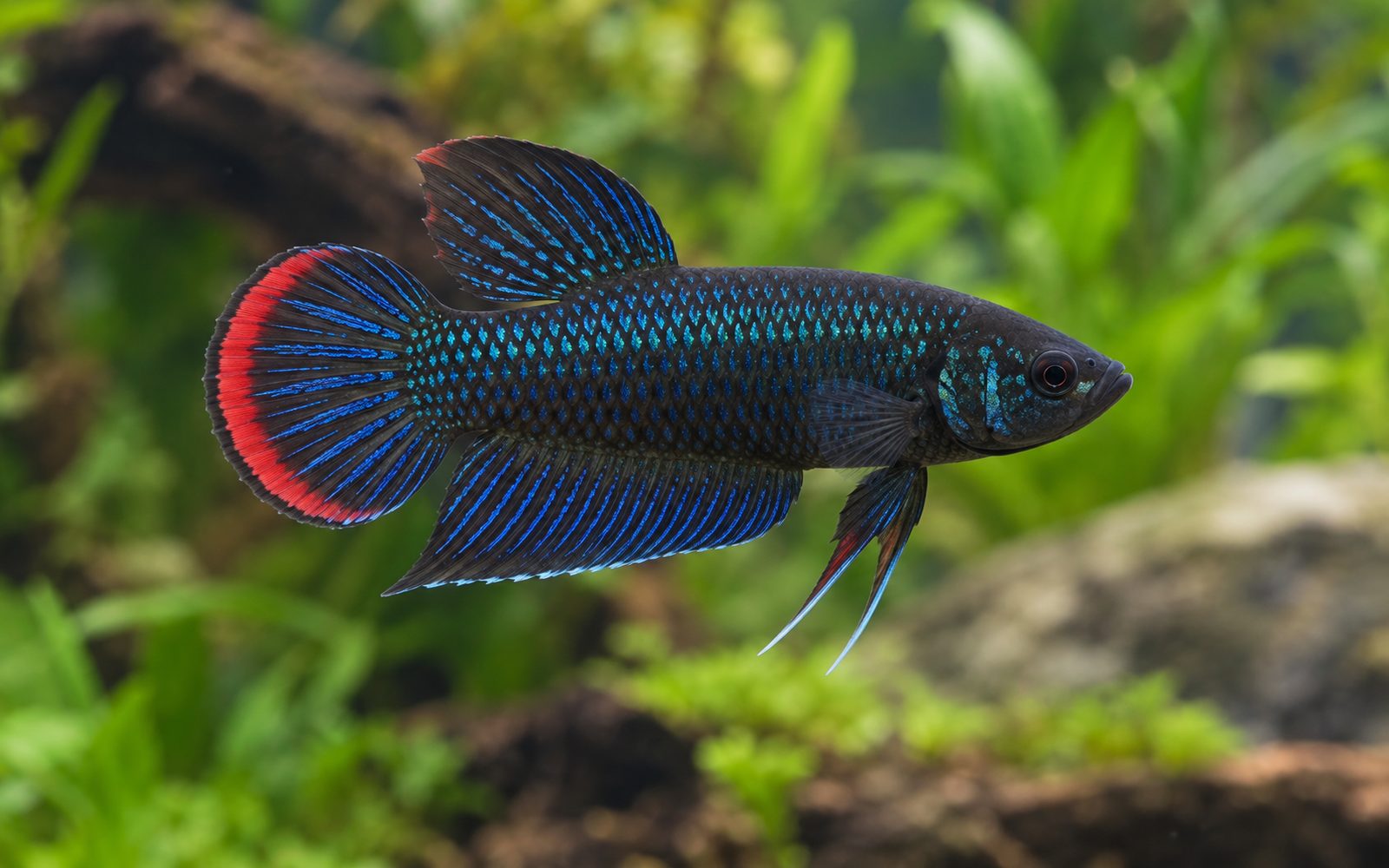
The males' dark blue-black body is covered with rows of shiny blue-green scales, and there is a bright red crescent band at the edge of the tail fin. Local forms are named after the area where they are found; color tones vary slightly between these forms.
Natural Habitat
It lives in shallow swamps, rice paddies, ditches and slow-flowing canals of the Malay Peninsula and Sumatra. These waters are full of plants and leaf litter, warm and still; some populations are found in tea-colored, acidic water.
Tank Setup
- Volume: at least 40 liters for a pair; 60 liters or more for more than one female or male.
- Water: 25–27°C, pH 5.5–7, soft to moderately hard water. Dried leaves and roots slightly darken the water and put the fish at ease.
- Plants: Dense plants, floating plants and hiding places; areas where the females can escape are important.
- Flow: Very weak; a sponge filter is ideal.
- Lid: It jumps well; a tight lid is needed, and there should be warm air between the surface and the lid.
Diet
Carnivorous. It accepts quality small granules and flakes; give frozen or live bloodworms, brine shrimp, daphnia and mosquito larvae a few times a week. Feed small amounts 1–2 times a day; like other bettas, it is sensitive to overfeeding.
Behavior and Compatibility
Much calmer than the Siamese fighting fish. Males display to each other, but in a large, densely planted aquarium serious fights are rare. It is peaceful with other species; it mostly leaves adult dwarf shrimp alone but eats their young.
Good companions: harlequin rasboras, pencilfish, small tetras, kuhli loaches, otocinclus, dwarf corydoras, nerite snails.
Avoid: Siamese fighting fish (they hybridize), fin nippers, fast and greedy schools, large gouramis, aggressive cichlids.
Group and Colony Structure
The most suitable setup is a pair or 1 male and 2 females. In aquariums of 80 liters or more with lines of sight broken by plants, more than one male can also be kept; each male picks its own corner. Do not keep two males in a small aquarium. Because it hybridizes easily with the Siamese fighting fish, do not keep the two species in the same aquarium.
Breeding
The male builds a bubble nest at the surface, often under a floating leaf. He collects the eggs released during the embraces with his mouth, places them in the nest and guards them. He is not as rough with the female as the Siamese fighting fish, but separating her after spawning is safer. The eggs hatch in 1–2 days; the fry start on infusoria and microworms, then eat brine shrimp nauplii. The fry are less aggressive towards each other than Siamese fighting fish fry, so raising them together is easier.
Health and Common Problems
Hardy. Fin rot can appear in hard and dirty water, and white spot and velvet in cold water. A 20–25% water change weekly, a stable temperature and slightly acidic water largely prevent problems.
Sexing
Males are dark blue-black with shiny scales and a red crescent band on the tail; their fins are longer and more pointed. Females are light brown with dark horizontal stripes on the body and short fins; an egg spot may be visible under the belly.
Tank mates
This list is calculated automatically from the species profile and grows as new species are added to the catalog. Try it in the planner for a definite answer.
Usually compatible
 Flame Tetra
 Blackfin Corydoras
 Polystictus Corydoras
 Emerald Cory
 Porthole Catfish
 Keyhole Cichlid
 Cupid Cichlid
 Geophagus altifrons
 Geophagus surinamensis
 Cryptocoryne Parva
Should not be kept together






Hobbyist notes
Things you won't find in books, learned by trial and error. The most helpful ones are on top.
Change history and contributors
- Page created · October 16, 2026