
Water parameters
Overview
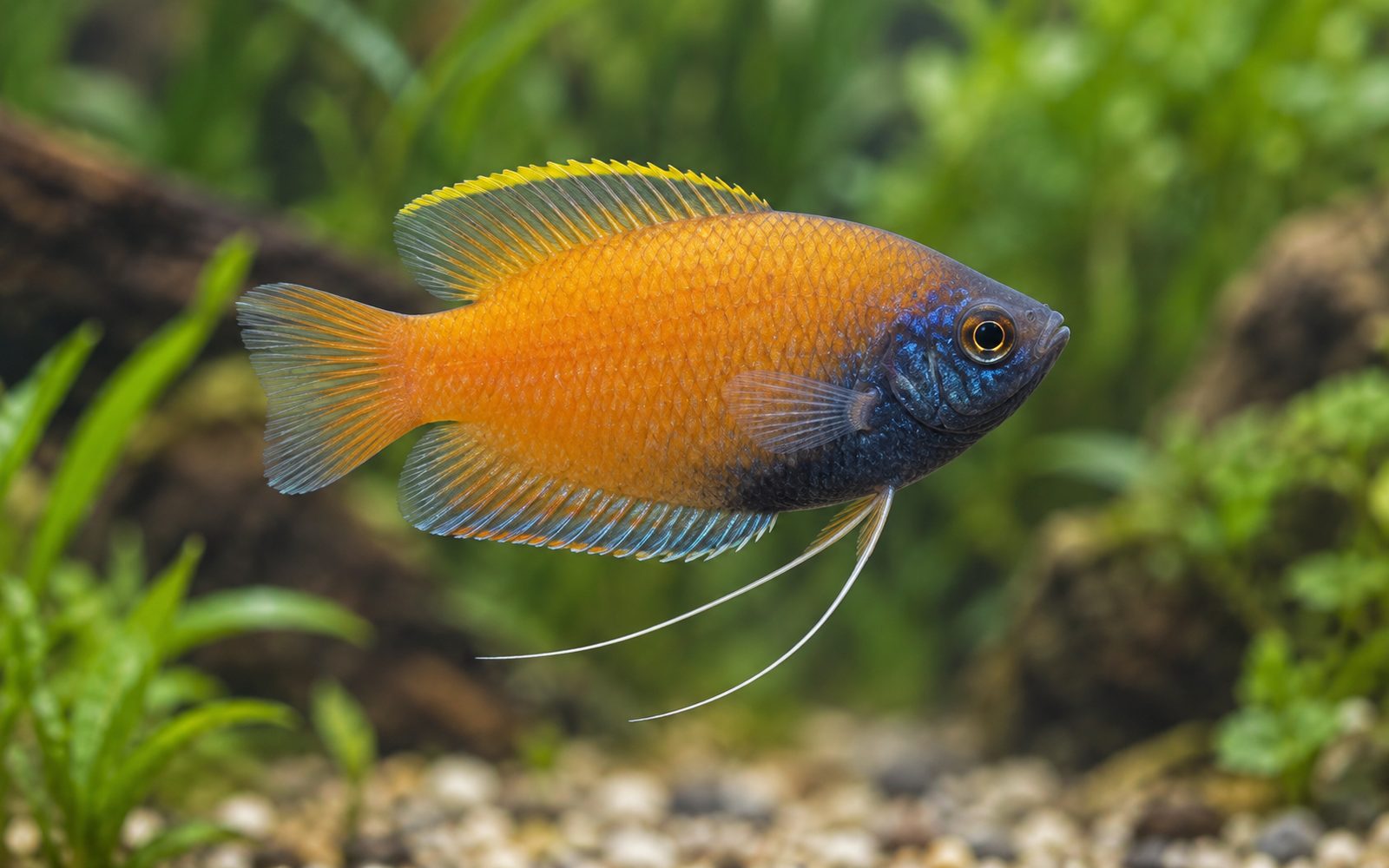
The honey gourami is a close relative of the dwarf gourami, but it is smaller, calmer and usually hardier. In the breeding season males take on a honey-orange body and a navy-black face and chest; the edge of the dorsal fin is lemon yellow. Females and males that have not yet colored up are plain silvery-beige with a brown stripe running along the body. This is why a honey gourami that looks pale in the store can turn into a completely different fish a few weeks after settling into the aquarium.
It breathes air from the surface with its labyrinth organ. It uses its thin, thread-like pelvic fins as touch organs; it first probes a new object with them.
Color and Fin Varieties
- Gold honey gourami: a selectively bred form common in stores, with a body that is solid golden yellow from head to tail.
- Red honey gourami: a selectively bred form with a deeper orange-red body. Its care is the same as the wild form.
Natural Habitat
It lives in ponds, lakeshores, ditches and flooded fields on the plains of the Ganges and Brahmaputra. These waters are shallow, warm, densely vegetated and without current; oxygen can drop in the summer months. The water is usually soft to moderately hard, with a pH between slightly acidic and neutral.
Tank Setup
- Volume: at least 40 liters for one male and two females; 60 liters provides more stable water.
- Water: 24–27°C is ideal, pH 6–7.5. A heater is needed.
- Flow: Should be weak. Use a sponge filter or a softened outlet; in strong flow it tires and cannot build a bubble nest.
- Plants: Densely planted edges and floating plants (salvinia, limnobium) give it confidence and bring out its color.
- Lid: There should be a warm air gap between the surface and the lid; breathing cold air harms labyrinth fish.
Diet
Omnivorous and not fussy. Small granules or fine flakes should be the staple; add frozen or live brine shrimp, daphnia, cyclops and small bloodworms a few times a week. Its mouth is small, so crush large pieces before feeding. Feeding 1–2 times a day, as much as is eaten within a few minutes, is enough. Because it is timid, watch whether it gets food next to fast, greedy neighbors.
Behavior and Compatibility
Extremely peaceful and somewhat timid. Males display to each other in the breeding season and brief chases occur; but this is not as rough as in the dwarf gourami. It usually leaves adult dwarf shrimp alone but may eat newborn shrimplets.
Good companions: harlequin rasboras, galaxy rasboras, small tetras, corydoras, kuhli loaches, otocinclus, dwarf shrimp, nerite snails.
Avoid: fin nippers such as tiger barbs, large and fast fish, aggressive cichlids; bettas and large gouramis with which it would have to share the surface zone.
Group and Colony Structure
1 male and 2 females is the most balanced setup; a single male also lives comfortably. Females get along with each other. In an aquarium of 80 liters or more with the surface divided by floating plants, two males can also be kept; each picks a corner for itself. Among crowded, fast schooling fish the honey gourami stays in the background; calm neighbors encourage it.
Breeding
The male builds a small, loose bubble nest under floating plants or attached to a leaf. When the female is ready, the embrace takes place under the nest and a few hundred small eggs are carried into the nest. The male guards the nest and drives the female away; the female should be removed after spawning. The eggs hatch in 24–36 hours, and the fry become free-swimming 2–3 days later; at this point the male is removed as well. In the first week infusoria or paramecium is given, then newly hatched brine shrimp. In weeks 3–4, when the labyrinth organ develops, the air above the breeding tank should be kept warm and humid; a lid is essential for this.
Health and Common Problems
Generally hardy. Fin rot and bacterial infections appear in poor water quality, and white spot after sudden temperature drops. Quarantining new fish for 2 weeks, preventing cold drafts over the surface and doing 20–25% water changes weekly prevent most problems.
Sexing
A male in breeding color is easy to tell apart: the body is orange, the face and throat navy-black, and the dorsal fin has a yellow edge. Females and males without color are silvery-beige and carry a brown stripe along the body. The male's dorsal fin is slightly more pointed than the female's. Males that look pale in the store color up within a few weeks in a calm aquarium.
Tank mates
This list is calculated automatically from the species profile and grows as new species are added to the catalog. Try it in the planner for a definite answer.
Usually compatible
 Flame Tetra
 Blackfin Corydoras
 Polystictus Corydoras
 Emerald Cory
 Emerald Dwarf Rasbora
 Porthole Catfish
 Keyhole Cichlid
 Cupid Cichlid
 Geophagus altifrons
 Geophagus surinamensis
Should not be kept together







Hobbyist notes
Things you won't find in books, learned by trial and error. The most helpful ones are on top.
Change history and contributors
- Page created · October 16, 2026