
Water parameters
Overview
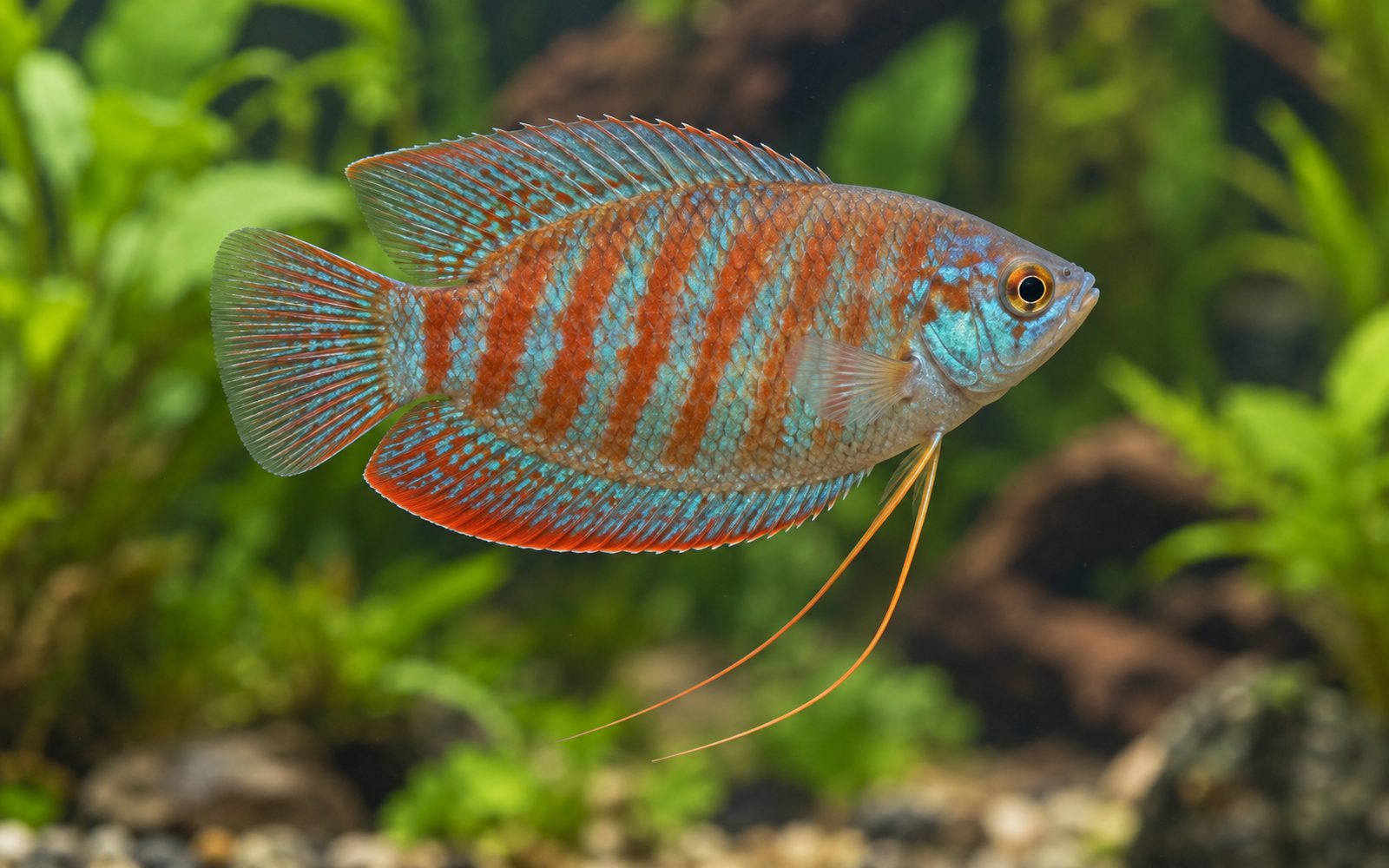
With orange-red and turquoise bands running diagonally across its body, the banded gourami is one of the largest South Asian gouramis. In the aquarium it usually reaches 8–10 cm. It closely resembles the thick-lipped gourami; it differs by being larger and having thinner lips. It is also sold under its old name, Colisa fasciata.
It is a calm, hardy and adaptable fish. It breathes air from the surface with its labyrinth organ and probes its surroundings with its long, thread-like pelvic fins.
Natural Habitat
It lives in the lowland waters of northern India, Bangladesh and Nepal; in densely vegetated, slow-flowing or still waters such as riverside ponds, ditches, lakes and flooded fields. Seasonal temperature differences and variable water parameters have made it hardy.
Tank Setup
- Volume: at least 100 liters for one male and two females; choose an aquarium 80 cm or longer.
- Water: 24–27°C is ideal, pH 6–7.5; it adapts to a wide hardness range.
- Decor: A layout with densely planted edges and an open center; floating plants both give security and provide nesting sites.
- Flow: Keep it gentle; avoid strong outlets that churn the surface.
- Lid: There should be a warm air gap between the lid and the water surface.
Diet
Omnivorous. Flakes and granules should be the staple; vary the diet with frozen bloodworms, brine shrimp, daphnia and spirulina foods. Feed 1–2 times a day, only as much as is eaten within a few minutes. It may also eat hydra and small snails.
Behavior and Compatibility
Generally peaceful; males are territorial with each other and around the nest in the breeding season. It gets along well with calm fish that are not much smaller than itself. At 10 cm it can also hunt adult dwarf shrimp; it should not be kept with valuable shrimp colonies.
Good companions: medium-sized tetras, rasboras, zebra danios, corydoras, kuhli loaches, bristlenose plecos, pearl gouramis.
Avoid: fin nippers (tiger barbs, black skirt tetras), aggressive cichlids, dwarf shrimp colonies, male three spot gouramis.
Group and Colony Structure
1 male and 2 females are recommended; a single male also lives comfortably. More than one male stays peaceful only in aquariums of 150 liters or more with the surface divided by plants. Females are docile towards each other. Because it has been reported to hybridize with the thick-lipped gourami, do not breed the two species together.
Breeding
The male builds a large bubble nest among floating plants at the surface, and his colors become their brightest. Hundreds of eggs are released in embraces that take place under the nest; the male carries the eggs to the nest and guards them. The female should be removed after spawning. The eggs hatch in about 24 hours; once the fry become free-swimming, the male is removed as well. The fry are fed infusoria, then newly hatched brine shrimp; in the first weeks the air above the tank should be kept warm and humid.
Health and Common Problems
It is a hardy species. Fin rot and bacterial infections can appear in poor water quality, and white spot after cold water changes. A 25% water change weekly and a 2-week quarantine largely prevent problems.
Sexing
Males have distinct orange-red and turquoise bands, a red-edged anal fin and a pointed dorsal fin. Females are silvery-brown with faded bands, colorless fins and a rounded dorsal fin; when mature their bellies become fuller.
Tank mates
This list is calculated automatically from the species profile and grows as new species are added to the catalog. Try it in the planner for a definite answer.
Usually compatible
 Flame Tetra
Glass Tetra
Flame Tetra
Glass Tetra
 Blackfin Corydoras
 Polystictus Corydoras
 Emerald Betta
 Emerald Cory
 Emerald Dwarf Rasbora
 Porthole Catfish
 Keyhole Cichlid
 Cupid Cichlid
Should not be kept together







Hobbyist notes
Things you won't find in books, learned by trial and error. The most helpful ones are on top.
Change history and contributors
- Page created · October 16, 2026