

Water parameters
Overview
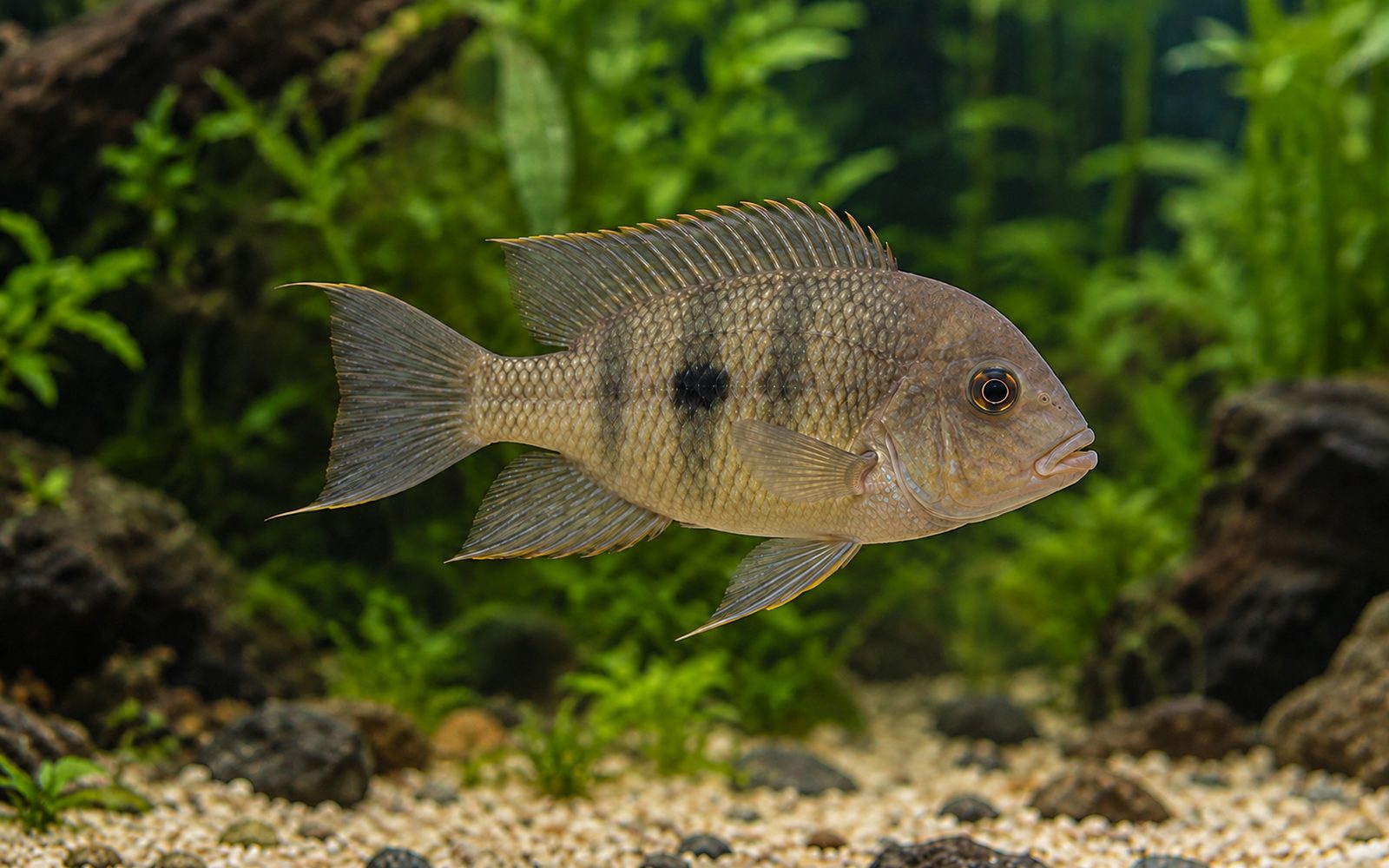
Thanks to the large, rounded hump on their foreheads, mature male Gymnogeophagus balzanii look like no other cichlid. Their gold-bronze bodies are decorated with shiny blue lines and spots on the head and fins. Females are much smaller, plain gray-olive in color and have no hump.
It comes from the subtropical regions of South America; so, unlike tropical cichlids, it benefits from being kept in cooler water (18–20°C) for a few months in winter. In water that is constantly 28°C or warmer, its lifespan shortens and its colors fade.
Natural Habitat
It lives in the basin of the Paraguay and Paraná rivers, in Argentina, Paraguay, Brazil and Bolivia. It is found in the sandy-muddy, vegetated shallows of slow-flowing rivers and lakes. In the region the water temperature varies markedly between summer and winter.
Tank Setup
- Volume: At least 200 liters and 100–120 cm of length for one male and 2–3 females.
- Substrate: Fine sand; it sifts the sand constantly.
- Decor: Roots, rounded stones and hardy plants along the edges; areas where females can hide.
- Heating: 24–26°C in summer, 18–20°C for a few months in winter. If room temperature is suitable, the heater can be switched off in winter.
- Water: A 30% water change every week; moderately hard water around neutral.
Diet
Omnivorous. Use small sinking granules and tablets as the staple; vary the diet with frozen bloodworms, brine shrimp, mysis and mosquito larvae. Reduce the amount of food during the cool period.
Behavior and Compatibility
Generally a calm species. During breeding the male claims an area of sand, invites the females with showy fin-spreading displays and chases away rival males.
Good companions: Calm species that tolerate cool water: corydoras (such as paleatus), medium-sized tetras, Ancistrus, peaceful subtropical cichlids such as Cichlasoma portalegrense.
Avoid: Species that need constantly warm water, such as discus and altum angelfish, aggressive large cichlids, small shrimp.
Group and Colony Structure
A harem setup is recommended: 1 male and 2–3 females. More than one male can be kept in a large tank, but the dominant male suppresses the others and makes their colors fade.
Breeding
It is a delayed mouthbrooder. The female lays the eggs in a pit or on a stone prepared by the male; about a day later she takes the eggs or the newly hatched larvae into her mouth. Incubation is mostly done by the female, and the fry stay in the mouth for around 2 weeks until they are free-swimming. The fry are fed brine shrimp nauplii.
Health and Common Problems
- Constantly high temperature: Weakens immunity and shortens lifespan.
- Hole-in-the-head disease (HLLE): In poor water quality.
- Gill irritation: From coarse substrate.
Sexing
Easy: the mature male is much larger, with a huge forehead hump, long fin tips and bright blue patterns. The female is small, has no hump and is plainly colored; the dark spot in the middle of her body is prominent.
Tank mates
This list is calculated automatically from the species profile and grows as new species are added to the catalog. Try it in the planner for a definite answer.
Usually compatible
 Emerald Betta
 Firemouth Cichlid
 Buffalohead Cichlid
 Festivum
 Geophagus surinamensis
 Rainbow Cichlid
 Pearl Cichlid
 Blood Parrot
 Redhead Cichlid
Should not be kept together



Hobbyist notes
Things you won't find in books, learned by trial and error. The most helpful ones are on top.
Change history and contributors
- Page created · October 16, 2026