
Water parameters
Overview
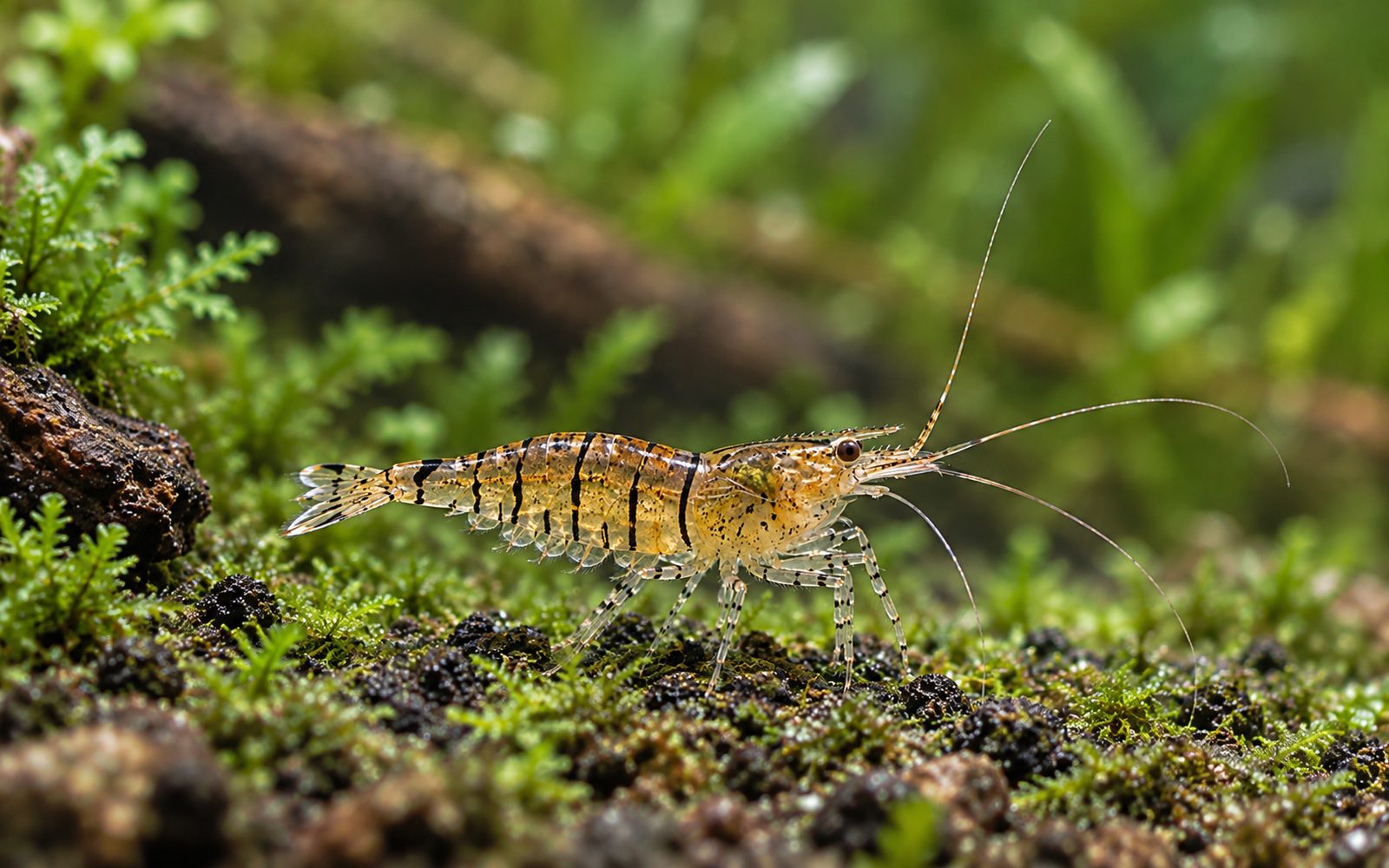
The tiger shrimp is recognized by the thin black stripes on each segment of its transparent or amber-toned body. It belongs to the same close-knit group of relatives as the bee shrimp and the crystal shrimp developed from it. Its care is similar to theirs, but it is more tolerant of water parameters; for this reason it is seen as an intermediate step between the red cherry and the crystal shrimp.
Breeders have developed many color forms from the wild pattern. All of them have the same care requirements; the difference is only in appearance.
Color and Fin Varieties
- Orange eye blue tiger (OEBT): Dark blue body, thin black stripes and orange eyes. The most sought-after form.
- Black tiger: The body is almost entirely dark; the stripes are hard to make out.
- Red tiger: Black stripes on a reddish base.
Natural Habitat
Wild individuals live in the cool, clear, oxygen-rich streams of southern China. They graze on biofilm under rocks and among accumulations of roots and leaves.
Tank Setup
- Volume: 20 liters or more; as the colony grows, 40–60 liters keeps parameters more stable.
- Water: GH 4–8, KH 1–4, pH 6.5–7.2 is the most comfortable range. In areas with soft tap water, aged tap water may be enough; in hard-water areas, RO water and shrimp minerals are needed.
- Temperature: 20–24°C is ideal; losses increase if it stays above 26°C for long.
- Substrate: An active substrate is not essential but helps keep pH stable.
- Filter: A sponge filter or a powered filter with a sponge-protected intake.
- Maturity: An aquarium at least 4–6 weeks old with established biofilm.
Diet
Omnivorous. Its main food is biofilm and fine algae. It is supplemented with shrimp food, spirulina tablets, dried almond or oak leaves and blanched spinach. Feed sparingly; remove food not eaten within 2–3 hours.
Behavior and Compatibility
Completely peaceful. In a larger group it becomes bolder and is seen more during the day.
Good companions: Nerite and horned snails, otocinclus, very small, peaceful fish (accepting some loss of young), Neocaridina shrimp (being a different genus, they do not interbreed).
Avoid: Bee and crystal shrimp (they hybridize and the patterns are spoiled), bettas, cichlids, any fish whose mouth can fit a shrimp, medications and fertilizers containing copper.
Group and Colony Structure
The tiger shrimp is set up as a colony. Start with at least 10, preferably 20 individuals; a female-heavy start helps the colony grow faster. To preserve the color line, only individuals with the desired pattern are used for breeding, and those that turn out pale or a different color are moved to a separate aquarium. Keeping a single color form per aquarium is the cleanest approach.
Breeding
There is no larval stage. The female carries 20–30 eggs under her abdomen for about 3–4 weeks, and tiny but fully formed shrimp hatch from them. In the color forms, some of the young may come out paler than their parents or closer to the wild color; that is why regular selection is needed. If kept in the same aquarium as bee shrimp, hybrids will form.
Health and Common Problems
- Failed molts: Sudden water changes or unsuitable GH. Do small, regular water changes.
- Sudden mass deaths: Usually temperature or pH swings, ammonia or copper.
- Planaria and hydra: They multiply with overfeeding; reduce feeding and treat with shrimp-safe products.
Sexing
Females are larger, with a wider and deeper abdomen; when mature, a saddle of developing eggs may be visible on the back. Males are smaller and slimmer.
Tank mates
This list is calculated automatically from the species profile and grows as new species are added to the catalog. Try it in the planner for a definite answer.
Usually compatible
 Flame Tetra
 Blackfin Corydoras
 Polystictus Corydoras
 Emerald Cory
 Emerald Dwarf Rasbora
 Porthole Catfish
 Cryptocoryne Parva
 European Bitterling
 Adolfo's Cory
 African Glass Catfish
Should not be kept together






Hobbyist notes
Things you won't find in books, learned by trial and error. The most helpful ones are on top.
Change history and contributors
- Page created · October 16, 2026