
Water parameters
Overview
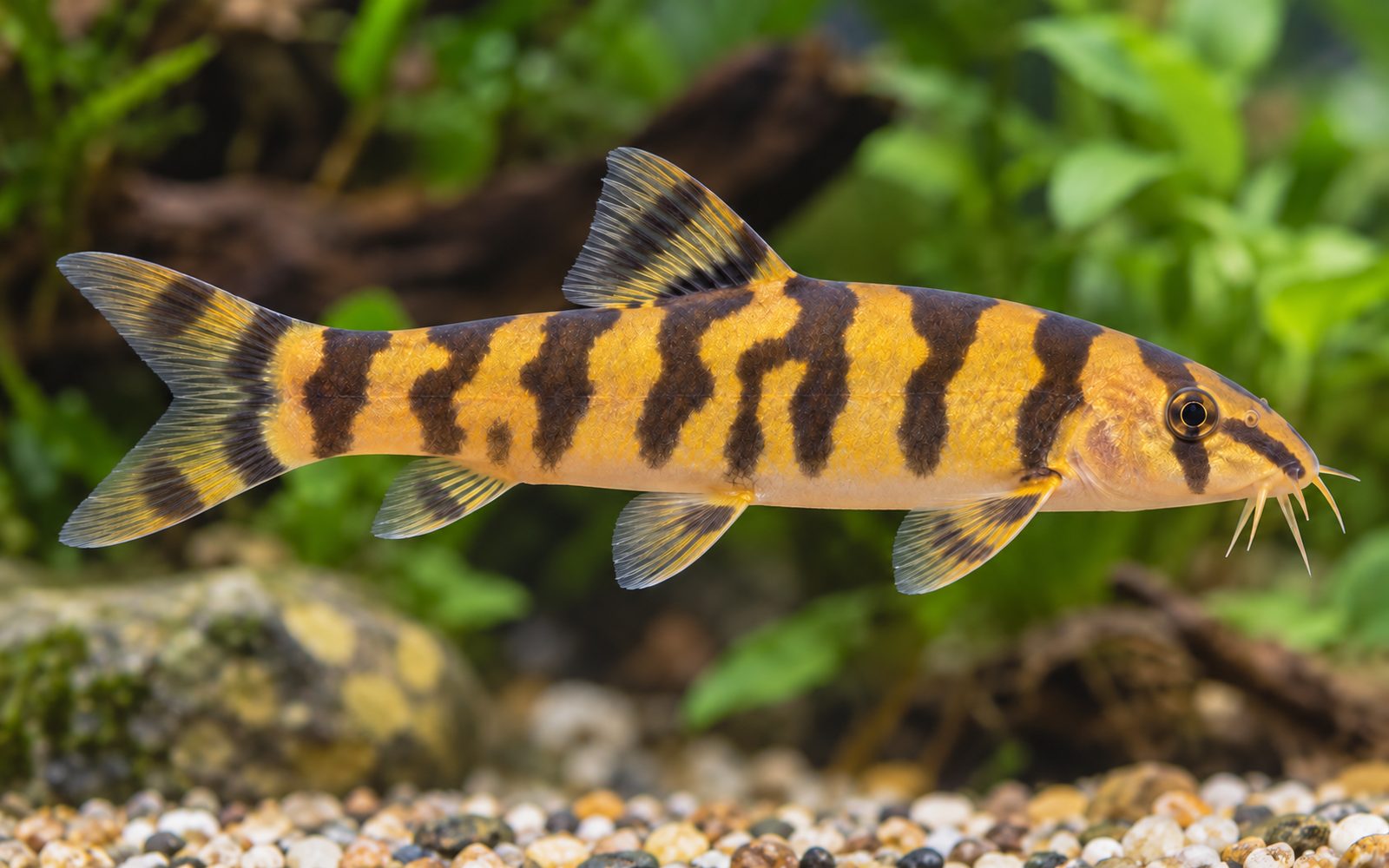
The golden zebra loach is a medium-sized loach that stands out with its broad dark bands on a yellow-gold background. When young, the bands look straight and complete; as the fish matures they split and the pattern becomes more complex. For this reason juveniles can be confused with the Kubotai loach, and adults with the emperor loach.
It is an active, curious and vocal fish: it makes audible clicking sounds while feeding or when excited. Adults grow to 12–13 cm.
Natural Habitat
It lives in the large river systems of Myanmar, in the Indian state of Manipur and in China's Yunnan region, in flowing, clear river tributaries. The bottom consists of sand, gravel and large stones; the fish hide under and between the stones.
Tank Setup
- Volume: at least 200 liters and 120 cm in length for a group of 5–6.
- Water: 23–27°C, pH 6–7.5, soft to moderately hard. 30% water change weekly.
- Flow: moderate flow, plenty of oxygen.
- Decor: stone piles, roots, caves and narrow crevices.
- Substrate: fine sand or rounded gravel; sharp gravel wears down the barbels.
- Lid: a tight lid is essential; it jumps.
Diet
An omnivore with a mainly carnivorous diet. Besides sinking granules and tablets, frozen bloodworms, brine shrimp, tubifex and mysis are given regularly. It also nibbles blanched vegetables. It hunts snails. Because it finds food on the bottom quickly, if it is kept with slow-eating bottom dwellers, food should be spread over several spots and part of it given in the evening before the lights go out.
Behavior and Compatibility
It is not aggressive, but it is active and large; it can frighten very small fish. It should not be kept with slow, long-finned species. It establishes a hierarchy within the group, rests together and feeds together.
Good companions: barbs, danios, devarios, rasboras, large tetras, other medium-sized loaches.
Avoid: snails, shrimp, long-finned fish such as bettas and fancy goldfish, nano species.
Group and Colony Structure
At least 5–6, ideally 10 or more individuals. A golden zebra loach kept alone withdraws and is almost never seen. In a large group, aggression is spread out and turns into harmless jostling. The group can be built from fish bought at the same time or completed in several batches; newcomers are usually accepted quickly.
Breeding
There is no known record of it being bred in the aquarium. The fish sold are collected from the wild.
Health and Common Problems
- Ich: common in newly arrived fish; quarantine is recommended.
- Medication sensitivity: it has small scales; start medications at half dose.
- Wasting: internal parasites are common in wild-collected loaches; do not buy fish with a sunken belly.
Sexing
Mature females have a fuller body and a rounder snout. Males have a longer snout and thicker lips.
Tank mates
This list is calculated automatically from the species profile and grows as new species are added to the catalog. Try it in the planner for a definite answer.
Usually compatible
 Flame Tetra
Glass Tetra
Flame Tetra
Glass Tetra
 Blackfin Corydoras
 Polystictus Corydoras
 Emerald Betta
 Emerald Cory
 Porthole Catfish
 Keyhole Cichlid
 Cupid Cichlid
 Buffalohead Cichlid
Should not be kept together






Hobbyist notes
Things you won't find in books, learned by trial and error. The most helpful ones are on top.
Change history and contributors
- Page created · October 16, 2026