
Water parameters
Overview
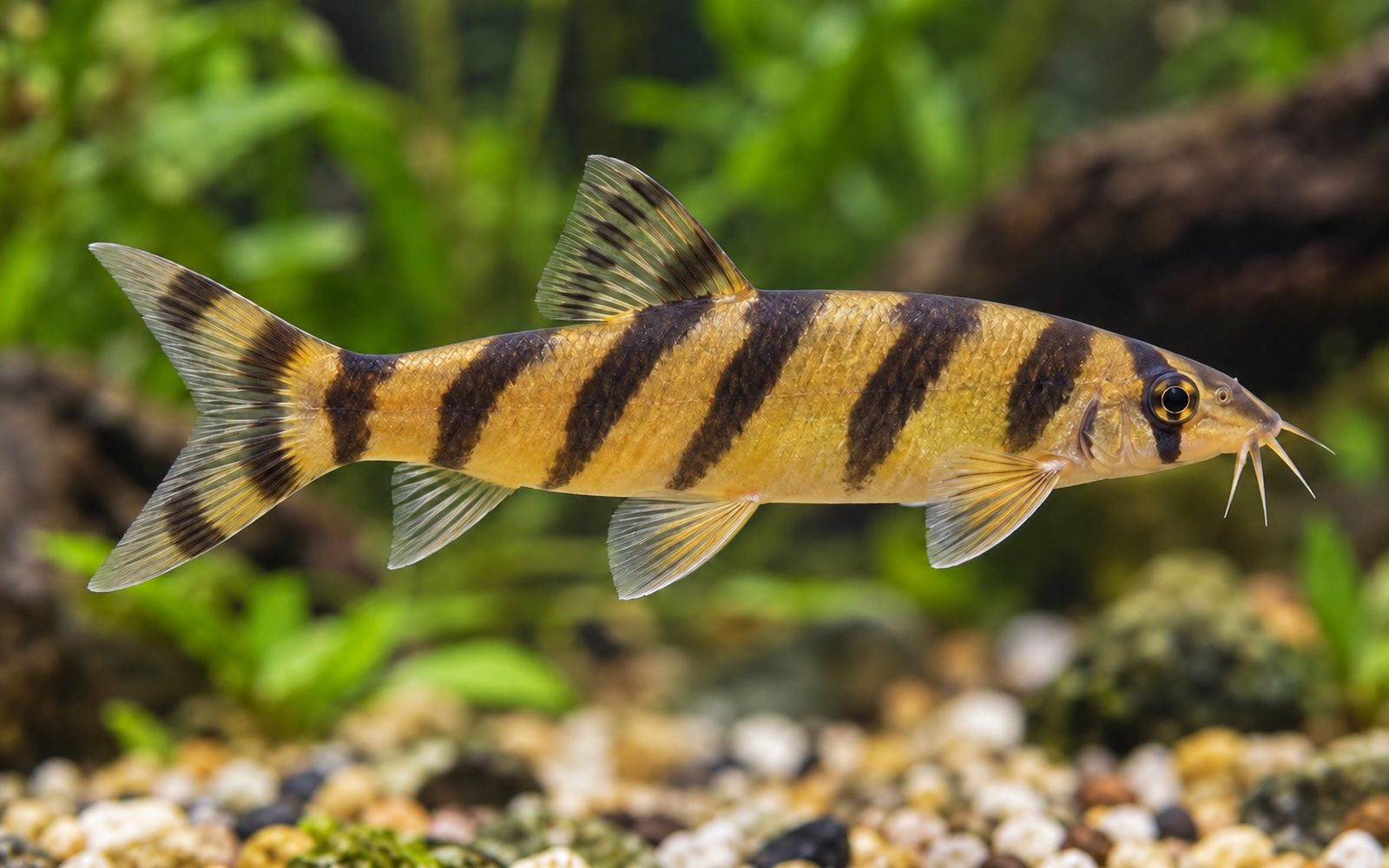
With dark brown bands slanting backward over a golden yellow background, the Bengal loach is one of the most elegant-looking loaches. It stays noticeably smaller than the clown loach; adults usually grow to 12–13 cm. Still, it is a fast, curious group fish that is constantly on the move, and it needs an aquarium with a large footprint.
It is visible out in the open during the day as well. Typical loach behaviors are easy to watch within the group, such as chasing, resting on its side and making clicking sounds when excited. Because it lives for many years, the future layout of the aquarium should be considered when buying it.
Natural Habitat
It lives in the middle and lower reaches of the Ganges and Brahmaputra rivers in northern India, Bangladesh and southern Bhutan. It prefers clear, flowing river tributaries with sand and gravel bottoms. In the region, water levels and temperatures change seasonally with the monsoon rains.
Tank Setup
- Volume: at least 200 liters and 120 cm in length for a group of 5–6. Footprint matters more than height.
- Water: 23–26°C, pH 6–7.5, soft to moderately hard water. 30% water change weekly.
- Flow: moderate flow and good aeration; it shows its best color in clean, oxygen-rich water.
- Substrate and decor: fine sand or rounded gravel. Roots, rocks and caves; loaches like to rest wedged into narrow crevices.
- Lid: a tightly closing lid is essential; it can jump.
Diet
An omnivore with a mainly carnivorous diet. Sinking granules and tablets should be the staple; vary with frozen bloodworms, brine shrimp, tubifex and daphnia. It also nibbles slices of blanched zucchini or cucumber. It eagerly hunts small snails; however, it should not be seen as the sole solution to a snail infestation.
Behavior and Compatibility
It is considered peaceful but is fast and noisy; its activity can unsettle very small, shy fish. It is better not to keep it with long-finned, slow species. Rank fights occur within the group, but serious injury is rare.
Good companions: medium-sized barbs, danios and devarios, rasboras, large tetras, other medium-sized loaches.
Avoid: snails, shrimp, slow long-finned fish (bettas, fancy goldfish), aggressive cichlids that claim the bottom.
Group and Colony Structure
The Bengal loach depends on its group: at least 5–6, ideally 8–10 individuals. When kept singly or in pairs, it withdraws, hides constantly or starts harassing other fish. In a large group a hierarchy forms; because the dominant fish spends its energy on its own kind, the other fish in the aquarium are more at ease. The sex ratio does not matter.
Breeding
Reliable records of it being bred in the aquarium are almost nonexistent. Most fish sold are collected from the wild.
Health and Common Problems
- Ich: loaches are prone to ich; new fish should be quarantined for 2–3 weeks.
- Medication sensitivity: its scales are very small. With medications containing malachite green and formalin, start at half dose.
- Wasting: internal parasites are common in wild-caught fish; do not buy fish with a sunken belly.
Sexing
Mature females have a fuller, rounder belly, while males are slimmer. Apart from this, there is no reliable external difference.
Tank mates
This list is calculated automatically from the species profile and grows as new species are added to the catalog. Try it in the planner for a definite answer.
Usually compatible
 Flame Tetra
Glass Tetra
Flame Tetra
Glass Tetra
 Blackfin Corydoras
 Polystictus Corydoras
 Emerald Betta
 Emerald Cory
 Porthole Catfish
 Keyhole Cichlid
 Buffalohead Cichlid
 Geophagus surinamensis
Should not be kept together






Hobbyist notes
Things you won't find in books, learned by trial and error. The most helpful ones are on top.
Change history and contributors
- Page created · October 16, 2026