
Water parameters
Overview
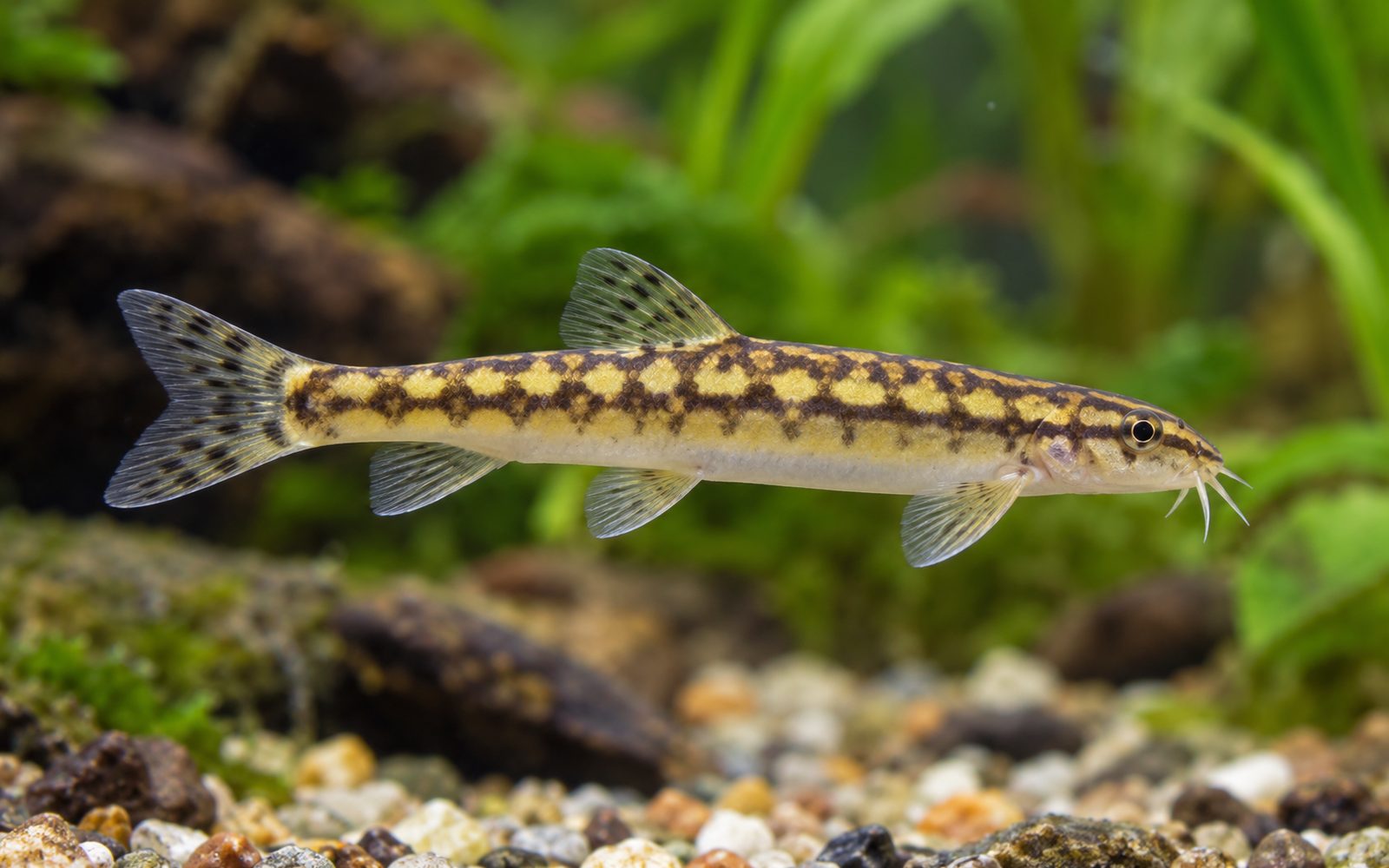
The dwarf chain loach is named for the dark lines along its back and upper flanks, which join together and look like the links of a chain. Adults grow to 5–6 cm, making it one of the few loaches that fit in a medium-sized aquarium. Unlike other loaches, it also likes to leave the bottom and swim in a group in midwater.
It is considered endangered in its natural habitat, and its range is quite narrow. Most of the fish found in the trade today are bred on farms; wild-collected fish should be avoided.
Natural Habitat
It lives in the Mae Klong basin in western Thailand and the Ataran river system on the Thailand–Myanmar border. It is found in clear, oxygen-rich river tributaries with sand and gravel bottoms.
Tank Setup
- Volume: at least 75 liters and 80 cm in length for a group of 8–10.
- Water: 23–28°C, pH 6–7.5, soft to moderately hard. 25–30% water change weekly.
- Flow: gentle to moderate flow and good aeration.
- Substrate: fine sand; it constantly rummages with its barbels.
- Decor: plants, roots and small caves. It causes no problems in a planted aquarium.
- Lid: it is an excellent jumper; gaps in the lid should be covered.
Diet
An omnivore with a mainly carnivorous diet. Give small sinking granules and tablets, frozen bloodworms, brine shrimp, daphnia and tubifex; it also nibbles blanched vegetables and fruit. It hunts small snails, but it is not a complete solution to a snail infestation on its own.
Behavior and Compatibility
Peaceful, playful and very active. It is suitable for community aquariums; however, it has been reported that its constant movement can disturb calm, long-finned fish. Periods of chasing and resting alternate within the group.
Good companions: rasboras, small danios, tetras, corydoras, otocinclus, dwarf gouramis.
Avoid: snails, shrimp (it will certainly eat the young and may hunt adults too), bettas and long-finned guppies, large fish whose mouths could swallow it.
Group and Colony Structure
The dwarf chain loach is a schooling fish that loves a crowd: at least 6, ideally 10 or more individuals. When the group is small, the fish hide and their colors fade; in a large group they swim together in midwater, play and are in constant interaction. The sex ratio does not matter.
Breeding
Commercial breeding is done with hormone support. Breeding in the hobby is very rare; there have been only isolated reports of fry appearing spontaneously in large, mature groups.
Health and Common Problems
- Ich: can occur in new fish; quarantine is recommended.
- Medication sensitivity: it has small scales; start medications at half dose.
- Water quality: it should not be added to an aquarium that has not finished cycling; it is sensitive to ammonia and nitrite.
Sexing
Mature females are fuller and slightly larger. Males have a slightly longer snout and thicker lips.
Tank mates
This list is calculated automatically from the species profile and grows as new species are added to the catalog. Try it in the planner for a definite answer.
Usually compatible
 Flame Tetra
 Blackfin Corydoras
 Polystictus Corydoras
 Emerald Cory
 Porthole Catfish
 Keyhole Cichlid
 Cupid Cichlid
 Geophagus altifrons
 Geophagus surinamensis
 Cryptocoryne Parva
Should not be kept together






Hobbyist notes
Things you won't find in books, learned by trial and error. The most helpful ones are on top.
Change history and contributors
- Page created · October 16, 2026