
Water parameters
Overview
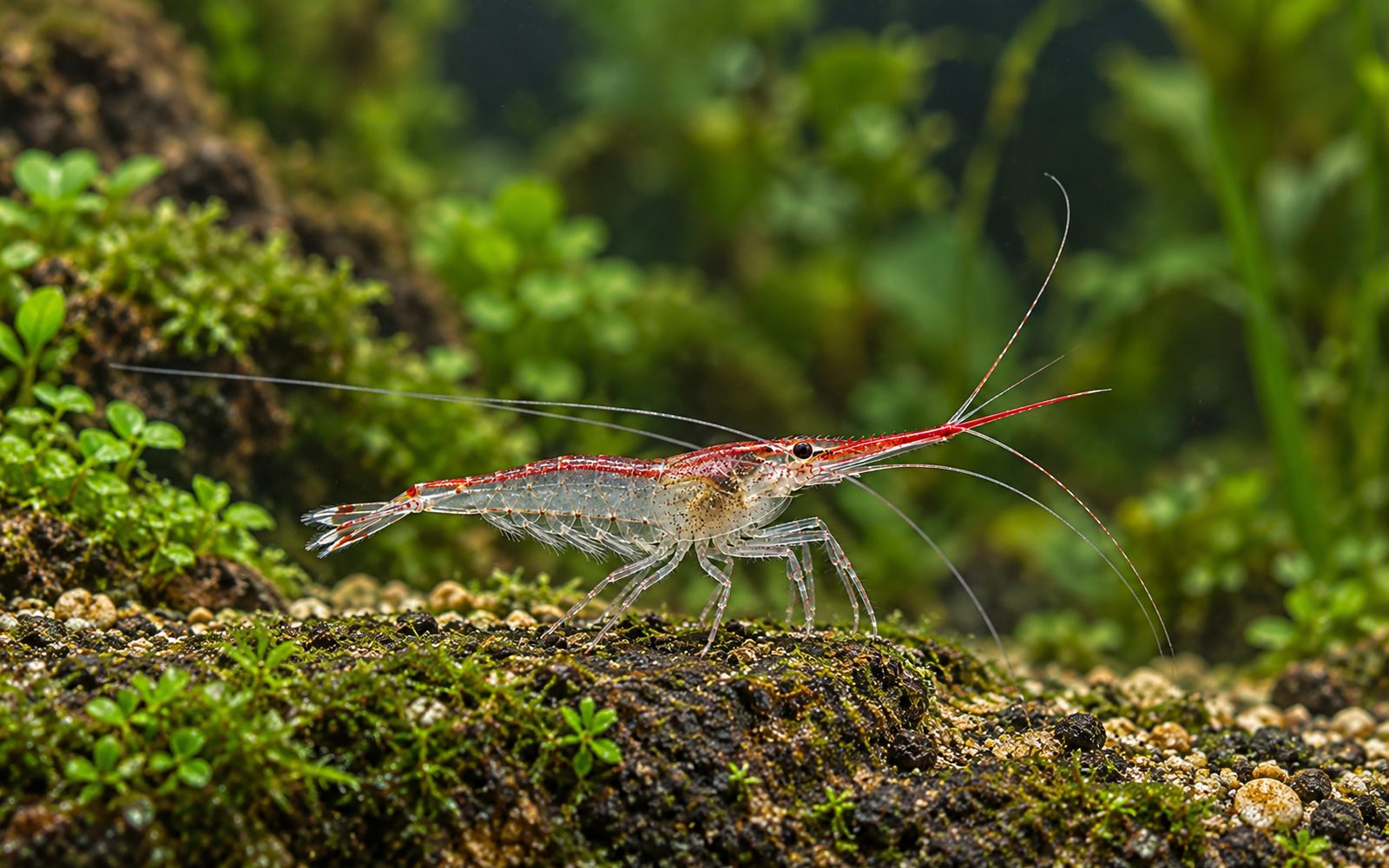
The red nose shrimp is instantly recognized by the thin red nose that projects forward in front of its eyes and can be almost as long as its body. This extension is called the rostrum; in this species it is unusually long and has earned it the names "Pinocchio" and "rhino" shrimp.
Its body is transparent, and there may be a faint reddish tint along its back. It is a more active swimmer than dwarf shrimp and is usually seen not on the substrate but among plants and in open water.
Natural Habitat
It lives in the Indo-Pacific region, in the lower reaches of rivers near the sea and in fresh water close to river mouths. Its larvae drift with the current to river mouths or the sea, and the juveniles return to fresh water.
Tank Setup
- Volume: 40 liters or more for 5–10 individuals; leave swimming space.
- Plants: Dense plants and moss provide hiding places; open space is still important.
- Water: 23–27°C, around neutral, soft to moderately hard. It likes gentle flow and good oxygenation.
- Lid: An active species; when startled it may jump and escape from the aquarium.
- Acclimation: Slowly, using the drip method. It is sensitive to shipping stress.
- Water changes: 10–20% a week; new water should be the same temperature and of similar hardness.
Diet
Omnivorous. It picks up biofilm, algae and leftover food; it is fed shrimp food, fine granules, spirulina tablets and small frozen foods (brine shrimp, cyclops). It also catches fine particles drifting in open water.
Behavior and Compatibility
Peaceful; it does not harm fish or plants. It can be shy; it looks more at ease in a larger group and with peaceful, calm fish around it. At feeding time it swims quickly through mid-water to catch sinking pieces of food; in aquariums with many fish, watch whether it is getting enough food.
Good companions: Small tetras, rasboras, corydoras, otocinclus, dwarf shrimp, nerite snails.
Avoid: Cichlids, bettas, large barbs, crayfish and large Macrobrachium shrimp.
Group and Colony Structure
It feels safer in a group. Keeping it with at least 5, preferably 8–10 individuals is recommended. Because it does not breed in the aquarium, the number does not increase on its own.
Breeding
Females can carry eggs in the aquarium, but the larvae develop only in brackish or salt water. Raising larvae at home is very difficult; most individuals for sale are collected from the wild.
Health and Common Problems
- Shipping losses: Can occur in wild-caught individuals in the first weeks; a mature aquarium and slow acclimation reduce losses.
- Molting problems: Sudden water changes or very soft water.
- Poisoning: Copper and many antiparasitic medications are deadly.
Sexing
Females are larger with a wider abdomen; in a berried female the eggs are visible under the abdomen. Males are smaller and slimmer.
Tank mates
This list is calculated automatically from the species profile and grows as new species are added to the catalog. Try it in the planner for a definite answer.
Usually compatible
 Flame Tetra
 Blackfin Corydoras
 Polystictus Corydoras
 Emerald Cory
 Emerald Dwarf Rasbora
 Porthole Catfish
 Cryptocoryne Parva
 Gold Spot Pleco (L001)
 Adolfo's Cory
 African Glass Catfish
Should not be kept together






Hobbyist notes
Things you won't find in books, learned by trial and error. The most helpful ones are on top.
Change history and contributors
- Page created · October 16, 2026