
Water parameters
Overview
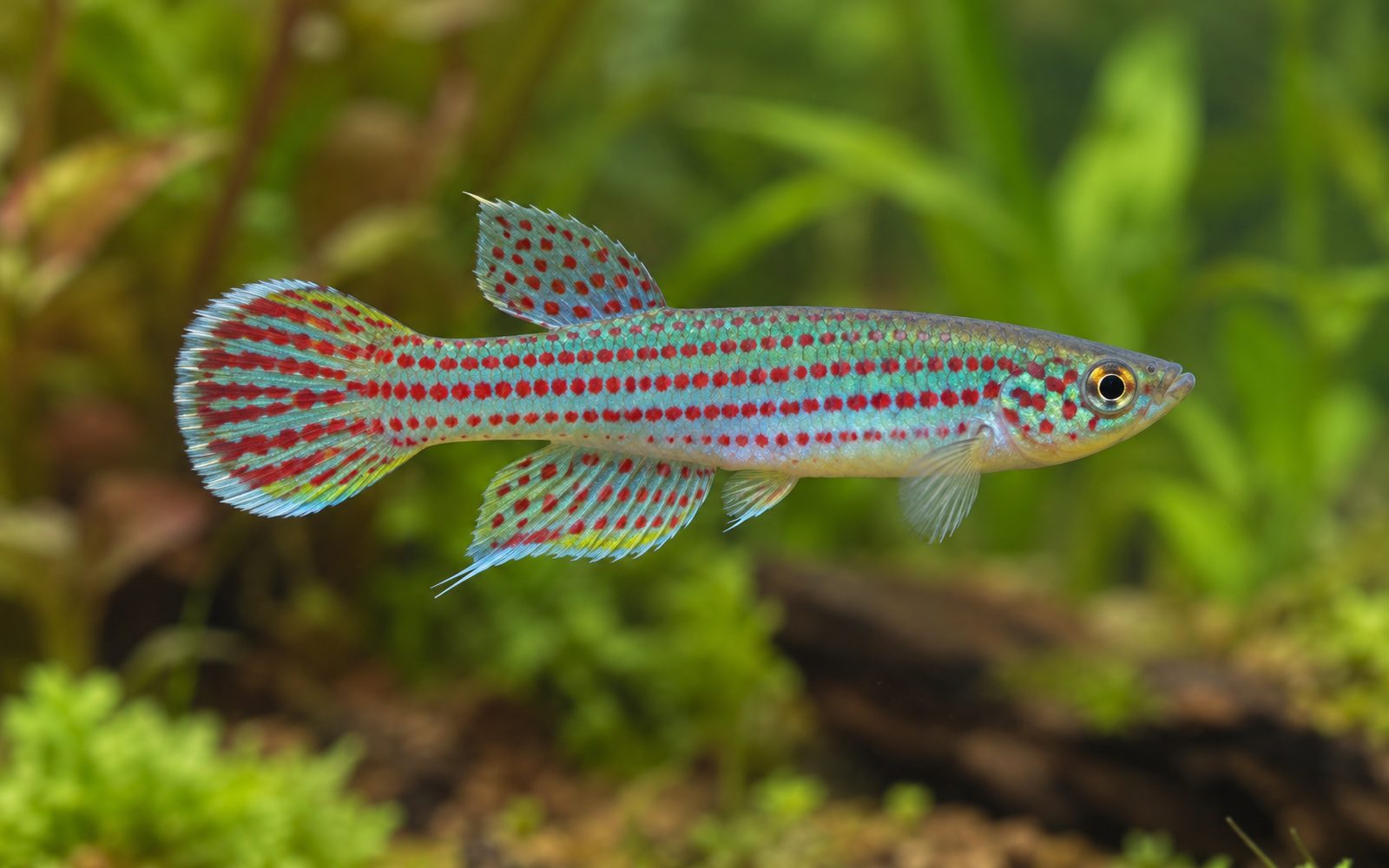
Aphyosemion striatum is a small killifish easily recognized by the lines on its body. Along the male's body, which has a green-blue sheen, run five thin red lines made up of rows of red spots. The tail fin is also striped with red, and the dorsal and anal fins are spotted with red.
It prefers cooler water than many killifish and can live comfortably without a heater in a warm room. As a peaceful, small and easy-breeding species, it is very well suited to planted nano aquariums.
Natural Habitat
It lives in the coastal forests of northern Gabon and Equatorial Guinea, in small, shallow streams under the canopy, in spring water and in forest swamps. The water is soft, slightly acidic and relatively cool; the bottom is covered with leaf litter.
Tank Setup
- Volume: 25 liters or more for one male and two to three females.
- Layout: dense plants, moss, floating plants and dim light; a few dried leaves.
- Water: 21–23°C is ideal; soft and slightly acidic. It does not like temperatures above 25°C for long periods.
- Filter: an air-driven sponge filter with weak flow.
- Lid: a tight lid is essential.
- Maintenance: a 20–25% water change every week.
Diet
Mainly carnivorous. Small live and frozen foods should be the staple: brine shrimp, daphnia, cyclops, microworms and small bloodworms. Over time it will also take fine flakes and micro granules.
Behavior and Compatibility
Calm and peaceful. Males display to each other, but serious fights are rare. It spends most of its day among plants in the middle and upper zones.
Good companions: small, calm fish: harlequin rasboras, galaxy rasboras, dwarf corydoras, otocinclus; adult dwarf shrimp (it may eat their young).
Avoid: fast and large fish, fin nippers, species that need warm water.
Group and Colony Structure
Two to three females per male are recommended. In a planted, large aquarium several males can live together without problems with enough females.
Breeding
It lays a few eggs every day in a yarn mop, moss or fine-leaved plants.
- The eggs are kept in water in a shallow container; at around 22°C they hatch in about 2–3 weeks.
- Eggs that develop fungus must be removed every day.
- The eggs can also be stored in damp peat for 2–3 weeks; once placed in water, they hatch shortly afterward.
The fry are small; in the first days they are fed microworms or infusoria, then newly hatched brine shrimp. In an aquarium with dense moss, some of them can also grow up alongside the parents.
Health and Common Problems
- Warm water: at high temperatures the colors fade and lifespan shortens.
- Velvet disease (Oodinium): common in killifish; early detection is important.
- It is hardy in mature, clean water.
Sexing
Males have a green-blue body, red lines and colorful fins. Females are smaller and plain light brown; their lines are faint and their fins short and colorless.
Tank mates
This list is calculated automatically from the species profile and grows as new species are added to the catalog. Try it in the planner for a definite answer.
Usually compatible
 Flame Tetra
 Blackfin Corydoras
 Polystictus Corydoras
 Emerald Cory
 Porthole Catfish
 Keyhole Cichlid
 Cryptocoryne Parva
 Adolfo's Cory
 Weeping Moss
 Flame Moss
Should not be kept together






Hobbyist notes
Things you won't find in books, learned by trial and error. The most helpful ones are on top.
Change history and contributors
- Page created · October 16, 2026