
Water parameters
Overview
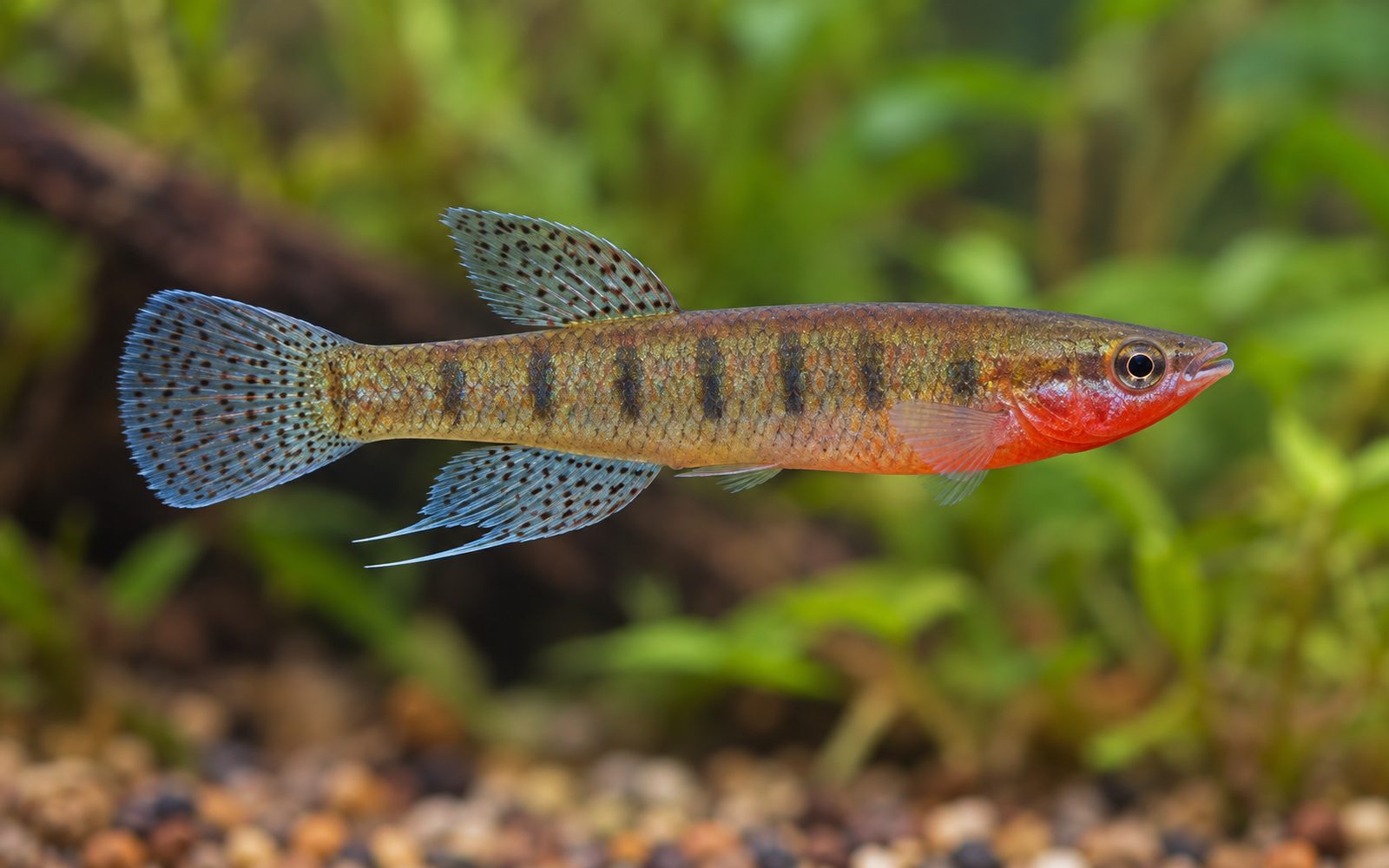
Epiplatys dageti is one of West Africa's hardiest and easiest-to-keep surface killifish. Its body is bronze-olive with dark vertical bars. Males have a scarlet-orange throat and lower jaw; the species' English name also comes from this red chin.
The form most often seen in the hobby is the Liberian subspecies E. dageti monroviae. Its ability to adapt to a wide range of water, from soft to moderately hard, and its resistance to disease make it a good choice for newcomers to killifish. The only thing to watch out for is that it sees fry and very small fish as prey.
Natural Habitat
It lives in the low plains along the West African coast, in slow-flowing streams, swamps and ditches at the edges of savanna and forest. It waits near the surface at the edge of the vegetation and hunts insects that fall into the water.
Tank Setup
- Volume: 50 liters or more for one male and two to three females; a large surface area is preferred.
- Lid: a tight lid is essential.
- Layout: floating plants, dense edge planting and roots; an open strip at the surface.
- Water: 23–25°C, soft to moderately hard. The flow should be weak.
- Maintenance: a 25% water change every week.
Diet
Carnivorous. It readily accepts floating flakes and granules; this should be supplemented with frozen and live foods: mosquito larvae, bloodworms, brine shrimp, daphnia, fruit flies. Live food noticeably brightens the males' chin color.
Behavior and Compatibility
Peaceful and calm; it glides slowly just below the surface. Males make brief chases among themselves with spread fins. It hunts small fish and fry that fit in its mouth.
Good companions: medium-sized peaceful fish: tetras (rummy-nose, black tetra), harlequin rasboras, corydoras, otocinclus, dwarf gouramis.
Avoid: fish under 2–2.5 cm and fry, aggressive fish that dominate the surface.
Group and Colony Structure
Two to three females per male are recommended. In a large aquarium several males can be kept together with enough females; floating plants reduce how much the males see each other.
Breeding
It breeds easily. It lays a few eggs every day among the roots of floating plants, in fine-leaved plants or in a yarn mop. At 24°C the eggs hatch in about 8–12 days. The parents eat the fry; the eggs should be collected into a separate container. The fry can be fed newly hatched brine shrimp or microworms from the first day.
Health and Common Problems
- Escape: it jumps out of uncovered aquariums.
- Velvet disease (Oodinium): a common problem in killifish.
- It is very hardy overall; fin rot can occur in poor water.
Sexing
Males have a scarlet-orange throat and lower jaw; the bars on the body are fainter, and the fins are longer and spotted. Females lack the chin color, their vertical bars are more distinct, and their fins are plain and short.
Tank mates
This list is calculated automatically from the species profile and grows as new species are added to the catalog. Try it in the planner for a definite answer.
Usually compatible
 Flame Tetra
 Blackfin Corydoras
 Polystictus Corydoras
 Emerald Cory
 Emerald Dwarf Rasbora
 Porthole Catfish
 Keyhole Cichlid
 Geophagus surinamensis
 Cryptocoryne Parva
 Gold Spot Pleco (L001)
Should not be kept together






Hobbyist notes
Things you won't find in books, learned by trial and error. The most helpful ones are on top.
Change history and contributors
- Page created · October 16, 2026