
Water parameters
Overview
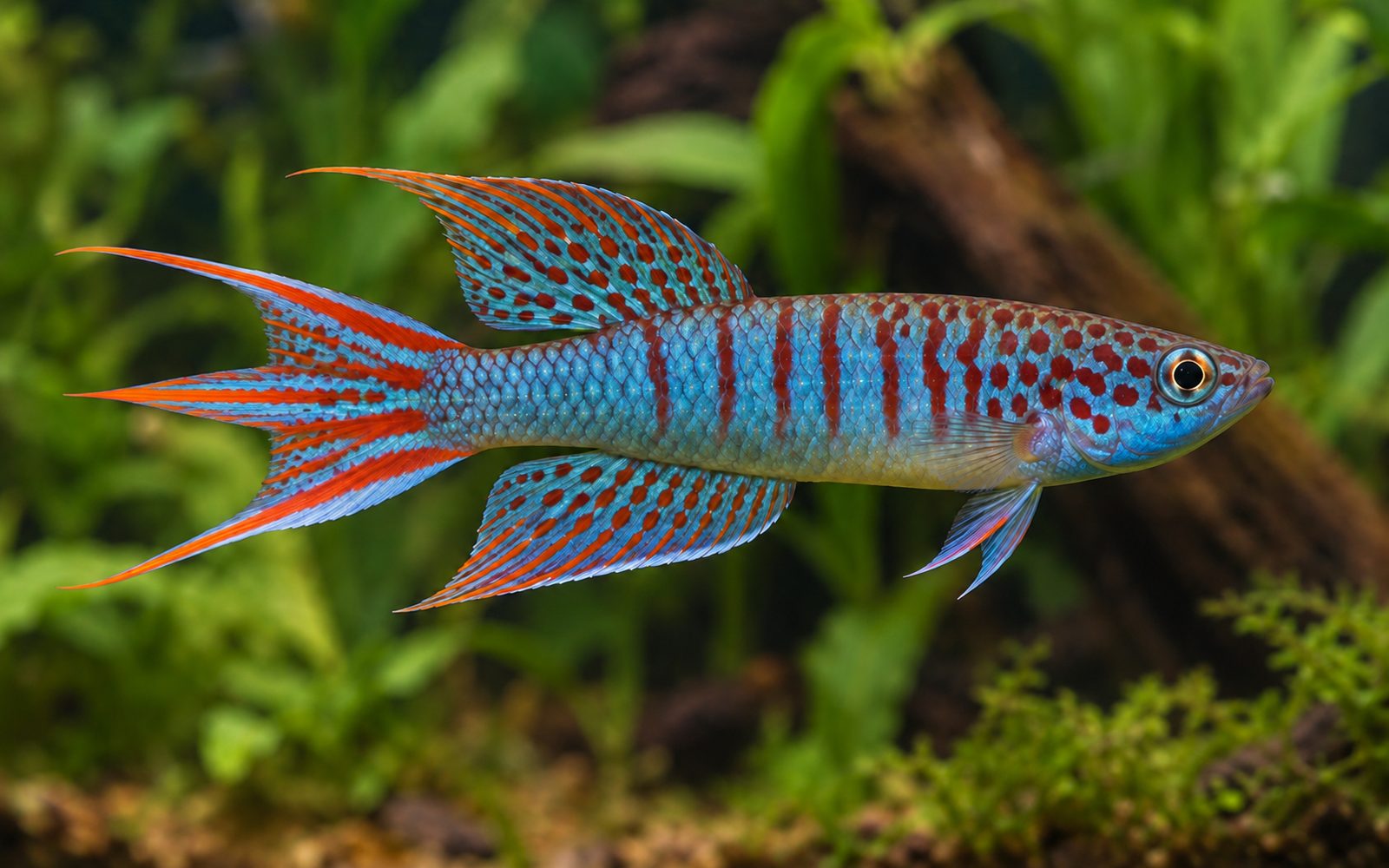
The blue gularis is one of the largest killifish species; males reach 10–12 cm. The front half of its blue-green body is decorated with red-brown bars and spots. Its most striking feature is the three-pointed tail, with elongated upper and lower tips and a pointed center; the tail is patterned with orange-red and blue stripes.
For a long time it was known in the hobby as Aphyosemion sjoestedti. It is a semi-annual species: its eggs are buried in the peat on the bottom and develop for weeks in damp peat. Its lifespan, however, is longer than that of annual species, and under good conditions it lives for several years.
Natural Habitat
It lives in swamps, shallow forest streams and pools that shrink in the dry season on the coastal plains of the Niger Delta and Cameroon. The water is soft, slightly acidic and brownish from plant debris.
Tank Setup
- Volume: at least 100 liters for one male and two females; a long aquarium is preferable.
- Lid: A tight lid is essential; because it is large, its jumps are powerful too.
- Layout: Dense plants, roots and floating plants; peat or fine dark sand on the bottom.
- Water: 22–25°C, soft to moderately hard. It prefers the cooler side and struggles above 27°C.
- Maintenance: 25–30% water change weekly.
Diet
Carnivorous and gluttonous. Bloodworms, mosquito larvae, mysis shrimp, large brine shrimp and pieces of earthworm should be the staple. It accepts granules with training. In the wild it also hunts small fish.
Behavior and Compatibility
Males are aggressive both towards each other and towards similar-looking fish. It eats any fish or shrimp that fits in its mouth. Still, it usually leaves large, calm fish alone.
Good companions: calm fish of its own size: large barbs, gouramis, large tetras, plecos and large corydoras species.
Avoid: small fish such as neons, rasboras and guppies, dwarf shrimp, other Fundulopanchax species (hybridization), aggressive cichlids.
Group and Colony Structure
Two females per male are recommended; the females must be able to hide among plants. Two males can be kept together only in a very large, divided aquarium.
Breeding
The pair deposits its eggs in the peat on the bottom or in a thick wool spawning mop.
- Collecting: The peat is removed every 1–2 weeks, drained and squeezed until damp.
- Storage: It is kept in a labeled bag at 22–24°C. The eggs usually develop visible eyes in 4–8 weeks.
- Wetting: The peat is placed in soft, shallow water; the fry hatch quickly. Eggs that do not hatch are dried again and tried later.
The fry are large and take brine shrimp from the first day. They grow fast, but once size differences appear they must be separated, as they may eat each other.
Health and Common Problems
- Velvet (Oodinium): common in killifish; it should be spotted early.
- Heat stress: Loss of appetite and disease increase in water that stays above 27°C for long periods.
- It is hardy in clean water; fin rot can occur in poor water quality.
Sexing
Males are large, colorful and have a three-pointed tail. Females are smaller, plain brown and sparsely spotted; their fins are short, rounded and colorless.
Tank mates
This list is calculated automatically from the species profile and grows as new species are added to the catalog. Try it in the planner for a definite answer.
Usually compatible
 Emerald Betta
 Firemouth Cichlid
 Buffalohead Cichlid
 Festivum
 Geophagus surinamensis
 Rainbow Cichlid
 Gymnogeophagus balzanii
 Pearl Cichlid
 Blood Parrot
Should not be kept together





Hobbyist notes
Things you won't find in books, learned by trial and error. The most helpful ones are on top.
Change history and contributors
- Page created · October 16, 2026