
Water parameters
Overview
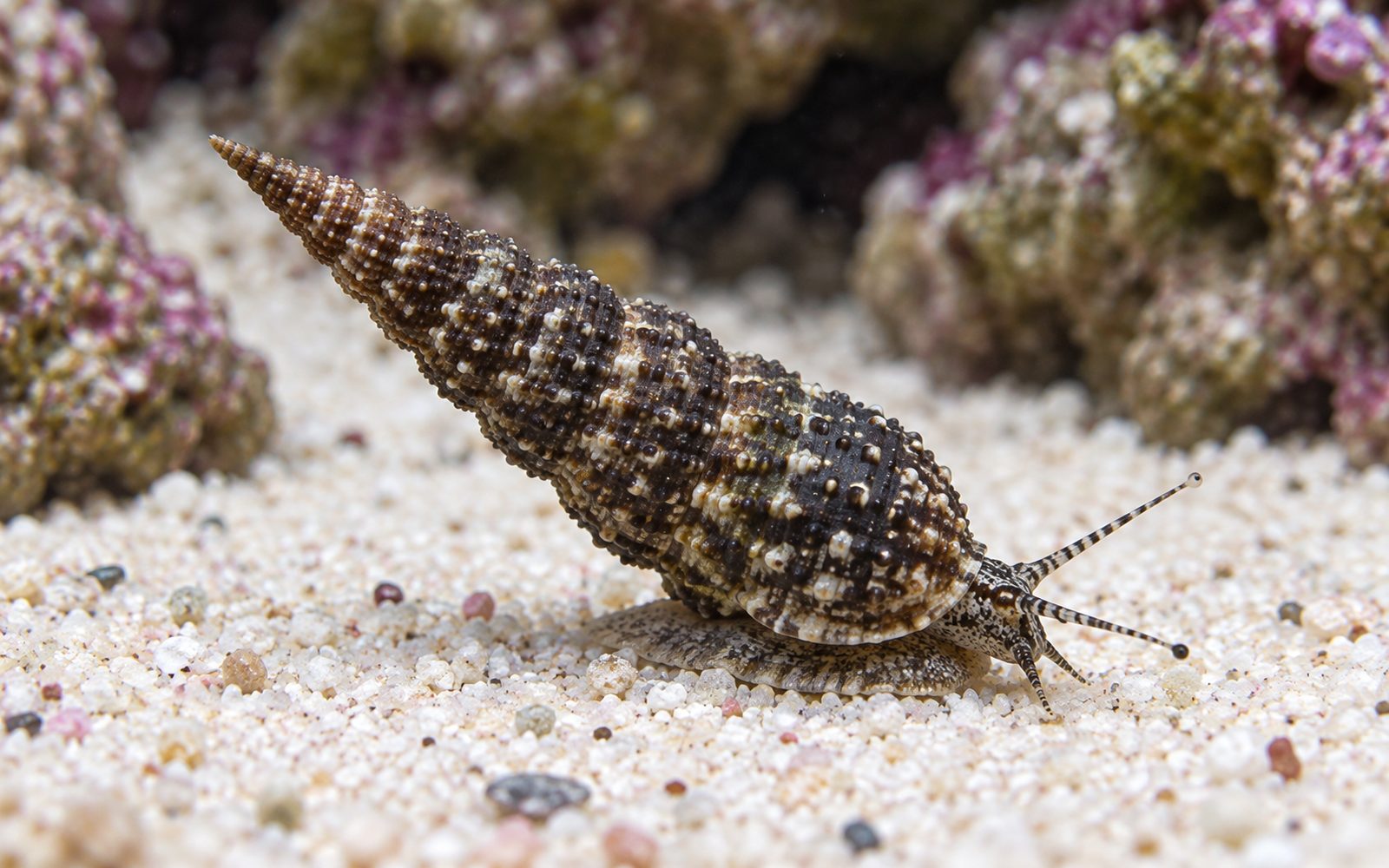
With its long, pointed tower-shaped shell, the Cerith snail is a versatile member of the cleanup crew. Its dark brown-gray shell is decorated with rows of small, bead-like bumps. It both stirs the sand by roaming the upper layer of the sand bed and cleans the algae film, diatoms and detritus on the glass, rocks and in narrow crevices.
Thanks to its slender build, it can reach gaps between rocks that turbo or Astraea snails cannot enter. When it turns upside down, it can easily right itself. Those on the market are wild-collected.
Natural Habitat
It lives on shallow sandy bottoms, seagrass beds and rocky bottoms from the southeastern USA to the Caribbean and Brazil. During the day it partly buries itself in the sand, and at night it comes out onto surfaces. Because it is used to shallow waters with variable temperature and salinity, it is one of the hardy members of the cleanup crew.
Tank Setup
- Volume: 30 liters and above; 1–2 snails per 20 liters.
- Sand: A fine to medium-grained sand bed is preferred; it collects diatoms and detritus while roaming the sand.
- Water: Salinity specific gravity 1.023–1.026, pH 8.1–8.4, temperature 24–27°C.
- Reef compatibility: Reef-safe; it leaves corals and other organisms alone.
- Acclimation and medication: Acclimate by the drip method for at least 1 hour. Copper-based medications kill snails.
Diet
Mainly herbivorous: it feeds on algae film, diatoms, microalgae on the sand surface and detritus. When algae run low in the aquarium, it should be supplemented with sinking algae tablets and pieces of nori. It is very effective at cleaning the brown diatom layer commonly seen in newly set-up aquariums.
Behavior and Compatibility
Completely peaceful. During the day it is mostly seen in the sand, at night on the glass and rocks. It can climb up to the water surface but has no tendency to escape from the aquarium.
Good companions: Almost all reef-safe fish; shrimp, other snails, the scarlet reef hermit crab.
Avoid: Wrasses that hunt in the sand, triggerfish and pufferfish; Astropecten sand stars; aggressive hermit crabs without spare shells.
Group and Colony Structure
It has no social needs. Depending on the algae and sand surface in the aquarium, 1–2 snails per 20 liters is enough. When used together with turbo or Astraea snails, the cleaning of different surfaces is shared.
Breeding
The sexes are separate. Females may leave thin, gelatinous egg strings on the glass or rocks. The larvae usually go through a planktonic stage and rarely survive in a home aquarium; lasting reproduction should not be expected.
Health and Common Problems
- Shell erosion: Low calcium and alkalinity.
- Turning upside down: Rarely a problem; the cerith rights itself easily. An individual that stays upside down for a long time is usually sick.
- Prolonged inactivity: A hungry or sick snail; dead individuals are noticed by their smell and should be removed.
- Sudden deaths: Copper, rapid acclimation, a sudden change in salinity.
Sexing
Cannot be distinguished externally. Individuals that leave egg strings are female.
Tank mates
This list is calculated automatically from the species profile and grows as new species are added to the catalog. Try it in the planner for a definite answer.
Hobbyist notes
Things you won't find in books, learned by trial and error. The most helpful ones are on top.
Change history and contributors
- Page created · October 16, 2026