
Water parameters
Overview
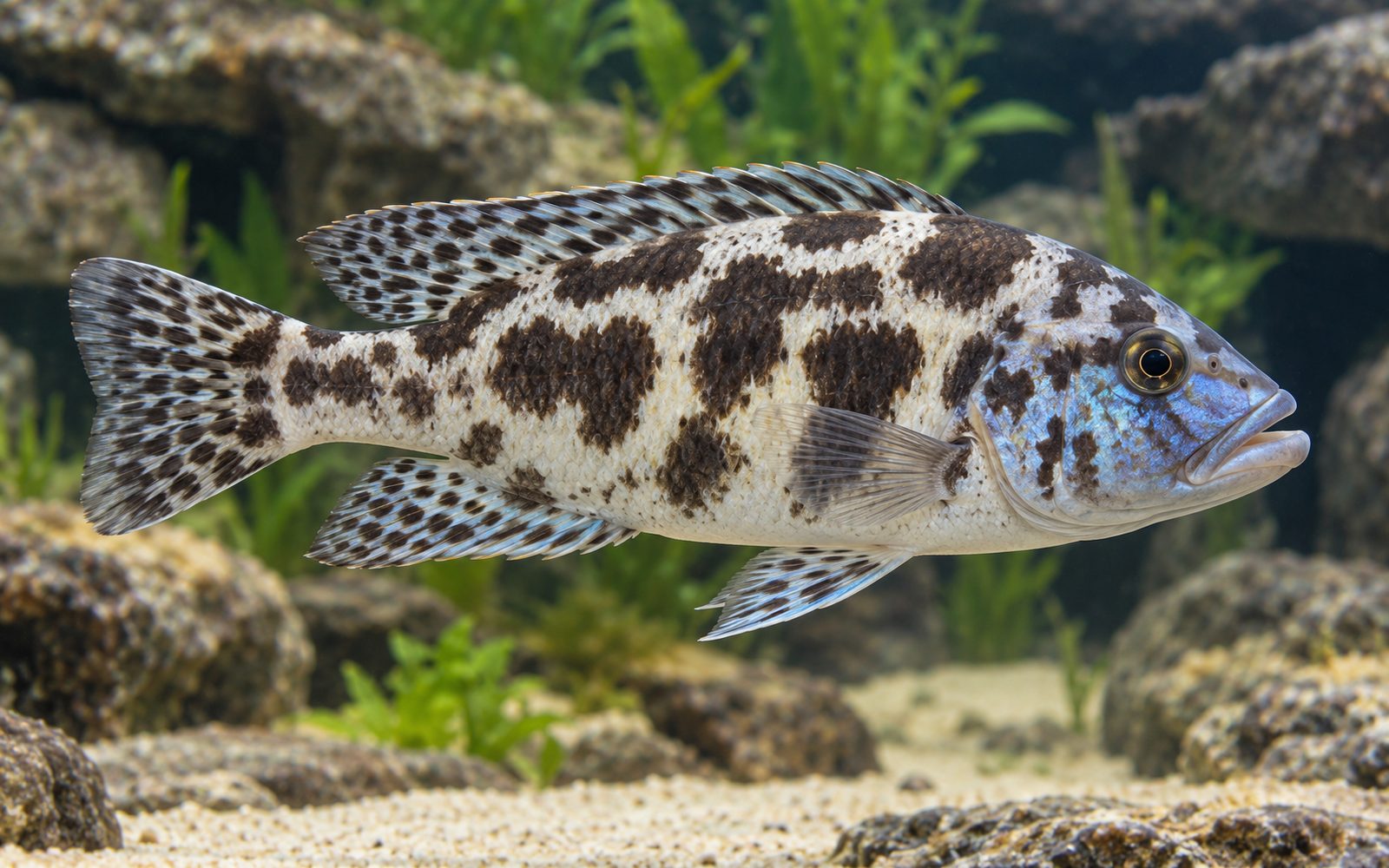
The livingstoni is a Malawi hap famous for its hunting method. It carries large, irregular brown blotches on a white or cream background; this pattern resembles a fish that has begun to decay. The fish lies motionless on its side on the sand and catches small fish that come to scavenge with a sudden lunge. The name "sleeper cichlid" comes from this behavior.
It is a large-mouthed predator that reaches 20–25 cm. Toward fish close to its own size, however, it has a measured temperament. Hobbyists panicking when they see a livingstoni lying on its side in the aquarium is a common occurrence; this behavior is completely normal.
Natural Habitat
It lives along the sandy and vegetated shallow shores of Lake Malawi, around reed beds and Vallisneria meadows. It feeds on small fish, especially the fry of other cichlids. The water is hard, alkaline and clear.
Tank Setup
- Volume: at least 500 liters and 150–180 cm in length for an adult group.
- Layout: A wide sandy area with sturdy rock groups along the sides; tough plants such as Anubias can be used.
- Water: Hard and alkaline (pH 7.8–8.5); aragonite substrate or Malawi salt.
- Maintenance: Strong filtration, weekly 40–50% water changes.
Diet
Carnivorous. A large cichlid pellet should be the staple; it is varied with frozen mysis, krill, shrimp and fish meat. Live feeder fish carry a disease risk and are not necessary. Mammalian meat and overly fatty foods can lead to Malawi bloat.
Behavior and Compatibility
During the day it cruises slowly near the rocks or waits motionless on the bottom. As males mature, they become territorial toward males of their own species. It generally lives without problems with haps of similar size.
Good companions: large haps such as the electric blue ahli, blue dolphin cichlid, Malawi eye-biter and Fossorochromis rostratus, large Aulonocara species, large Synodontis catfish suited to hard water.
Avoid: any fish that fits in its mouth, small mbuna and Aulonocara species, community fish, shrimp and snails.
Group and Colony Structure
- Harem: 1 male and 2–3 females; a single male in the aquarium is recommended.
- Large hap community: It fits well in a mixed aquarium made up of single males or small harems of different species.
- Because it can hybridize with other Nimbochromis species, a single species should be kept in a harem aquarium.
Breeding
A mouthbrooder. The male digs a pit in the sand or cleans a flat rock; the female picks up the eggs in her mouth and they are fertilized via the egg spots on the male's anal fin. Large females carry dozens of eggs for about 3–4 weeks. After release, the fry grow quickly on crushed pellets and brine shrimp.
Health and Common Problems
- Malawi bloat: wrong food and stress.
- Hole in the head: associated with insufficient water changes and a monotonous diet.
- Lying on its side: this is hunting behavior; but if the fish has no appetite, is breathing rapidly and is losing its balance, it may be a sign of illness.
Sexing
Males grow larger; as they mature, the head and fins take on a bluish sheen and the fin edges can turn orange-red; they carry prominent egg spots on the anal fin. Females keep the plain blotched pattern. Sexing juveniles is difficult.
Tank mates
This list is calculated automatically from the species profile and grows as new species are added to the catalog. Try it in the planner for a definite answer.
Usually compatible
 Yellow Regal Peacock
 Firemouth Cichlid
 Rainbow Cichlid
 Pearl Cichlid
 Redhead Cichlid
 Red Hump Eartheater
 Pundamilia nyererei
 Pundamilia pundamilia
 Yellow Tail Acei
 Butterfly Goodeid
Should not be kept together






Hobbyist notes
Things you won't find in books, learned by trial and error. The most helpful ones are on top.
Change history and contributors
- Page created · October 16, 2026