
Water parameters
Overview
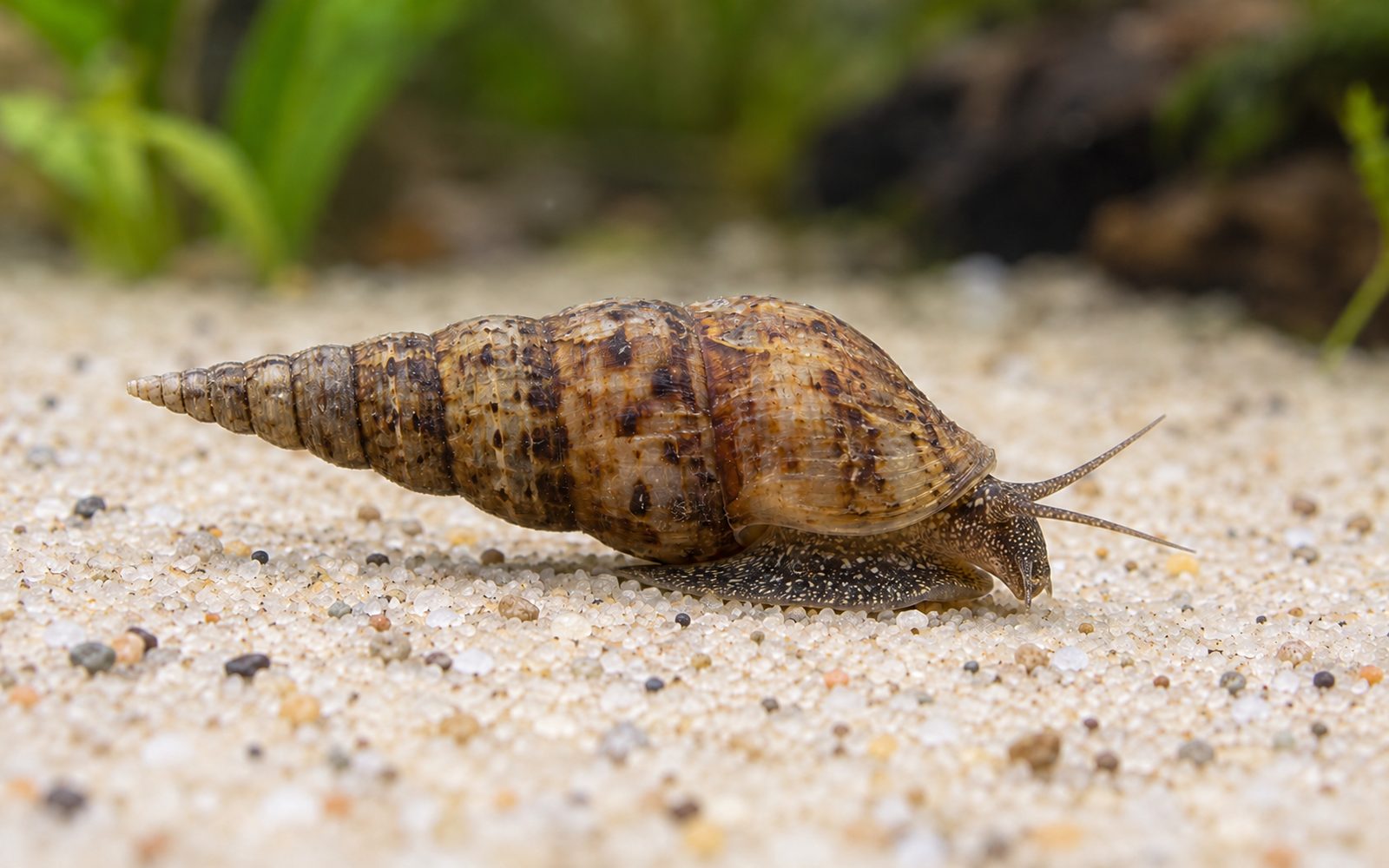
The Malaysian trumpet snail is recognized by its long, pointed, cone-shaped, brown-speckled shell. It often arrives in the aquarium unintentionally with plants. During the day it lives inside the sand and comes to the surface at night and when the lights go off.
It is a useful cleaner: by constantly turning over the sand it prevents oxygen-free pockets from forming and eats leftover food and decaying matter. But because it can multiply quickly, whether it is "friend or pest" depends on the amount of food in the aquarium.
Natural Habitat
It lives on soft bottoms in lakes, ponds and slow-flowing waters of tropical regions. It has spread as a non-native (invasive) species in many countries; snails from the aquarium must not be released into the wild.
Tank Setup
- Volume: it lives in aquariums of any size.
- Substrate: fine sand is the most suitable substrate; this is where its real benefit shows.
- Water: hardness and pH should be above 7; in soft, acidic water the shell erodes.
Diet
Omnivorous: food leftovers, biofilm, algae, decaying plant matter. There is usually no need to feed it separately; the more food you give, the more it multiplies.
Behavior and Compatibility
Completely peaceful; it does not harm healthy plants.
Good companions: almost any community aquarium, shrimp tanks.
Avoid: snail-eating species (clown loach, pea puffer, assassin snail) — or use these species to control numbers.
Group and Colony Structure
It has no social needs; even a single individual can reproduce on its own (see breeding). The population depends directly on the amount of food: little food = few snails.
Breeding
It gives birth to live young, and most populations reproduce asexually (parthenogenetically): a single snail can start a colony. The young develop inside the shell and are born as small snails. If there is a population explosion, reduce feeding, collect the snails that come out at night or add assassin snails.
Health and Common Problems
Hardy. Medications containing copper and many parasite treatments kill snails.
Sexing
Most populations consist only of females; the sexes cannot be distinguished externally.
Tank mates
This list is calculated automatically from the species profile and grows as new species are added to the catalog. Try it in the planner for a definite answer.
Usually compatible









Hobbyist notes
Things you won't find in books, learned by trial and error. The most helpful ones are on top.
Change history and contributors
- Page created · October 16, 2026