
Water parameters
Overview
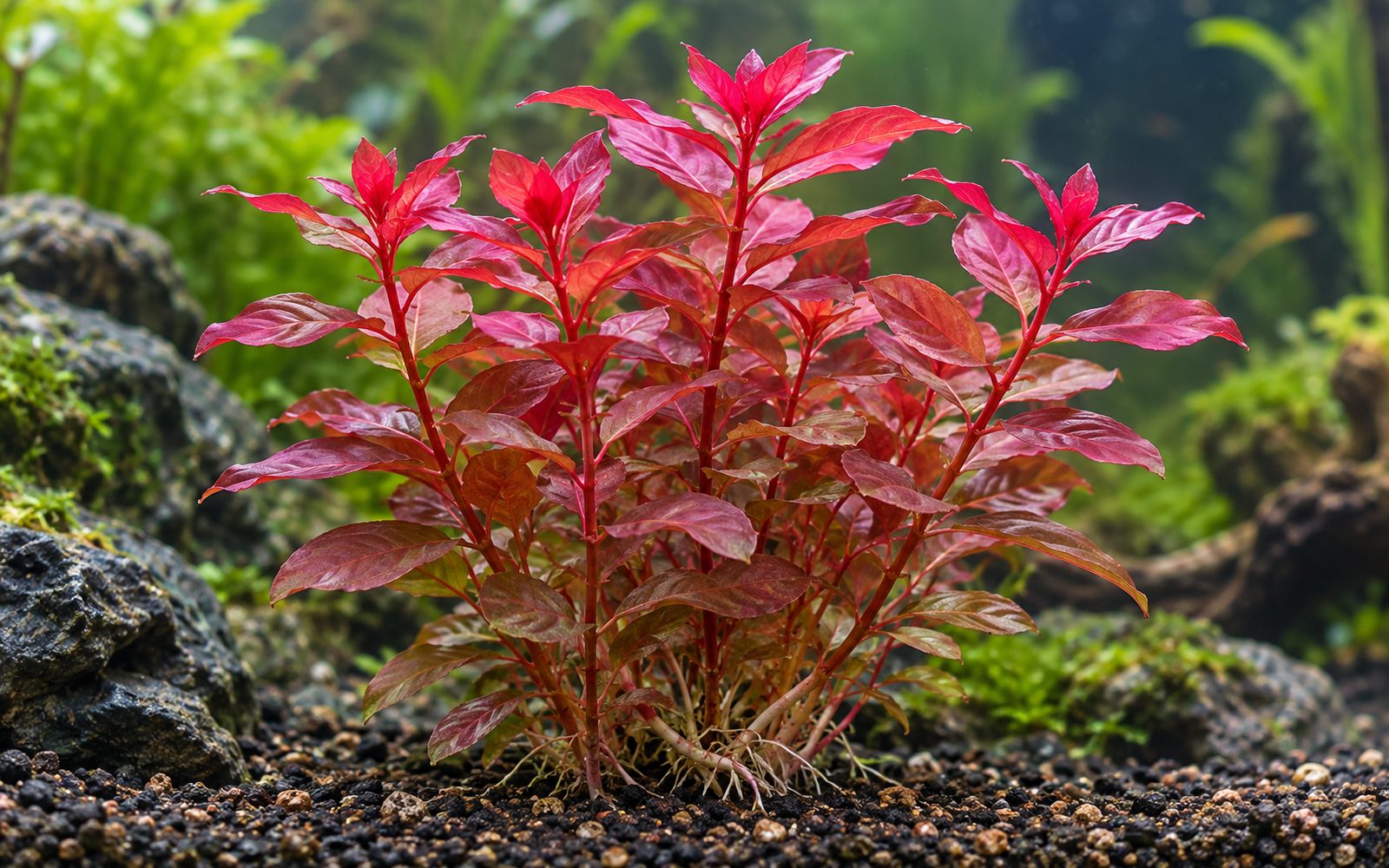
Unlike most rotalas, Rotala macrandra produces broad, oval, delicate-textured leaves. Under the right conditions the leaves turn from deep red to pink, sometimes to orangey tones, and the plant becomes the most eye-catching point in the aquarium. Narrower-leaved forms such as 'Narrow Leaf' are also sold.
The leaf texture is very delicate; it breaks easily, and contact with hands, nets and large fish damages the leaves. It is one of the difficult red plants: strong light, constant CO₂, soft water and regular iron supplementation are essential. When any of these is lacking, the leaves become smaller, curl or melt.
Planting and Placement
- Stems are planted singly or in groups of 2–3, 3–4 cm apart.
- Hold the stem at its lower part with tweezers; do not press on the leaves.
- Choose a spot that gets direct light and where the current is not strong.
- A nutrient-rich active substrate and root tabs support growth.
Care and Fertilization
- Light: High; in weak light the leaves stay greenish-brown.
- CO₂: Required.
- Water: Soft (GH 1–8), pH 5.5–7.0, temperature 22–28 °C.
- Fertilizer: Iron, potassium and micronutrients are dosed regularly. Nitrate running out completely also makes the leaves smaller; balanced fertilization is needed.
- Trimming: Cut carefully from the top; broken leaf pieces should be removed from the water.
Propagation
It is propagated by top cuttings; the cut stem also produces side shoots. Because the cuttings are quickly damaged out of water, they should be replanted without delay during trimming.
Common Problems
- Curling, stunted new leaves: Hard water, fluctuating CO₂ or nutrient deficiency.
- Melting and leaf drop: Seen after new planting or with sudden changes in water parameters.
- Fading color: Light is insufficient or iron is lacking.
- Torn leaves: Strong current, frequent handling or leaf-nibbling fish.
Hobbyist notes
Things you won't find in books, learned by trial and error. The most helpful ones are on top.
Change history and contributors
- Page created · October 16, 2026