
Water parameters
Overview
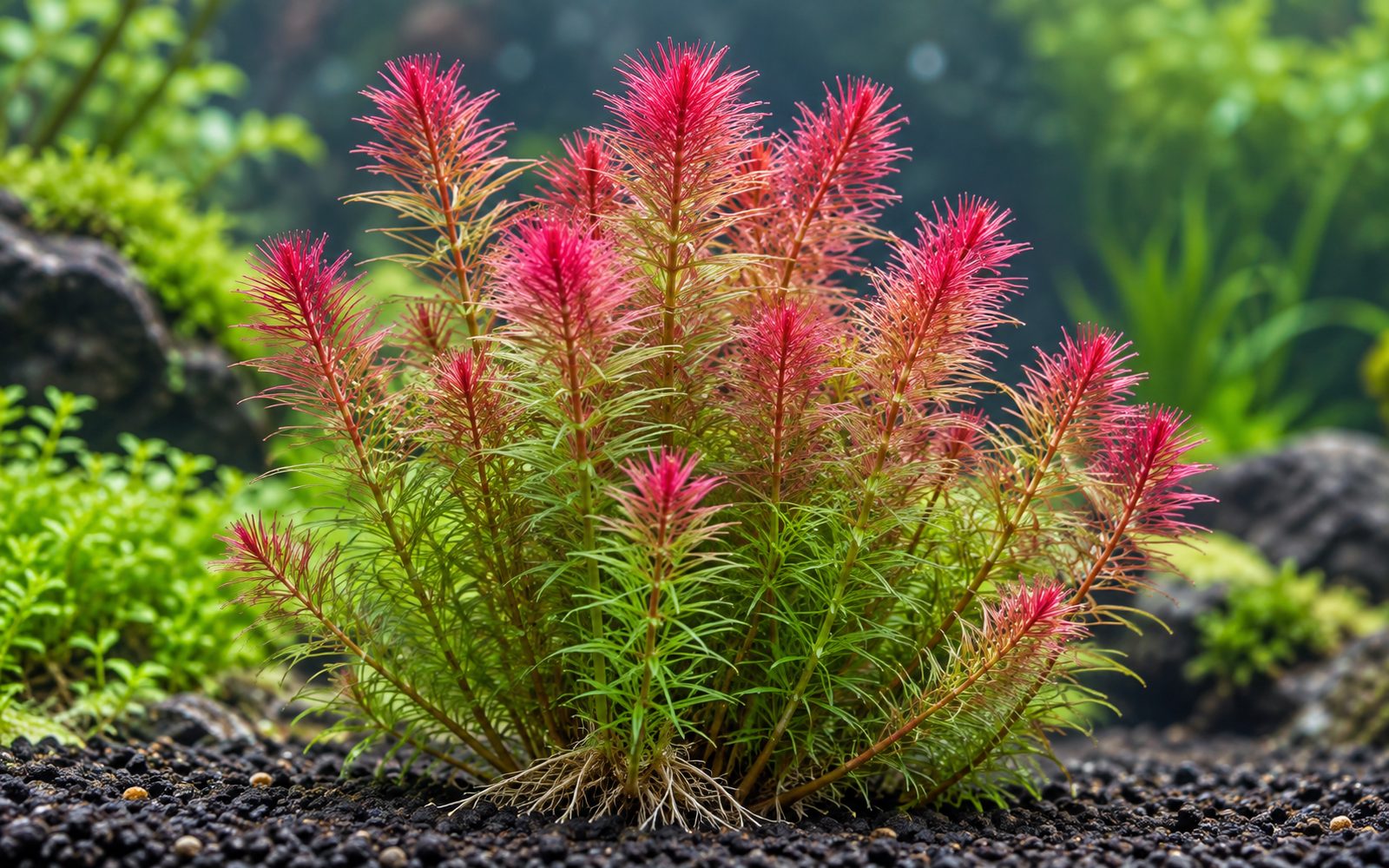
Rotala wallichii is easily told apart from other rotalas by its very thin, needle-like leaves arranged in whorls (verticils) along the stem. In strong light the shoot tips turn pink, red or wine-colored; from a distance the cluster looks like a soft, feathery brush.
Despite its beauty, it is a demanding plant. It wants soft, slightly acidic water, plenty of light, regular CO₂ and micronutrients. In hard water or in an aquarium without CO₂ it usually becomes spindly and disappears within a few weeks. For this reason it is not for beginners but suits planted aquariums with a CO₂ system.
Planting and Placement
- The stems are thin and brittle; they are buried 3–4 cm deep in small bunches of 3–5, held with tweezers.
- Leave about 3 cm between bunches so that the lower parts also get light.
- In the midground or background it creates contrast next to plainer green plants.
- Nutrient-rich active substrates that slightly acidify the water make things easier.
Care and Fertilization
- Light: High; in weak light it stays green and the stems become thin.
- CO₂: Required; without regular, balanced CO₂, growth stops.
- Water: Soft (GH 1–8) and pH 5.5–7.0.
- Fertilizer: Micronutrients, iron above all, should be dosed regularly; when lacking, the tips fade.
- Trimming: Cut from the top. A cluster that has grown too old is renewed by replanting fresh tops.
Propagation
It is propagated by top cuttings. The cut tops are replanted immediately; the main stem also produces side shoots. However, since old stems weaken over time, replanting the cluster with fresh tops every few months gives the best results.
Common Problems
- Pale, whitish tips: Iron deficiency.
- Tips curling and becoming stunted: Hard water or a CO₂ level that fluctuates during the day are the most common causes.
- Thread algae among the leaves: The fine leaves easily trap algae. Keeping the photoperiod at 7–8 hours a day and algae-eating shrimp help.
- Bare lower stems: When the cluster becomes too dense, the lower leaves get no light; frequent trimming and replanting are the solution.
Hobbyist notes
Things you won't find in books, learned by trial and error. The most helpful ones are on top.
Change history and contributors
- Page created · October 16, 2026