
Water parameters
Overview
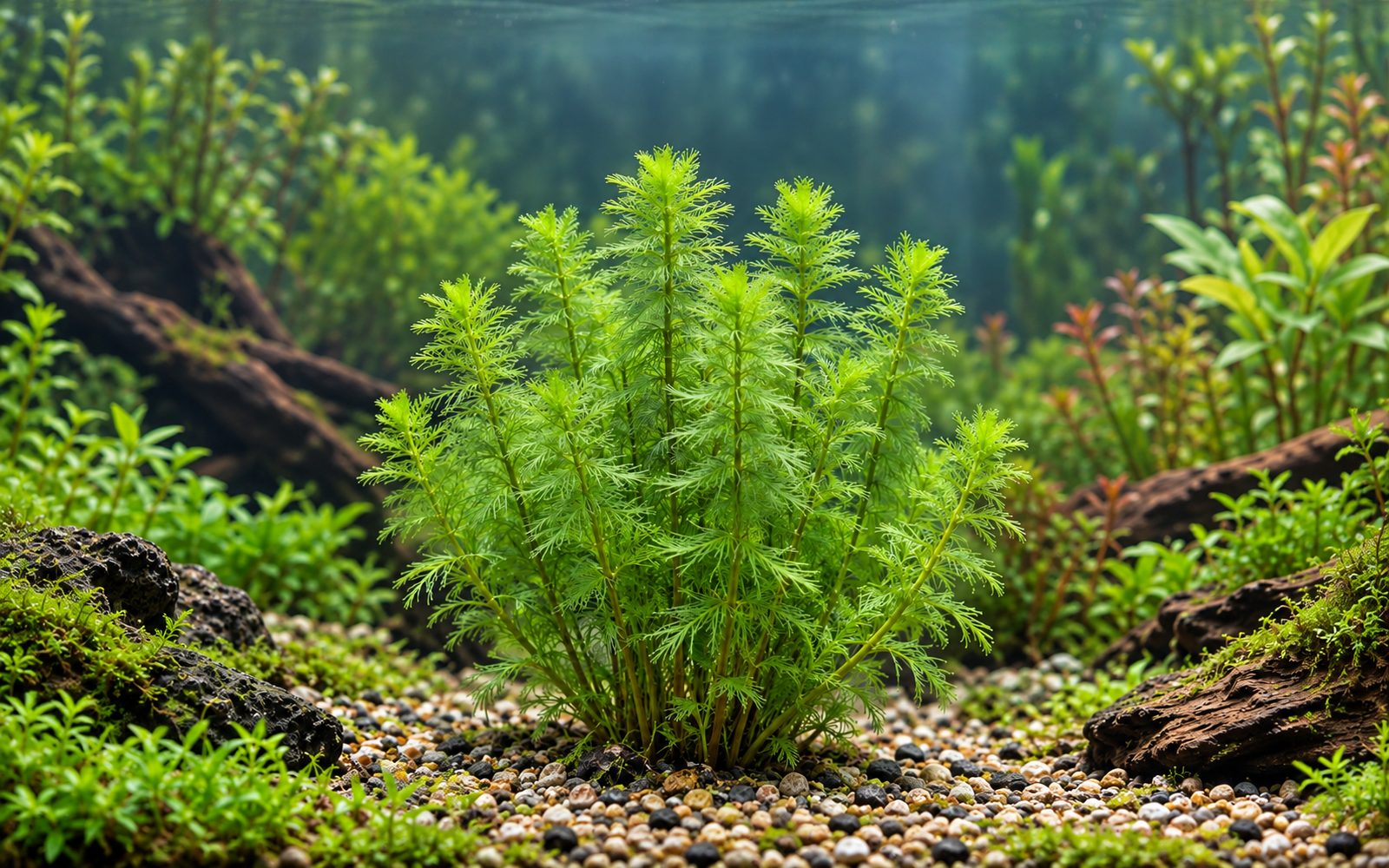
Ambulia adds a soft texture to the aquarium with its feathery, finely divided light green leaves arranged in whorls along the stem. From a distance it looks very much like cabomba; the easy way to tell them apart is the leaf arrangement: in cabomba the leaves are opposite and fan-shaped, while in ambulia each node has many fine leaves forming a whorl.
It is much less demanding than cabomba: it grows in medium light, without CO₂ and across a wide range of water parameters. Because it grows fast and uses up excess nutrients in the water, it is a good "helper" plant that competes with algae in newly set-up aquariums. Its dense leaves provide hiding places for fry and small fish.
Do not release it into the wild: In the United States, ambulia is on the list of prohibited noxious weeds as an invasive species. Trimmings and surplus plants must never be dumped into lakes, streams or canals.
Planting and Placement
- The stems are separated one by one, the leaves on the lower 2–3 nodes are removed and the stem is buried 3–4 cm deep.
- Leave about 3 cm between stems; plant in clusters in the background and corners.
- Because it grows fast, it is placed not at the front but in the back areas where trimming is easy.
Care and Fertilization
- Light: Medium; in strong light it grows denser with shorter internodes, and the tips may turn slightly bronze.
- CO₂: Not required; if added, growth speeds up noticeably.
- Fertilizer: Liquid fertilizer a few times a month is enough; when nutrients are scarce, new leaves turn pale.
- Trimming: When it reaches the surface it spreads across it and shades the plants below; trim it from the top once a week or every two weeks.
Propagation
It propagates very easily from top cuttings; every healthy cut top roots quickly. The cut lower stems also produce side shoots.
Common Problems
- Bare lower stems: Tops spreading across the surface shade the lower leaves. Trim regularly and, if needed, replant the cluster with fresh tops.
- Thin, leggy stems with long internodes: Light is insufficient.
- Debris clinging to the leaves: The fine leaves trap floating particles; filtration and regular water changes keep it looking good.
Hobbyist notes
Things you won't find in books, learned by trial and error. The most helpful ones are on top.
Change history and contributors
- Page created · October 16, 2026