
Water parameters
Temperature18–28°C
pH6–7.5
General hardness (GH)2–12 dGH
Recommended range
Overview
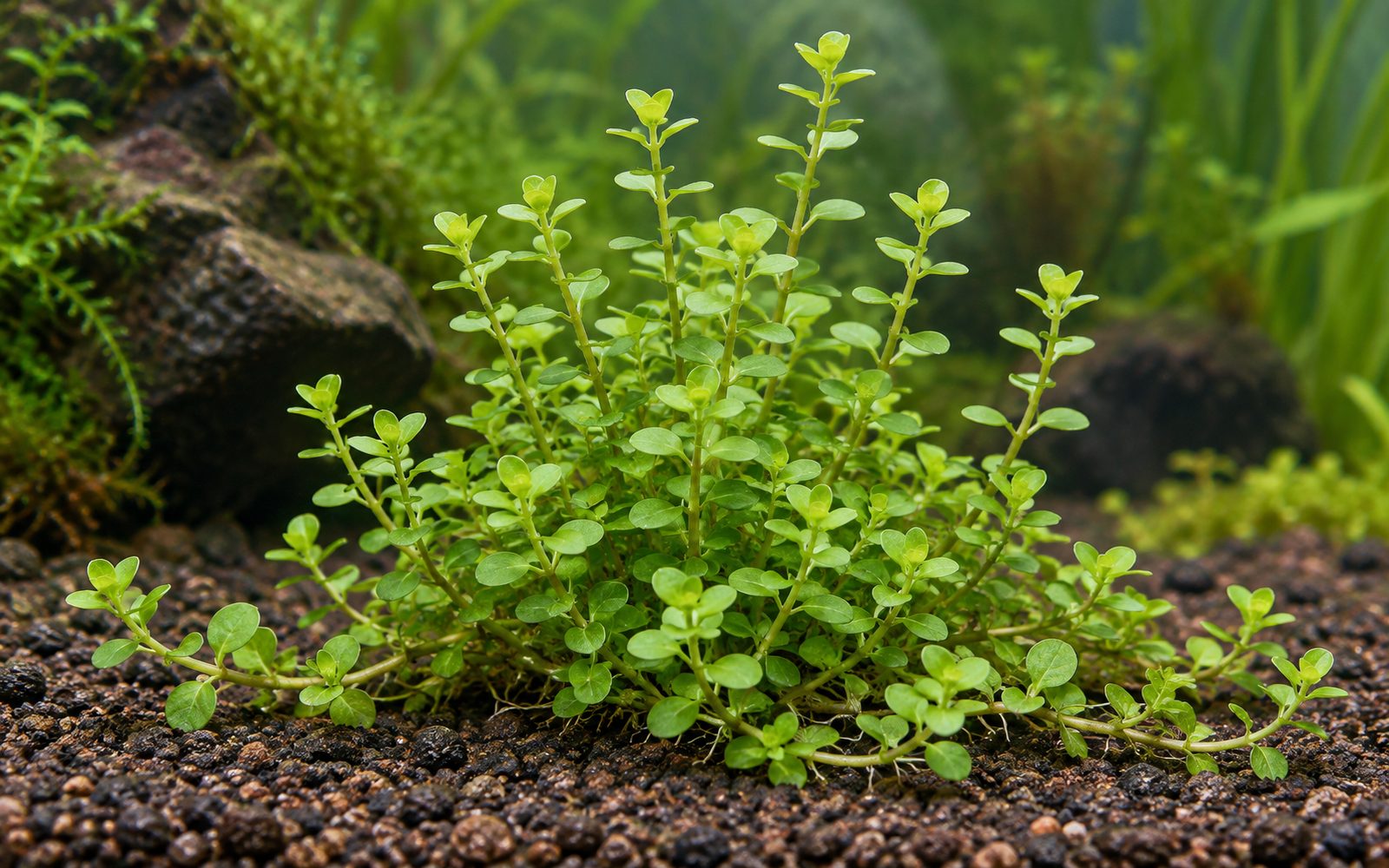
Bacopa australis is a bacopa from southeastern Australia with much smaller, rounder leaves than its relative B. caroliniana. The light green leaves are arranged in opposite pairs on thin stems. Its growth form changes with light: in medium light it grows upright and builds dense clumps in the midground; in strong light, however, the stems lie down and creep along the substrate, forming a low cover. It is an easy plant and also grows in an aquarium without CO₂.
Planting and Placement
- Stems are planted in small groups of 3–5, 2–3 cm apart and 2–3 cm deep.
- It is used in the midground, at the base of stones and wood, or in the transition zone to the foreground.
Care and Fertilization
- Light: Medium; in strong light it grows lower and more spreading.
- CO₂: Not required, but beneficial.
- Fertilizer: Regular liquid fertilizer is enough.
- Trimming: The more it is clipped from the top, the more side shoots it produces and the denser the clump becomes.
Propagation
This section has not been written yet. How is it propagated?
Be the first to write it
Common Problems
This section has not been written yet. Problems such as melting, yellowing and algae, and how to fix them.
Be the first to write it
Hobbyist notes
Things you won't find in books, learned by trial and error. The most helpful ones are on top.
No notes yet. If you have experience with this species, leave the first note.
Was this page helpful?
Change history and contributors
- Page created · October 16, 2026