
Water parameters
Overview
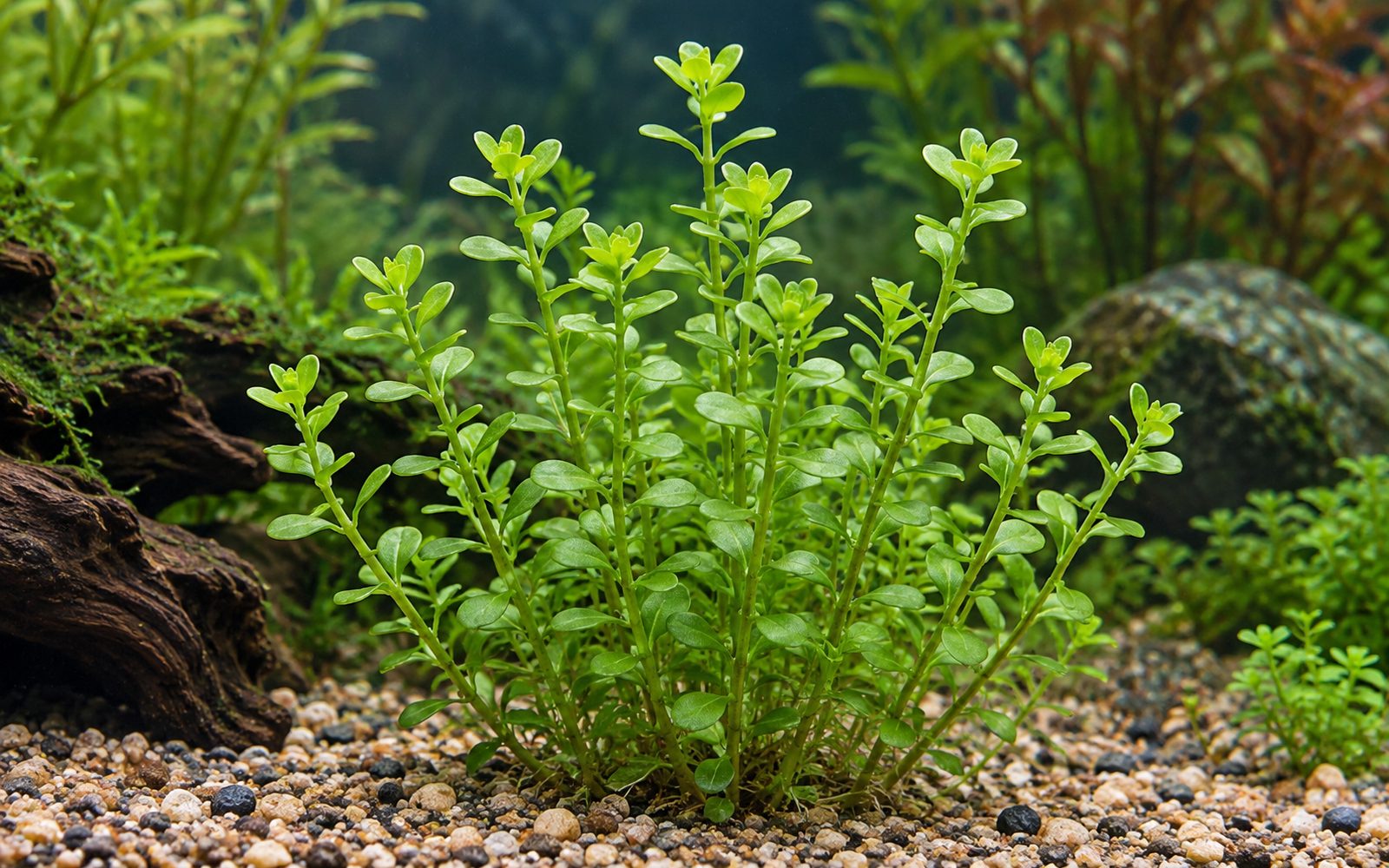
Bacopa monnieri is a marsh plant widely distributed in wetlands across the warm regions of the world. Its small, spoon-shaped, rather thick, glossy green leaves are arranged in dense pairs along the stem. It resembles Bacopa caroliniana, but its leaves are smaller, its stems thinner and it has no lemon scent.
It is one of the most adaptable stem plants in the aquarium: it grows in soft and hard water, between 20 and 30 °C, without CO₂. It is also the plant used under the name "brahmi" in traditional Indian medicine. Planted in a cluster in the midground, it forms a bright green, dense texture.
Planting and Placement
- Stems are planted in groups of 3–5, leaving 3 cm between groups.
- The lower leaf pairs are removed and the stem is buried about 3 cm deep.
- It is used in the midground or in front of tall background plants to create a step.
Care and Fertilization
- Light: Medium; in strong light the internodes shorten and the plant looks denser.
- CO₂: Not required.
- Fertilizer: Occasional liquid fertilizer is enough; root tabs support growth.
- Trimming: Cut from the top; regular trimming increases side branching and makes the cluster bushier.
Propagation
It propagates easily from top cuttings. Stems lying on the substrate root from their nodes and produce new shoots.
Common Problems
- Long, sparse internodes: Light is insufficient.
- Loss of lower leaves: Shading; thin out the cluster.
- Leaf drop during the transition from the emersed form: Normal in the first weeks; new leaves come in suited to life underwater.
- Yellowing leaves: Lack of nutrients; fertilize regularly but lightly.
Hobbyist notes
Things you won't find in books, learned by trial and error. The most helpful ones are on top.
Change history and contributors
- Page created · October 16, 2026