
Water parameters
Overview
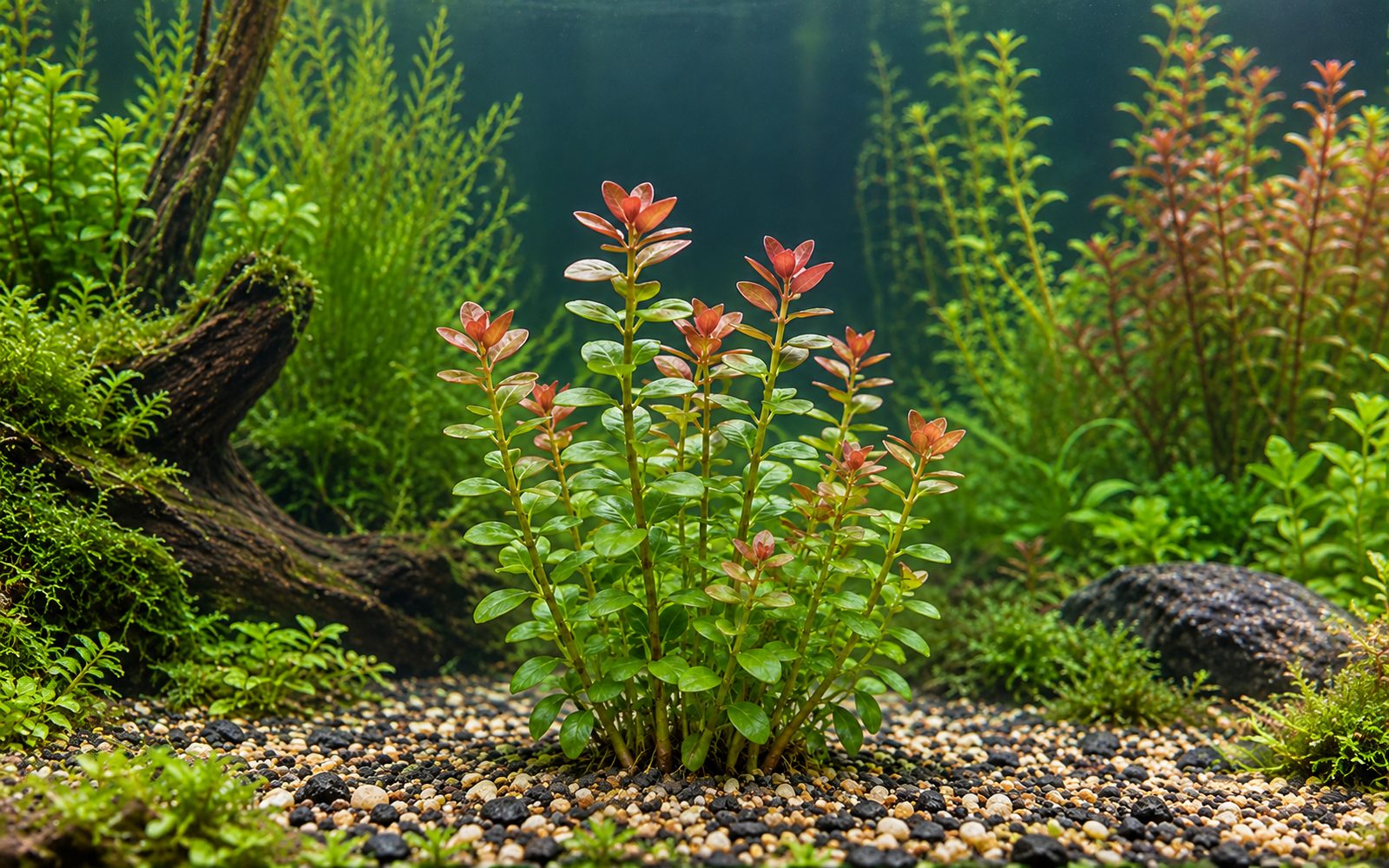
Bacopa caroliniana is a stem plant with thick, fleshy leaves that grows in the swamps of southeastern North America. The leaves are arranged in regular pairs along the stem, and when the upright stems are planted in a cluster they give a tidy, "ladder"-like look. When crushed, its leaves give off a pleasant lemon-like scent, which is where the name "lemon bacopa" comes from.
It is a hardy, slow-growing plant; it lives in medium light in an aquarium without CO₂. In medium light it stays light green, while in strong light the top leaves take on copper, pink or reddish tones. Its fleshy leaves are rarely nibbled by most fish.
Planting and Placement
- The stems are planted one by one with 2–3 cm between them; the thick stems make planting easy.
- The lower leaf pairs are removed and the stem is buried 3–4 cm deep.
- It looks natural when planted in the background or midground in clusters of 5–7 stems of different heights.
Care and Fertilization
- Light: Medium; in strong light it grows denser and more colorful.
- CO₂: Not required; CO₂ speeds up growth a little.
- Fertilizer: Root tabs and occasional liquid fertilizer are enough.
- Trimming: Because it grows slowly, it is trimmed infrequently. A cut stem branches, but if you want a neat single-stem look, it is better to cut the top and replant it.
Propagation
It is propagated by top cuttings; the cuttings root easily. The cut lower stem also produces a few side shoots.
Common Problems
- Yellowing lower leaves: Shading or lack of nutrients.
- Very slow growth: This is the nature of the species; increasing light and fertilization speeds it up a little.
- Emersed leaves dropping: Nursery stems may lose some leaves as they transition underwater; the new leaves come in adapted.
Hobbyist notes
Things you won't find in books, learned by trial and error. The most helpful ones are on top.
Change history and contributors
- Page created · October 16, 2026