
Water parameters
Temperature20–28°C
pH6–7.5
General hardness (GH)2–15 dGH
Recommended range
Overview
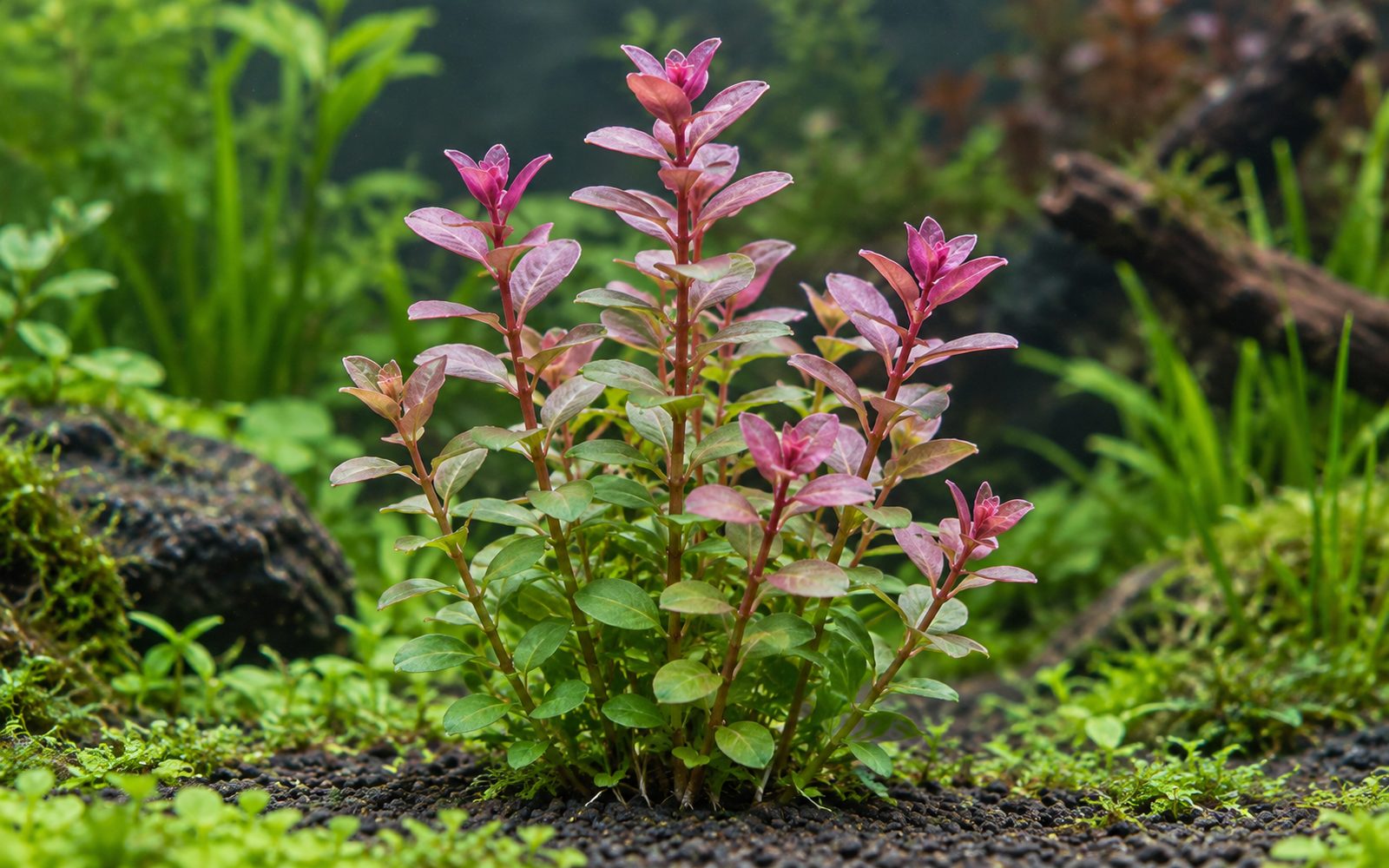
Bacopa 'Colorata' is a form that has the familiar Bacopa look, with fleshy, oval leaves arranged in opposite pairs, but shows pink and purple tones on its top leaves. Which species it belongs to is uncertain; in the trade it is often sold as Bacopa sp. or Bacopa caroliniana 'Colorata'. The stems rise straight up without branching. The color depends on light: in medium light the plant stays largely green.
Planting and Placement
- Stems are planted one by one, 2–3 cm apart, in neat rows or small groups.
- Because it grows upright, it creates a good transition in the midground behind low foreground plants.
Care and Fertilization
- Light: High light brings out the pink tones.
- CO₂: Not essential; however, in an aquarium without CO₂ the color usually stays weak.
- Fertilizer: Liquid fertilizer and root tabs; iron supports the color.
- Trimming: Because it grows slowly, it is rarely needed. The top can be cut and replanted; the remaining stem produces side shoots.
Propagation
This section has not been written yet. How is it propagated?
Be the first to write it
Common Problems
This section has not been written yet. Problems such as melting, yellowing and algae, and how to fix them.
Be the first to write it
Hobbyist notes
Things you won't find in books, learned by trial and error. The most helpful ones are on top.
No notes yet. If you have experience with this species, leave the first note.
Was this page helpful?
Change history and contributors
- Page created · October 16, 2026