
Water parameters
Overview
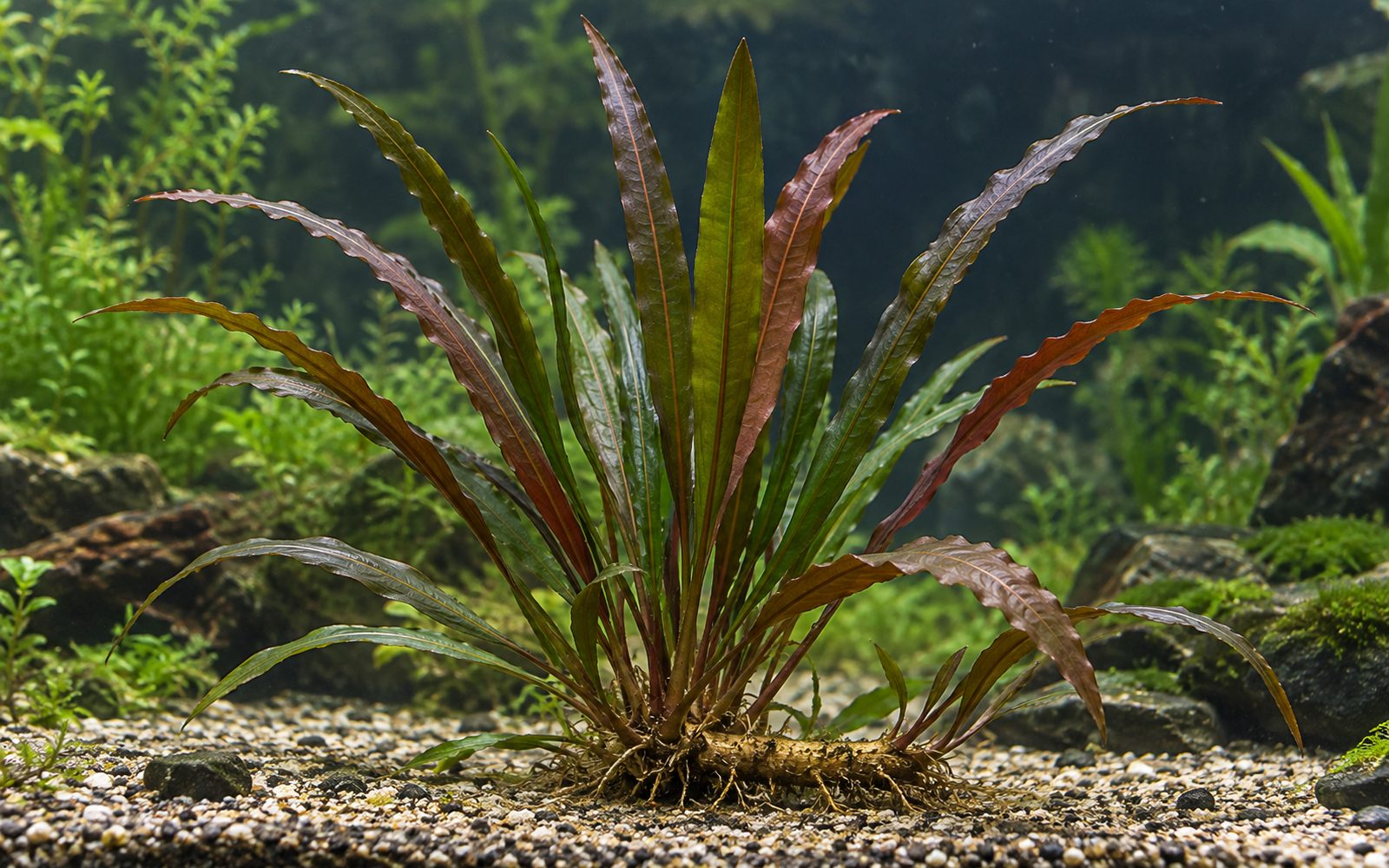
Aponogeton rigidifolius is endemic to Sri Lanka. While other members of the genus grow from a tuber or bulb, this species has a long rhizome that creeps along the substrate surface, and new leaves emerge from this rhizome. This has an important consequence: unlike many Aponogetons, it does not shed its leaves and go dormant in winter. Its leaves are 20–55 cm long but only about 2.5–4 cm wide; as its name suggests, their texture is stiff, and their color ranges from dark green to reddish brown.
Planting and Placement
The rhizome is pressed lightly onto the substrate or buried very shallowly; the roots are directed into nutrient-rich substrate. It takes time to settle in, so do not move it during this period. Because of its height, it is used in the background, in a spot with gentle flow, alone or in a small group.
Care and Fertilization
- Light: Medium; very strong light is not necessary.
- CO₂: Beneficial; together with good water movement it supports growth.
- Fertilizer: Root tabs are recommended.
- It grows slowly, but is hardy once established. As the rhizome lengthens, it can be propagated by dividing it so that each piece keeps a few leaves.
Propagation
Common Problems
Hobbyist notes
Things you won't find in books, learned by trial and error. The most helpful ones are on top.
Change history and contributors
- Page created · October 16, 2026