
Water parameters
Overview
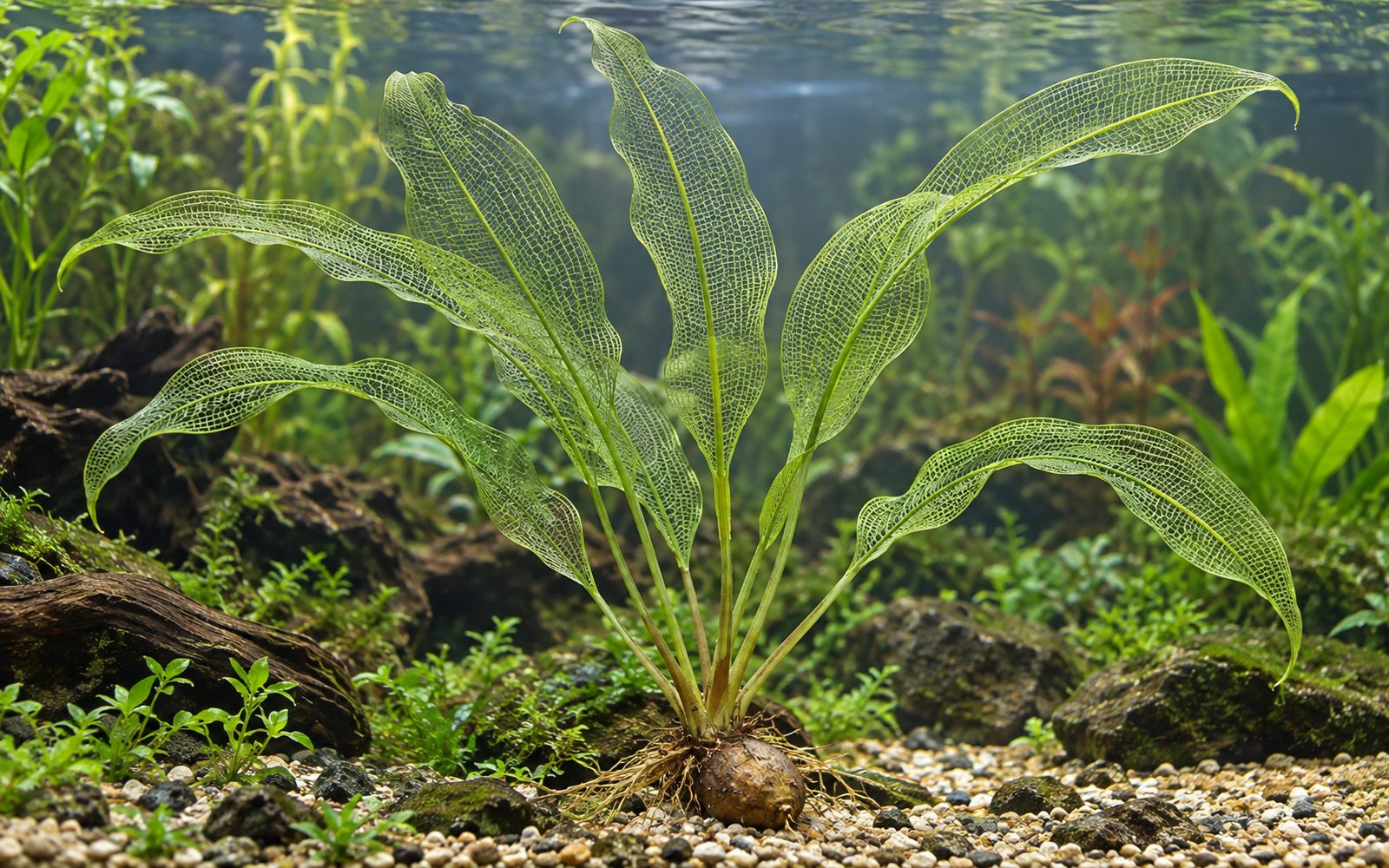
The lace plant lives in the rivers of Madagascar and is almost unique in the plant world because of the structure of its leaves. Since no tissue ever forms between the veins, the leaf blade consists only of a fine latticework; light passes right through the leaves. In the aquarium it can reach 30–50 cm in height and form a wide rosette. In the trade there are narrow- and broad-leaved forms.
It is not easy to care for: it likes clean, soft, slightly acidic water, a regular dormancy period and an algae-free environment. Under the right conditions, though, it is a striking focal plant that lives for years.
Planting and Placement
- Bury the tuber lightly so that its top stays at the surface of the substrate.
- Plant it on its own in the midground or background, leaving space around it.
- Its roots need root tabs or a nutrient-rich substrate.
Care and Fertilization
- Water: Soft (GH below 8), slightly acidic and very clean water. Weekly water changes of 25–30%.
- Temperature: Staying above 26°C for long periods weakens the plant; 22–24°C is ideal.
- Light: Medium. Strong light leads to algae building up in the lace-like leaves.
- CO₂: Beneficial.
- Flow: Gentle flow helps keep the leaves clean.
- Dormancy: After a few months of growth it may shed its leaves and go dormant. Keeping the tuber in cooler water (around 18–20°C) for 1–2 months helps it sprout again.
Propagation
Difficult in the aquarium. If the two-branched flower spike that rises above the water is pollinated, it can set seed; the seeds can germinate in the substrate. Old, large tubers can sometimes be divided, but this carries a risk of rot. Most plants sold in the trade come from tissue culture or commercial nurseries.
Common Problems
- Algae in the lace tissue: the most common problem; reduce the light, keep the water clean, and cut algae-covered leaves off at the base.
- Leaves melting and the tuber stalling: usually warm water or a skipped dormancy period.
- Soft tuber: it has rotted; remove it from the aquarium.
Hobbyist notes
Things you won't find in books, learned by trial and error. The most helpful ones are on top.
Change history and contributors
- Page created · October 16, 2026