
Water parameters
Overview
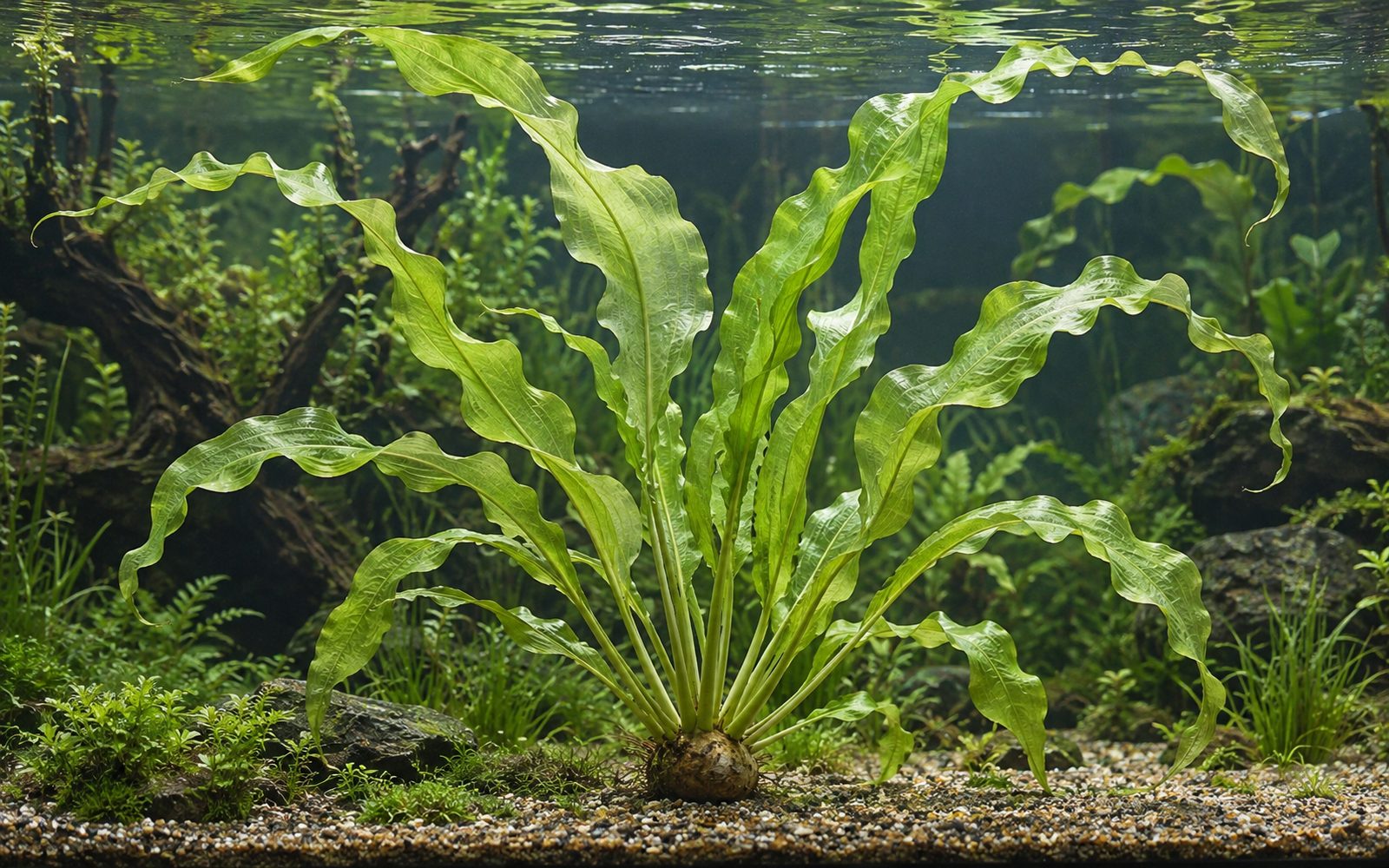
Aponogeton ulvaceus is a large plant from the rivers of Madagascar that grows from a tuber. Its leaves are broad, thin, translucent and light green; their edges are wavy and they twist slightly along their length. When light passes through the leaves, it creates a soft look reminiscent of sea lettuce (Ulva) in the water; the species name comes from this.
A single plant reaches 40–60 cm in height and a similar width. That is why it is considered a focal plant for aquariums of at least 150 liters and 50 cm in height.
Planting and Placement
- Bury the tuber lightly so that its top stays at the surface of the substrate.
- Leave at least 30 cm of open space around it.
- Place a root tab next to the roots; in the first weeks it grows on the nutrients stored in the tuber.
Care and Fertilization
- Light: Medium.
- CO₂: Not required; with it the leaves are larger and more numerous.
- Fertilizer: A root tab once a month; with iron deficiency new leaves turn pale.
- Dormancy: After a few months of growth it may stop producing leaves and shed them. This is a natural period; leave the tuber in place, or take it out and keep it for a few weeks in a cool (20–22°C) aquarium.
Propagation
The flower stalk rises above the water and forms a two-branched spike. If the flowers are pollinated (hand-pollinating with a soft brush helps), seeds form; seeds that fall into the water can germinate in the substrate. It does not multiply by plantlets in the aquarium; new plants are usually obtained from seed or by buying a new tuber.
Common Problems
- Tuber not sprouting after dormancy: check the tuber; if it is firm and sound, wait; if it is soft and smelly, it has rotted.
- Small, pale leaves: nutrient deficiency; replace the root tabs.
- Shading neighboring plants: cut old leaves in the outer ring off at the base.
Hobbyist notes
Things you won't find in books, learned by trial and error. The most helpful ones are on top.
Change history and contributors
- Page created · October 16, 2026