
Water parameters
Overview
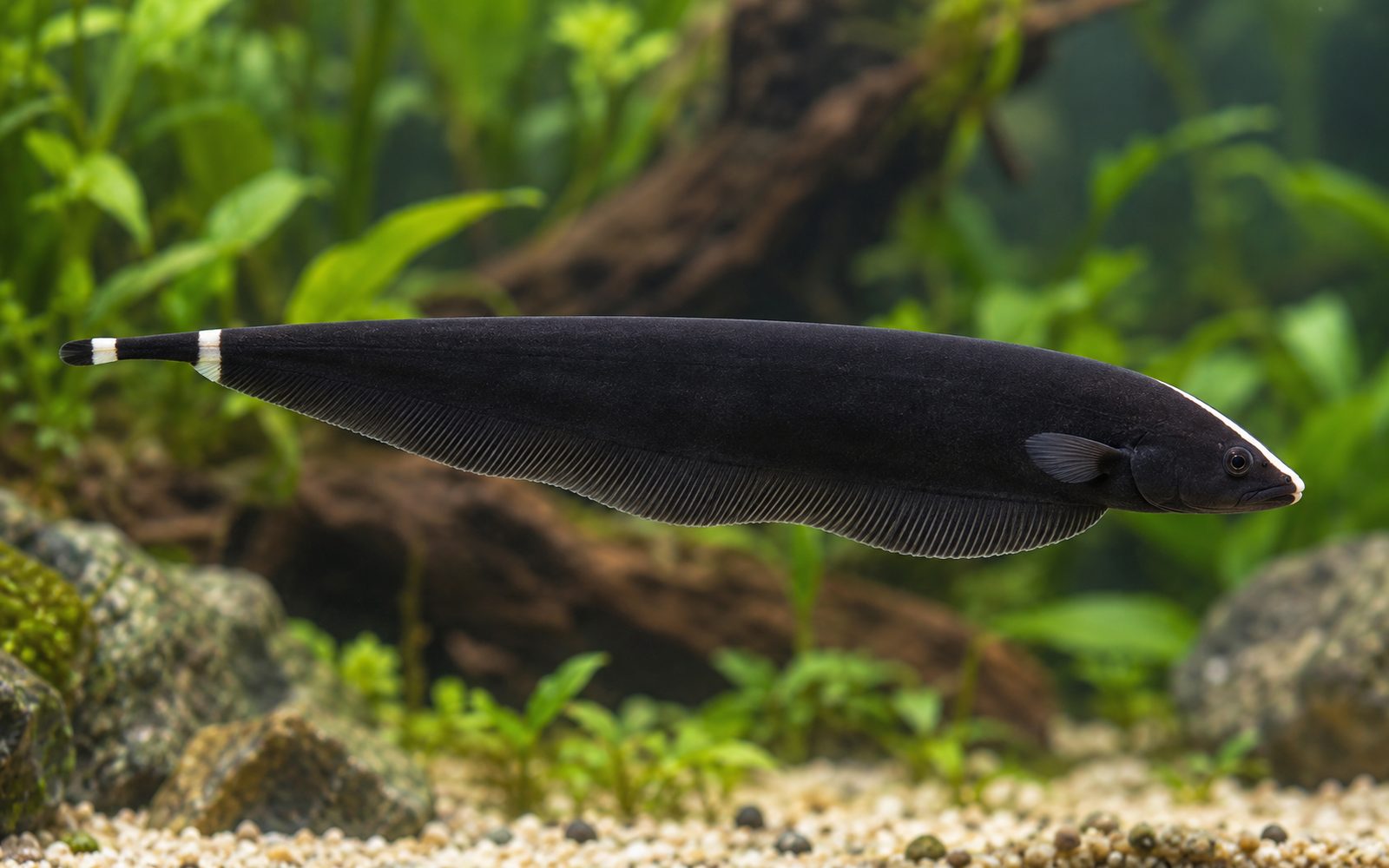
The black ghost is a South American fish with no dorsal fin and a long body shaped like a knife blade. With the wavy fin running along its belly, it glides forward and backward with equal ease. Its velvet-black body, the thin white stripe running from its snout to its forehead and the two white rings on its tail base are its most distinctive features.
It produces a weak electric field with an organ in its tail and, by sensing changes in this field, finds its way and searches for prey in the dark. It is harmless to humans. It is sold at 10 cm in stores but reaches 40–45 cm as an adult and is a nocturnal predator.
Natural Habitat
It lives in the large rivers of South America, in flowing, root-filled stretches with sand bottoms. During the day it hides among roots and in hollows, and at night it hunts insect larvae and small creatures.
Tank Setup
- Volume: at least 400 liters and 150 cm length for an adult.
- Hiding tube: always provide a hiding place; a glass or plastic tube its body fits into is best. A fish that cannot hide becomes stressed and stops eating.
- Light and substrate: dim light, floating plants; a fine sand substrate.
- Water: very clean and well-oxygenated; moderate flow. It is sensitive to ammonia and nitrite and should go into a mature aquarium.
Diet
Carnivorous. Frozen bloodworms, brine shrimp, mysis, worms and small shrimp. It is best fed after the lights go out. Over time it also accepts sinking tablets and granules.
Behavior and Compatibility
Usually calm toward other species, but it hunts small fish and shrimp that fit in its mouth at night. It is very territorial toward its own kind and similar knifefish.
Good companions: calm, medium to large species too big for its mouth: angelfish, gourami species, large tetras, calm cichlids, large Corydoras and plecos.
Avoid: neons and similar small fish, shrimp, fin-nipping species, a second ghost knifefish.
Group and Colony Structure
In a home aquarium a single fish is kept. More than one can only be tried in very large aquariums offering each individual its own hiding place.
Breeding
Breeding in a home aquarium is very rare. Some of the fish in the trade are bred on farms in Southeast Asia.
Health and Common Problems
- White spot: it catches it often because of its finely scaled skin; for treatment, halving the medication dose and supporting it with temperature is recommended.
- Medication sensitivity: sensitive to copper and many medications.
- Loss of appetite: usually caused by a lack of hiding places or poor water.
Sexing
There is no reliable external way to tell the sexes apart.
Tank mates
This list is calculated automatically from the species profile and grows as new species are added to the catalog. Try it in the planner for a definite answer.
Usually compatible
 Banded Jewel Cichlid
 Chocolate Cichlid
 Pearl Cichlid
 Threadfin Acara
 Redhead Cichlid
 Cryptocoryne Parva
Adonis Pleco
African Brown Knifefish
Cryptocoryne Parva
Adonis Pleco
African Brown Knifefish
 Weeping Moss
 Flame Moss
Should not be kept together









Hobbyist notes
Things you won't find in books, learned by trial and error. The most helpful ones are on top.
Change history and contributors
- Page created · October 16, 2026