
Water parameters
Overview
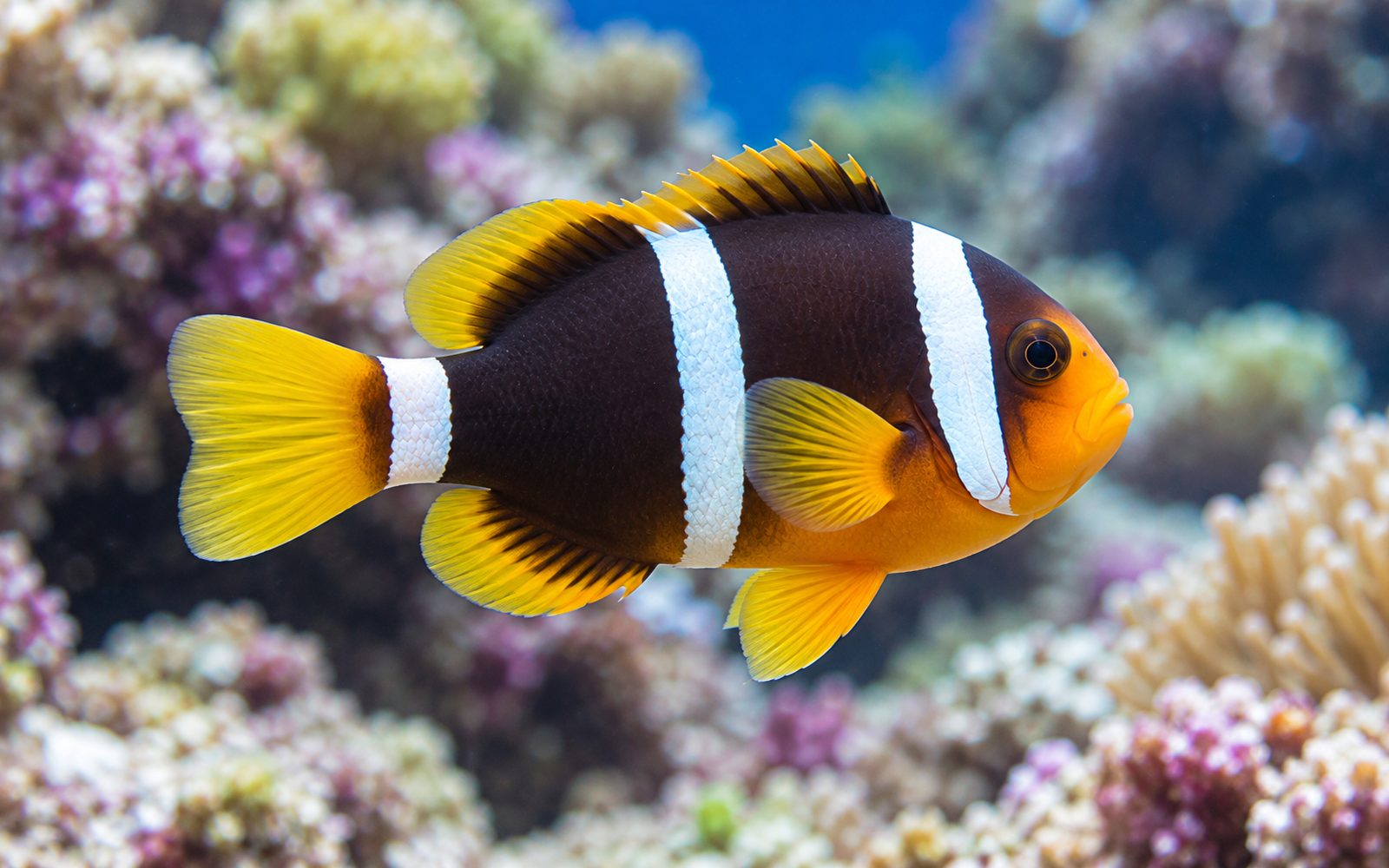
The clarkii clownfish is the most widespread clownfish and the most flexible in its choice of host: it is the only clownfish that can live in partnership with all ten host anemone species known in the wild. Its color varies with region and age; the sides of the body darken from brown to almost black, while the snout, chest and fins stay orange-yellow. The last of its three white bands is on the caudal peduncle; the tail fin is usually yellow or whitish.
It is larger than the ocellaris (up to 12 cm), bolder and hardier. Captive-bred fish are easy to find; choose them over wild-caught individuals. It is a saltwater fish.
Natural Habitat
It lives over a wide range from the Persian Gulf to the Western Pacific, from shallow lagoons to outer reef slopes. Because it is not picky about its host, it is seen in very different anemones such as Entacmaea quadricolor, Heteractis crispa and Stichodactyla haddoni. The anemone protects the pair and their young from predators; the fish in turn cleans the anemone, chases away fish that try to eat it and feeds it with leftover food.
Tank Setup
- Volume: at least 110 liters for a pair.
- Water: salinity 1.023–1.026 specific gravity, pH 8.1–8.4, temperature 24–27°C. Ammonia and nitrite must be zero and nitrate low.
- Reef compatibility: reef safe; it does not touch corals, shrimp or snails.
- Anemone: not essential. The host it most readily accepts in the aquarium is the bubble-tip anemone (Entacmaea quadricolor), which is relatively easy to care for. The anemone should be added after the aquarium has matured for a few months.
- Layout: leave caves and corners in the rockwork; the pair will choose one of them as its base.
Diet
Omnivorous and greedy. Make marine fish granules and flakes the staple; vary the diet with frozen mysis, brine shrimp, copepods and finely chopped seafood. Add foods containing algae as well. Twice a day, as much as is eaten within a few minutes.
Behavior and Compatibility
Noticeably more territorial than other clownfish. The female in particular chases fish that approach her home, and the keeper's hand. It may harass much smaller, shy fish, so it should not be kept with sensitive species in a small tank.
Good companions: medium-sized reef fish that can defend themselves: tangs, dwarf angelfish, royal gramma, large gobies, cleaner shrimp.
Avoid: other clownfish species, predators such as lionfish, very shy small species such as firefish (in a small tank).
Group and Colony Structure
Keep a single pair in the aquarium. In the wild, several small non-breeding individuals may live alongside the pair in a large anemone; in the aquarium, however, a third fish is usually chased constantly. Different clownfish species are not kept in the same aquarium.
To form a pair, buy two juveniles or two fish of different sizes; the larger one turns into the female. Putting two adult females of the same size together leads to serious fighting.
Breeding
Clownfish are born male; the dominant, larger fish of the pair turns into the female. The clarkii is one of the species that spawn readily in the aquarium: the pair lays hundreds of orange eggs on a flat surface at the base of the anemone or a rock, and the male fans and guards the eggs. The eggs hatch in 7–10 days. The larvae are planktonic; they need rotifers in the first days and then newly hatched brine shrimp. They can be raised in a separate rearing setup.
Health and Common Problems
- Brooklynella and Uronema: more common in wild fish; excess mucus, peeling skin, rapid breathing.
- Velvet and marine ich: quarantine new fish for 3–4 weeks.
- Captive-bred fish are usually very hardy.
Sexing
The larger fish of the pair is the female. All juveniles are male; there is no other reliable external difference.
Tank mates
This list is calculated automatically from the species profile and grows as new species are added to the catalog. Try it in the planner for a definite answer.
Should not be kept together


Hobbyist notes
Things you won't find in books, learned by trial and error. The most helpful ones are on top.
Change history and contributors
- Page created · October 16, 2026