
Water parameters
Overview
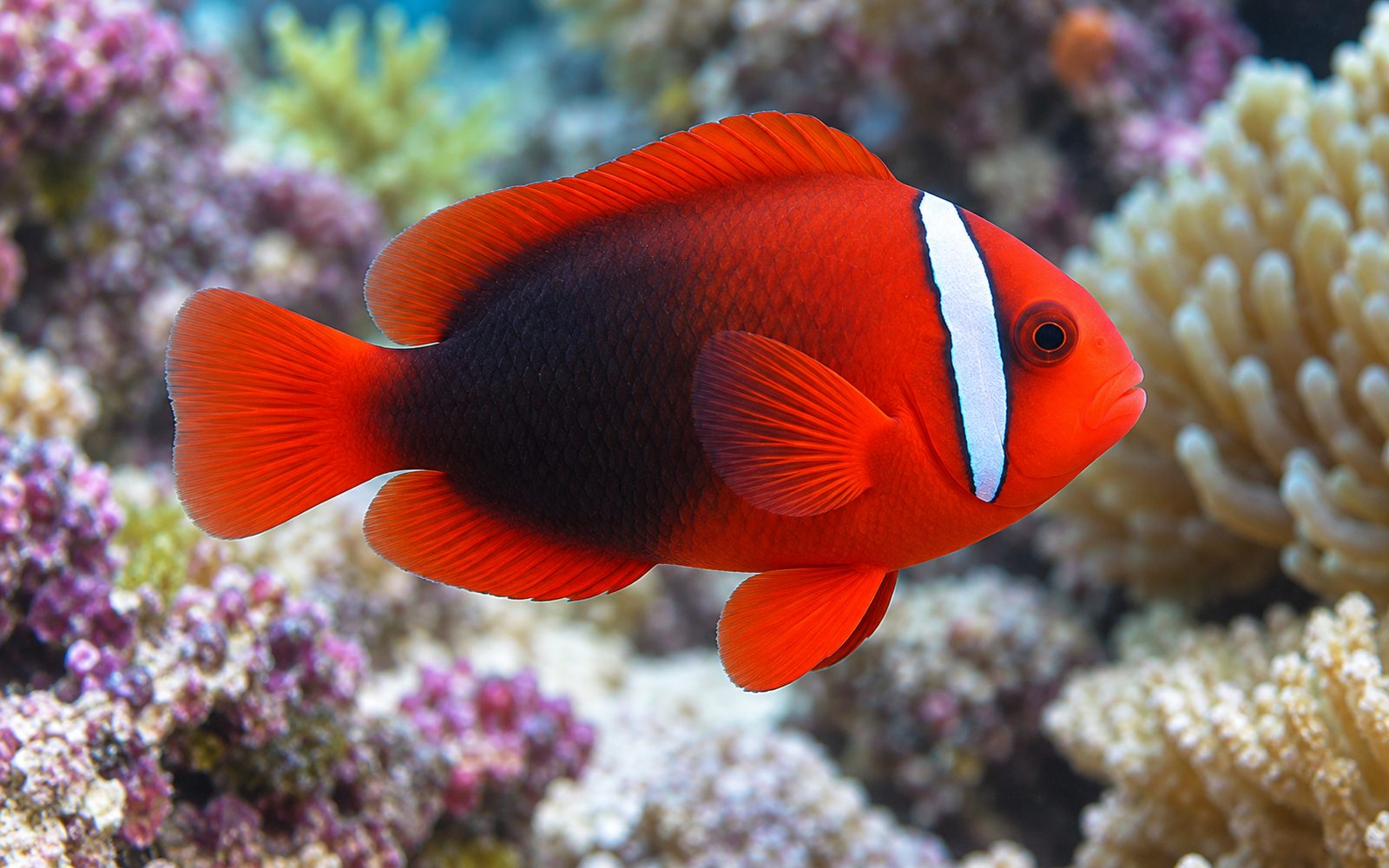
The tomato clownfish owes its name to its bright red color. It carries a single black-edged white band just behind the eye; juveniles may have a second band in the middle of the body, which disappears as they grow. The flanks of adult females darken to red-black. The red pelvic and anal fins set it apart from the cinnamon clownfish (melanopus), whose fins are black.
It is a hardy, greedy species; captive-bred fish are widely available and should be preferred over wild individuals. It is one of the more strongly territorial clownfish and may become cranky as it grows. It is a saltwater fish.
Natural Habitat
It lives in shallow lagoons and on reefs of the Western Pacific, mostly with the bubble-tip anemone (Entacmaea quadricolor). In the wild this anemone often forms dense clusters, and a clownfish pair claims part of the cluster. The anemone protects the fish; the fish in turn cleans the anemone and chases away fish that try to eat it.
Tank Setup
- Volume: at least 110 liters for a pair.
- Water: salinity 1.023–1.026 specific gravity, pH 8.1–8.4, temperature 24–27°C; zero ammonia and nitrite, low nitrate.
- Reef compatibility: reef safe; it does not touch corals or invertebrates.
- Anemone: not essential, but its natural host, the bubble-tip anemone, is the easiest anemone to keep in the aquarium, and the pair often claims it quickly. Because the anemone may move around, cover pump intakes with sponges; keep in mind that the anemone can touch and sting corals.
- Cycling: the fish is added to a fully cycled aquarium, the anemone to a mature aquarium a few months old.
Diet
Omnivorous and very eager to eat. Make marine fish granules and flakes the staple; vary the diet with frozen mysis, brine shrimp, copepods and chopped seafood. Feed small amounts twice a day. The pair may carry large pieces of food to the anemone.
Behavior and Compatibility
The pair is quite territorial around its home; the large female in particular tries to bite approaching fish and the keeper's hand. In a sufficient volume it lives without problems with fish that can defend themselves.
Good companions: tangs, dwarf angelfish, large gobies, blennies, cardinalfish, cleaner shrimp.
Avoid: other clownfish species, the domino damsel, which may want the same home, predators and, in a small tank, very shy species.
Group and Colony Structure
Keep a single pair in the aquarium. In the wild, small non-breeding individuals may live alongside the pair in large anemone clusters; in the aquarium, however, a third fish is usually chased. It is not kept with other clownfish species.
To form a pair, buy two juveniles or two fish of different sizes; the larger one turns into the female and the smaller one stays male.
Breeding
Clownfish are born male, and the larger fish of the pair turns into the female. The tomato clownfish spawns frequently in the aquarium: the pair cleans a rock surface at the base of the anemone and lays hundreds of orange eggs. The male fans and guards the eggs; they hatch in 7–10 days. The larvae are planktonic; they can be raised in a separate container on rotifers and newly hatched brine shrimp.
Health and Common Problems
- Brooklynella: especially in wild fish; excess mucus and rapid breathing.
- Velvet and marine ich: quarantine new arrivals for 3–4 weeks.
- Captive-bred fish are noticeably more resistant to these diseases.
Sexing
The female is clearly larger and darker in color; the male stays small and brighter red. All juveniles are male.
Tank mates
This list is calculated automatically from the species profile and grows as new species are added to the catalog. Try it in the planner for a definite answer.
Should not be kept together


Hobbyist notes
Things you won't find in books, learned by trial and error. The most helpful ones are on top.
Change history and contributors
- Page created · October 16, 2026