
Water parameters
Overview
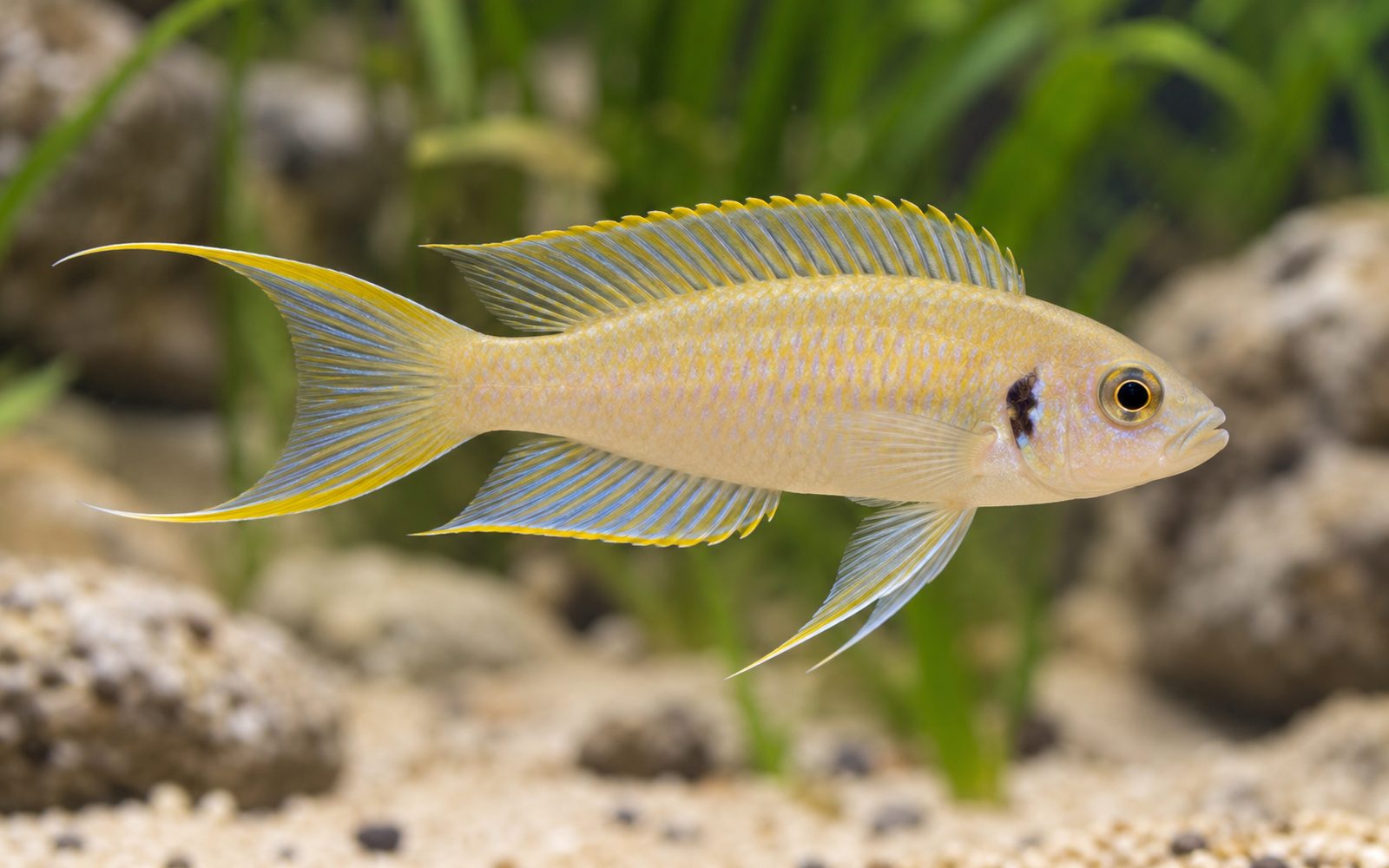
The daffodil cichlid is one of the similar-looking Tanganyika species known, together with the Princess of Burundi (Neolamprologus brichardi), as the "princess group." Its body ranges from pale yellow to cream; the fin edges are in yellow and light blue tones. The upper and lower tips of the tail lengthen with age, giving it a lyre shape. In the trade it is almost always found as the yellowish local form called "Daffodil."
The species is the most studied example of cooperative breeding in cichlids (young from earlier generations helping to care for new fry). Some studies regard it as the same species as the Princess of Burundi; in the hobby the two names are kept separate and the two fish are not mixed in the same aquarium.
Natural Habitat
It lives in large communities along the lake's rocky shores, among rock piles and crevices. Each family defends its own rock crevice; families lined up side by side form colonies of hundreds of individuals. The water there is hard, alkaline and rich in zooplankton.
Tank Setup
- Volume: 100 liters for a pair and their fry; 200 liters or more for a growing colony or with other species.
- Rockwork: many caves and crevices; the colony establishes its territory among the rocks. Leave open water at the front.
- Water: hard and alkaline (pH 8–9); a 25% water change every week. Stability matters more than the target value.
- Substrate: fine sand; they dig under caves to enlarge them.
Diet
In the wild it feeds on drifting zooplankton and small invertebrates. A quality small granule or flake food should be the staple; vary it with frozen mysis, brine shrimp and cyclops. Small food particles ensure the colony's fry get fed too.
Behavior and Compatibility
Extremely harmonious within the family, but it defends collectively against other fish approaching its territory. As the colony grows, it claims an ever larger part of the aquarium.
Good companions: Tanganyika species that can hold their own territory, such as Cyprichromis, Julidochromis, Altolamprologus and Synodontis; with enough rock and space.
Avoid: community fish and small fish (it becomes aggressive while guarding its fry and hunts small ones), shrimp, the Princess of Burundi in the same aquarium, aggressive Malawi mbuna.
Group and Colony Structure
The daffodil is a typical family colony species:
- Start with a pair. 5–6 juveniles are grown up together; the pair that forms stays and the rest are removed.
- The pair spawns at regular intervals and fry from earlier generations stay in the aquarium. Older siblings clean the eggs and guard the nest and the little ones.
- When the colony becomes crowded, the largest juveniles are removed.
- Adults from outside are not added to an established colony; a stranger is targeted by the family.
- Two separate colonies can live side by side only in a setup of 200 liters or more divided by rocks.
Breeding
Dozens of eggs are laid on the ceiling or wall inside a cave. The eggs hatch in 2–3 days and the fry become free-swimming a few days later. The parents and older siblings protect the fry. The fry grow on newly hatched brine shrimp, cyclops and crushed food.
Health and Common Problems
- Bloat: seen with overly high-protein food and poor water quality; loss of appetite is the first sign.
- Falling pH: stress and susceptibility to disease in soft water. KH should be kept high.
- Generally hardy; most problems come from incorrect water parameters and territorial fights.
Sexing
Difficult to tell apart from the outside. Mature males are usually slightly larger and have longer fin extensions, especially the lyre tips of the tail. A definite distinction is made by looking at the genital papilla during spawning.
Tank mates
This list is calculated automatically from the species profile and grows as new species are added to the catalog. Try it in the planner for a definite answer.
Usually compatible
 Yellow Regal Peacock
 Egyptian Mouthbrooder
 Yellow Tail Acei
 Butterfly Goodeid
Anatolian Killifish
Eastern Happy
Red Shoulder Peacock
Butterfly Goodeid
Anatolian Killifish
Eastern Happy
Red Shoulder Peacock
 Fairy Cichlid
Blue Orchid Peacock
Sulphur Head Peacock
Fairy Cichlid
Blue Orchid Peacock
Sulphur Head Peacock
Should not be kept together





Hobbyist notes
Things you won't find in books, learned by trial and error. The most helpful ones are on top.
Change history and contributors
- Page created · October 16, 2026