
Water parameters
Overview
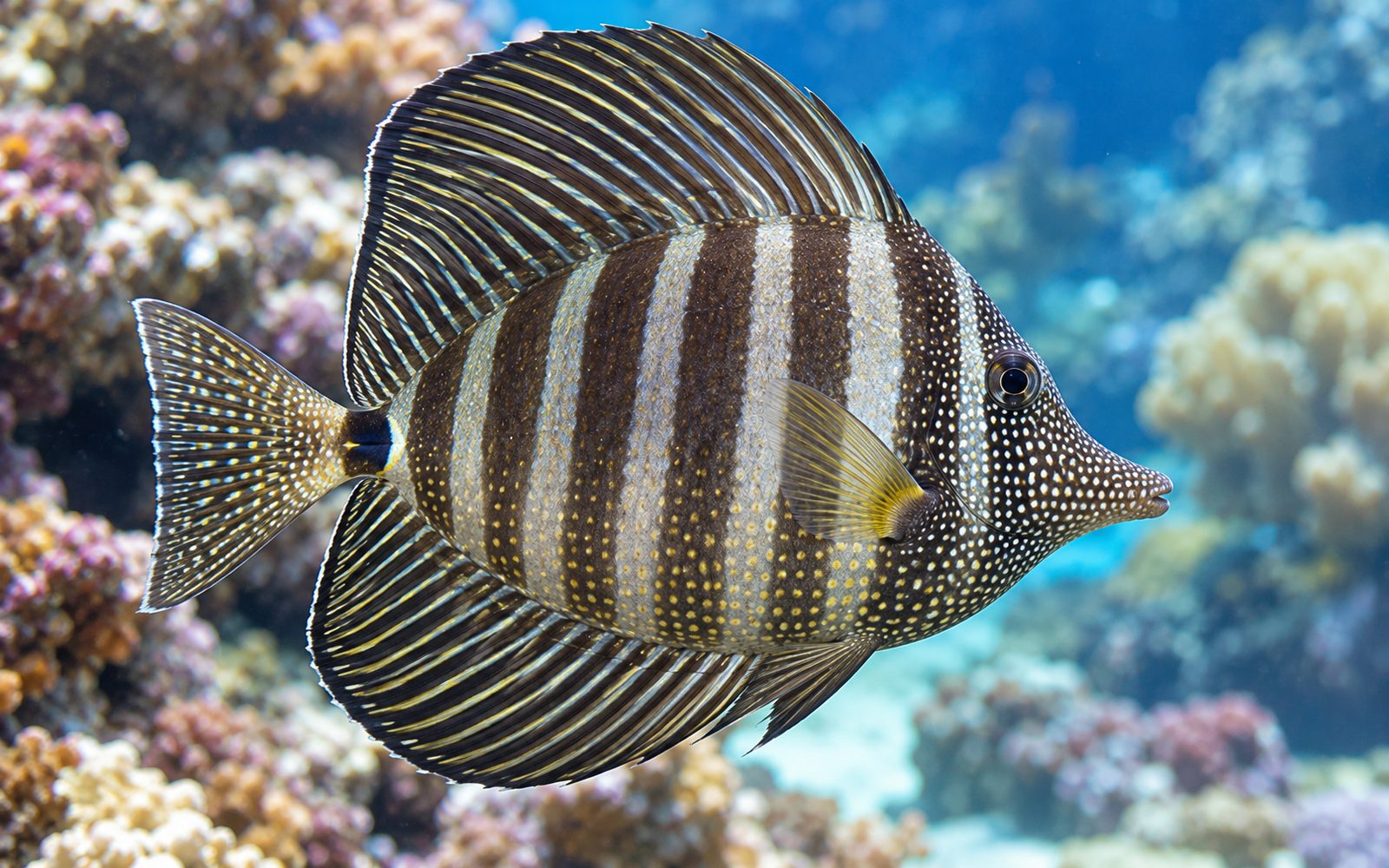
The Desjardini tang is one of the "sailfin" tangs, reaching almost twice its body height when it spreads its fins. Its body has dark and light vertical bands, and its head and lower body are covered with small light-colored spots. It is confused with its very similar Pacific relative Zebrasoma veliferum; desjardinii lives in the Red Sea and the Indian Ocean and has more distinct spots on its head. It is a hardy tang that takes food quickly, but it reaches 40 cm.
Tank Setup
- At least 1000 liters and 200 cm in length for an adult.
- Salinity specific gravity 1.023–1.026, pH 8.1–8.4, temperature 24–27°C; strong flow and high oxygen.
- Reef-safe; it leaves corals and invertebrates alone.
- It is prone to marine white spot; a 4–6 week quarantine is recommended.
Diet
Herbivorous. Offer dried seaweed (nori) and foods containing seaweed every day, supplemented with frozen mysis and brine shrimp. It should be fed 2–3 times a day.
Behavior and Compatibility
Usually calm and composed; it becomes cantankerous towards its own species, other Zebrasoma and similarly shaped tangs. When it feels threatened, it spreads its fins to the full to look larger.
Good companions: In a very large aquarium, tangs from a different genus, large angelfish, Heniochus, foxface, anthias, wrasses.
Avoid: Yellow, purple or other Zebrasoma tangs; small aquariums.
A short profile for this species
The Desjardini Tang page has the basics, but the sections below have not been written yet. If you keep this species, write a section from your own experience; it will be published under your name after editor approval.
Tank mates
This list is calculated automatically from the species profile and grows as new species are added to the catalog. Try it in the planner for a definite answer.
Hobbyist notes
Things you won't find in books, learned by trial and error. The most helpful ones are on top.
Change history and contributors
- Page created · October 16, 2026