
Water parameters
Overview
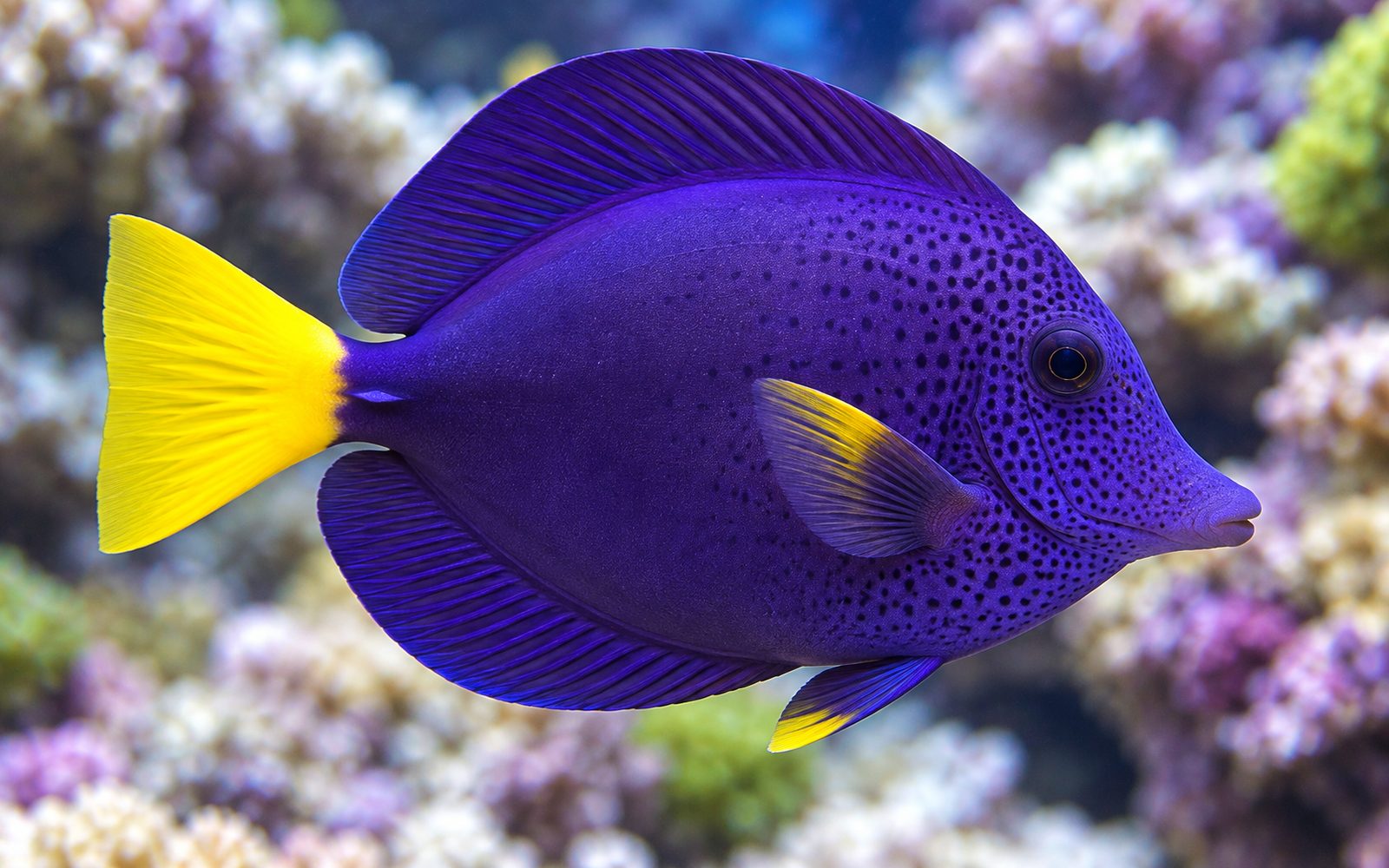
The purple tang is the Red Sea's close relative of the yellow tang. Its body ranges from dark purple to navy; it has fine black dots on the head and the front of the body, a bright yellow tail and yellow-tipped pectoral fins. The scalpel spine on the caudal peduncle is sharp; be careful when handling it.
Individuals in the trade are collected from the wild. Because fish from the Red Sea make a long journey in shipping, they may not take food in the first days; do not buy one without seeing it eat in the store.
Natural Habitat
It lives on shallow coral reefs of the Red Sea and the Arabian Sea, singly or in small groups. It grazes fine algae on the rocks.
Tank Setup
- Volume: at least 500 liters and 150 cm in length; a long, open swimming area is essential.
- Water: salinity 1.023–1.026 specific gravity, pH 8.1–8.4, temperature 24–27°C. High oxygen, strong flow and low nitrate.
- Decor: mature live rock and crevices for shelter; the algae on the rock become a natural grazing ground.
- Maintenance: a 10% water change weekly or 20% every two weeks. Tangs are sensitive to low oxygen; keep the surface agitated.
- Reef compatibility: reef safe; it does not harm corals or invertebrates.
Diet
Herbivore. Feed dried seaweed (nori) and algae-based granules or flakes every day. Add frozen mysis and brine shrimp a few times a week. A small amount split into 2–3 meals a day is better than one large meal.
Behavior and Compatibility
A bold, self-confident fish; once it settles into the aquarium it takes on a dominant character. It is aggressive toward fish of the same genus, especially the yellow tang, toward species with a similar body shape and toward tangs added later. It generally leaves other fish alone.
Good companions: clownfish, anthias, wrasses, cardinalfish, dwarf angelfish; in a large aquarium a tang of a different genus (Acanthurus or Paracanthurus), provided the purple tang is added last.
Avoid: another Zebrasoma (yellow tang, sailfin tangs), a second purple tang, large triggerfish.
Group and Colony Structure
Kept as a single individual in the aquarium. Forming a group is not recommended except in large public aquariums. If several tangs will be kept, the purple tang should be the last fish added; if it is added first, it may not accept newcomers.
Breeding
It is a pelagic spawner; in the wild, groups release eggs into the water column. It does not breed in home aquariums.
Health and Common Problems
- Marine white spot (Cryptocaryon) and velvet (Amyloodinium): like all tangs it is prone to them; a 4–6 week quarantine is the best protection.
- Head and lateral line erosion (HLLE): prevented by an algae-based diet and good water quality.
- Fight wounds: torn fins and scalpel cuts when kept with other tangs.
Sexing
The sexes cannot be told apart externally.
Tank mates
This list is calculated automatically from the species profile and grows as new species are added to the catalog. Try it in the planner for a definite answer.
Hobbyist notes
Things you won't find in books, learned by trial and error. The most helpful ones are on top.
Change history and contributors
- Page created · October 16, 2026