
Water parameters
Overview
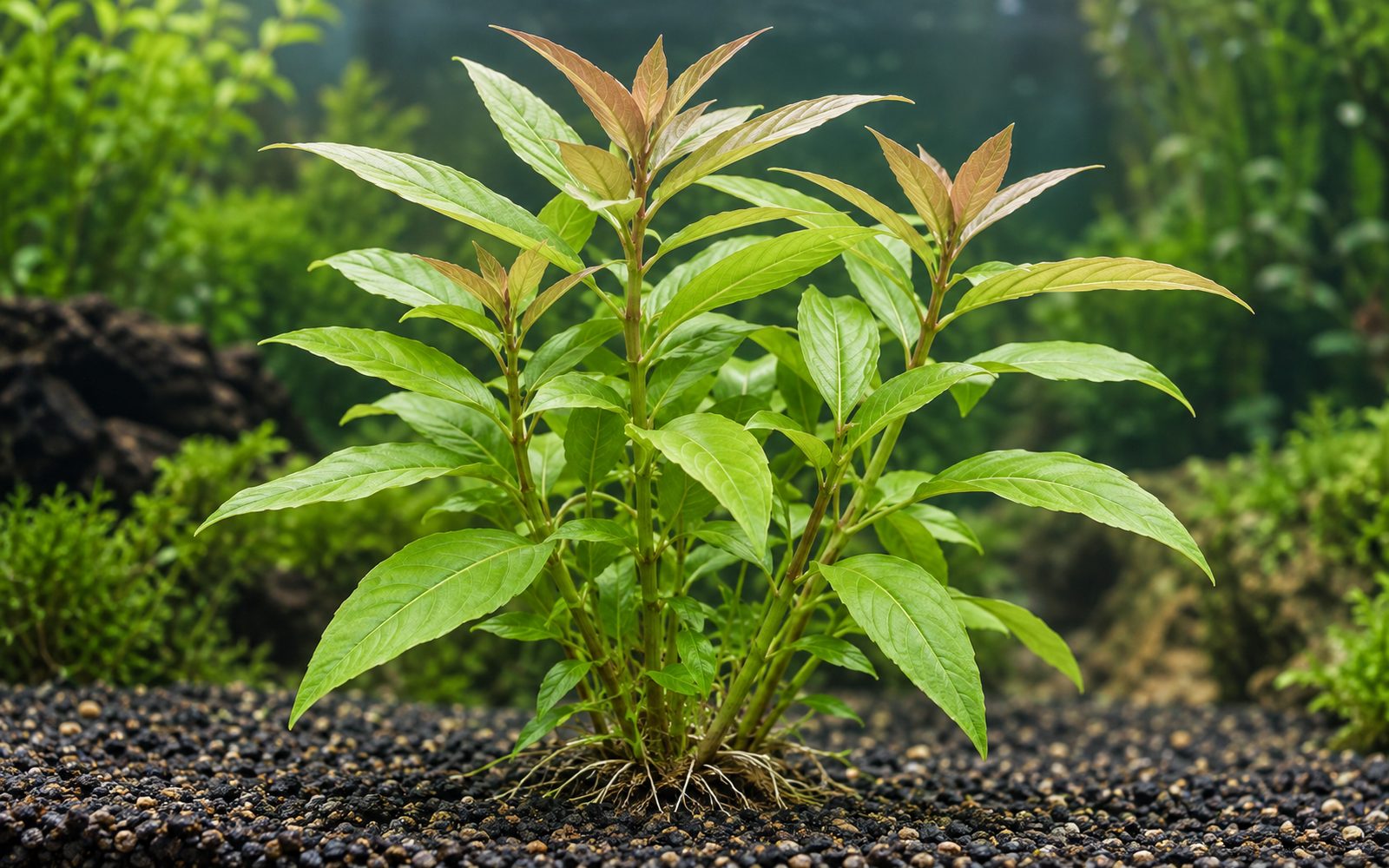
Hygrophila corymbosa is an Asian stem plant with large leaves and thick stems. Its leaves are arranged in opposite pairs, are lance-shaped and can reach 10–12 cm in length. As the light gets stronger, the top leaves take on a bronze-brown tone. It grows fast and quickly fills the background in large aquariums.
It is an easy plant: it lives in an aquarium without CO₂, in medium light and across a wide range of water parameters. Many forms are found in the trade: 'Angustifolia' has long, very narrow leaves, 'Kompakt' has short internodes and stays lower, and plants sold as 'Siamensis' are also mostly forms of this species.
Planting and Placement
- Stems are planted one by one with 4–5 cm between them; it needs plenty of room because its large leaves shade neighboring plants.
- The lower leaves are removed and the thick stem is buried 4–5 cm deep.
- It looks best in the background of aquariums of 60 liters or more, in groups of 3–5 stems.
Care and Fertilization
- Light: Medium; in strong light the leaves become denser and more colorful.
- CO₂: Not required; if added, growth speeds up noticeably.
- Fertilizer: Its nutrient demand is high; root tabs and regular liquid fertilizer are recommended.
- Trimming: Cut from the top. Two side shoots grow from the cut point; if not trimmed regularly, the stems reach the surface and spread horizontally.
Propagation
It is propagated by top cuttings. The cut tops root within a few days. Stems lying on the substrate can also produce new plants from their nodes.
Common Problems
- Holes in the leaves and yellowing edges: Potassium deficiency; this species shows nutrient deficiencies early.
- Pale new leaves: Iron deficiency.
- Lower leaves dropping: Shading or insufficient light.
- Nibbled leaves: Silver dollars, some large cichlids and apple snails eat its soft leaves.
Hobbyist notes
Things you won't find in books, learned by trial and error. The most helpful ones are on top.
Change history and contributors
- Page created · October 16, 2026