
Water parameters
Temperature20–28°C
pH6–7.5
General hardness (GH)2–15 dGH
Recommended range
Overview
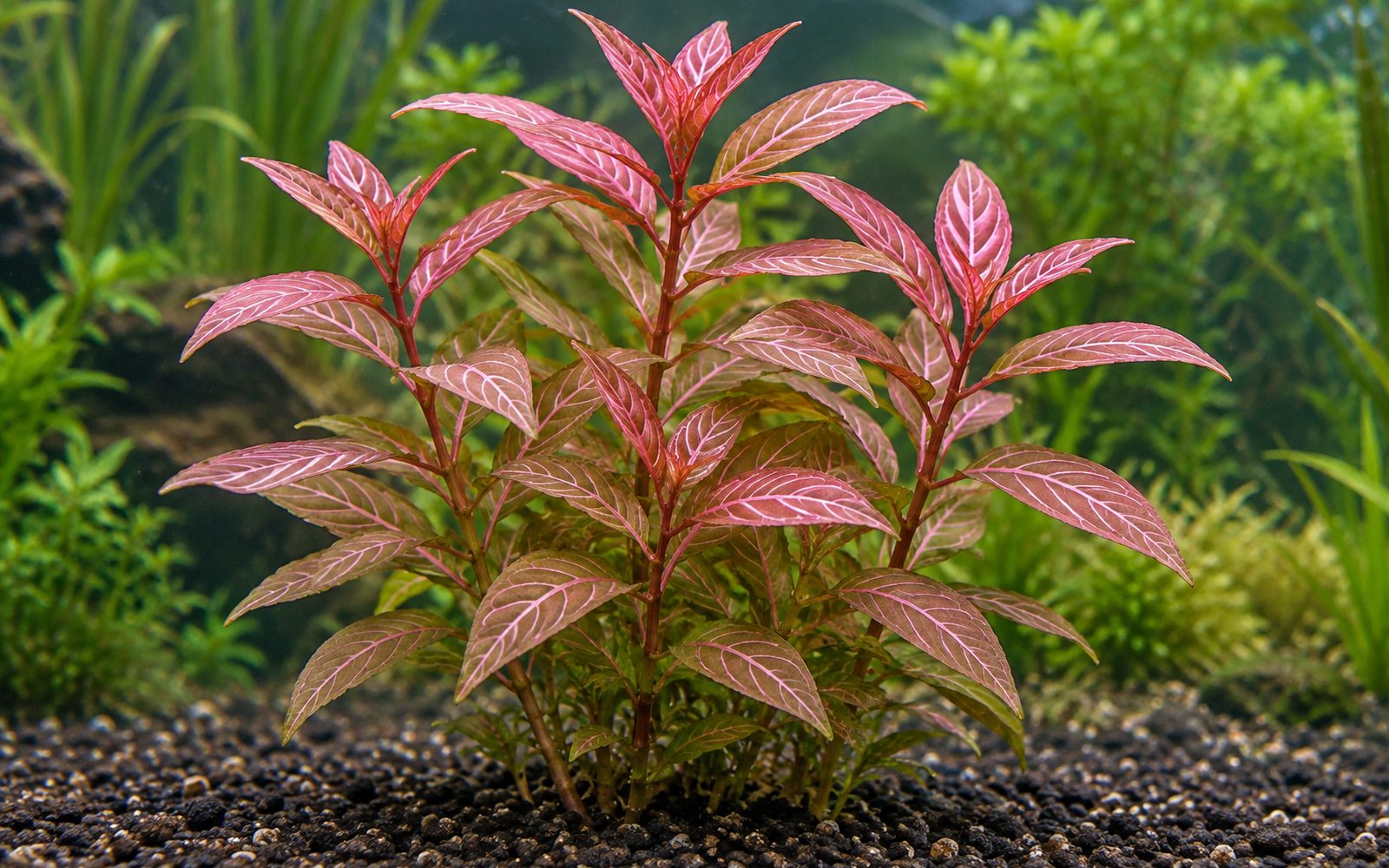
'Rosanervig' is a colorful form selected from the well-known Hygrophila polysperma. The leaves take on pink, orangey or reddish tones, and whitish-pink veins stand out clearly on them; the name "Sunset hygro" also comes from these colors. It largely keeps the hardiness of the parent species, but grows a little more slowly. The pattern and color become distinct in strong light; in weak light the leaves turn greenish.
Planting and Placement
- Stems are planted one by one, 3 cm apart and 3–4 cm deep.
- It is used in the midground or background in clusters of 5–7 stems as a color accent among green plants.
Care and Fertilization
- Light: Medium; the color and vein pattern become distinct in strong light.
- CO₂: Not required, but beneficial.
- Fertilizer: Iron supplementation supports the color; regular liquid fertilizer is recommended.
- Trimming: Cut from the top; the cut tops are replanted. As with the parent species, do not leave broken-off pieces floating; trimmings must not be dumped into the wild.
Propagation
This section has not been written yet. How is it propagated?
Be the first to write it
Common Problems
This section has not been written yet. Problems such as melting, yellowing and algae, and how to fix them.
Be the first to write it
Hobbyist notes
Things you won't find in books, learned by trial and error. The most helpful ones are on top.
No notes yet. If you have experience with this species, leave the first note.
Was this page helpful?
Change history and contributors
- Page created · October 16, 2026