
Water parameters
Overview
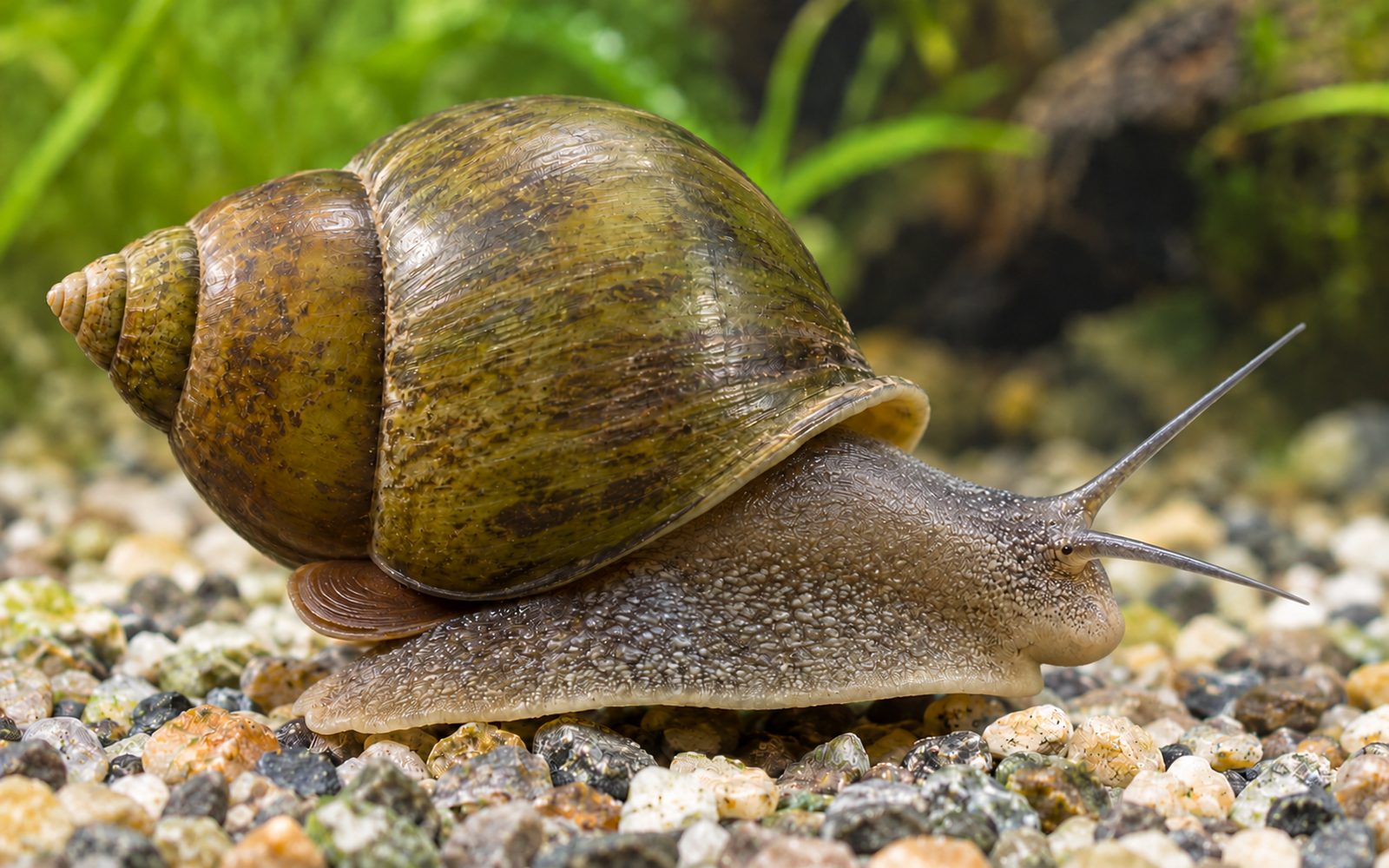
The Japanese trapdoor snail is a large, sturdy member of the family Viviparidae. It takes its name from the hard operculum that shuts the opening of its shell tightly, like a door. Its shell has rounded whorls, is smooth and ranges from olive green to dark brown; in adulthood it can reach 5 cm.
Its most distinctive feature is that it gives birth to live young: it does not lay eggs but gives birth to fully formed small snails. Because it reproduces slowly, it does not overrun the aquarium. Its tolerance of cold water and a wide range of values also makes it popular for garden ponds.
Warning: in North America it has escaped into lakes and rivers and established invasive populations. Never release it into the wild.
Natural Habitat
It lives in the ponds, irrigation canals, rice paddies and slow-flowing, muddy-bottomed waters of Japan. In winter it becomes inactive in cold water and waits in the mud.
Tank Setup
- Volume: 40 liters or more for a few individuals; it can also be kept in a garden pond.
- Water: pH 7 or above, moderately hard to hard water; 15–24°C is ideal. It also lives at tropical temperatures, but its lifespan may be shorter.
- Substrate: sand or fine gravel; organic debris on the bottom is a food source.
- Calcium: needed for its thick shell; cuttlebone can be added in soft water.
- Copper: lethal to snails.
- Pond: it can spend the winter at the bottom of a garden pond; make sure the pond is not connected to natural waters through flooding.
Diet
Omnivorous. It eats debris on the bottom, biofilm and algae; it can also feed by filtering fine particles from the water with its gills. Supplement with sinking tablets, spirulina and blanched vegetables. It generally leaves healthy plants alone.
Behavior and Compatibility
Completely peaceful. When it senses danger it withdraws into its shell and closes its operculum, which protects it from most fish attacks.
Good companions: goldfish and other coldwater fish, peaceful community fish, shrimp, other snails.
Avoid: clown loaches, puffers, large cichlids and crayfish (they may eat the young and small individuals).
Group and Colony Structure
The sexes are separate; a male and a female are needed for breeding. Starting with 3 or more individuals increases the chance of having both a male and a female. Reproduction is slow; the population does not explode on its own.
Breeding
It is a livebearer: the fertilized eggs develop inside the female, and the young are born as fully formed, shelled snails a few millimeters long. Females give birth to a few young at intervals during the warm months.
Health and Common Problems
- Shell erosion: low pH and low calcium.
- Checking for death: it can be normal for it to close its operculum and not move for days; if the operculum has loosened and there is a bad smell, the snail has died, so remove it immediately.
- Poisoning: copper and many antiparasitic medications are lethal.
Sexing
In males the right tentacle is shorter and thicker than the left because it functions as the copulatory organ; its tip may look curled. In females both tentacles have the same shape.
Tank mates
This list is calculated automatically from the species profile and grows as new species are added to the catalog. Try it in the planner for a definite answer.
Usually compatible









Hobbyist notes
Things you won't find in books, learned by trial and error. The most helpful ones are on top.
Change history and contributors
- Page created · October 16, 2026