
Water parameters
Overview
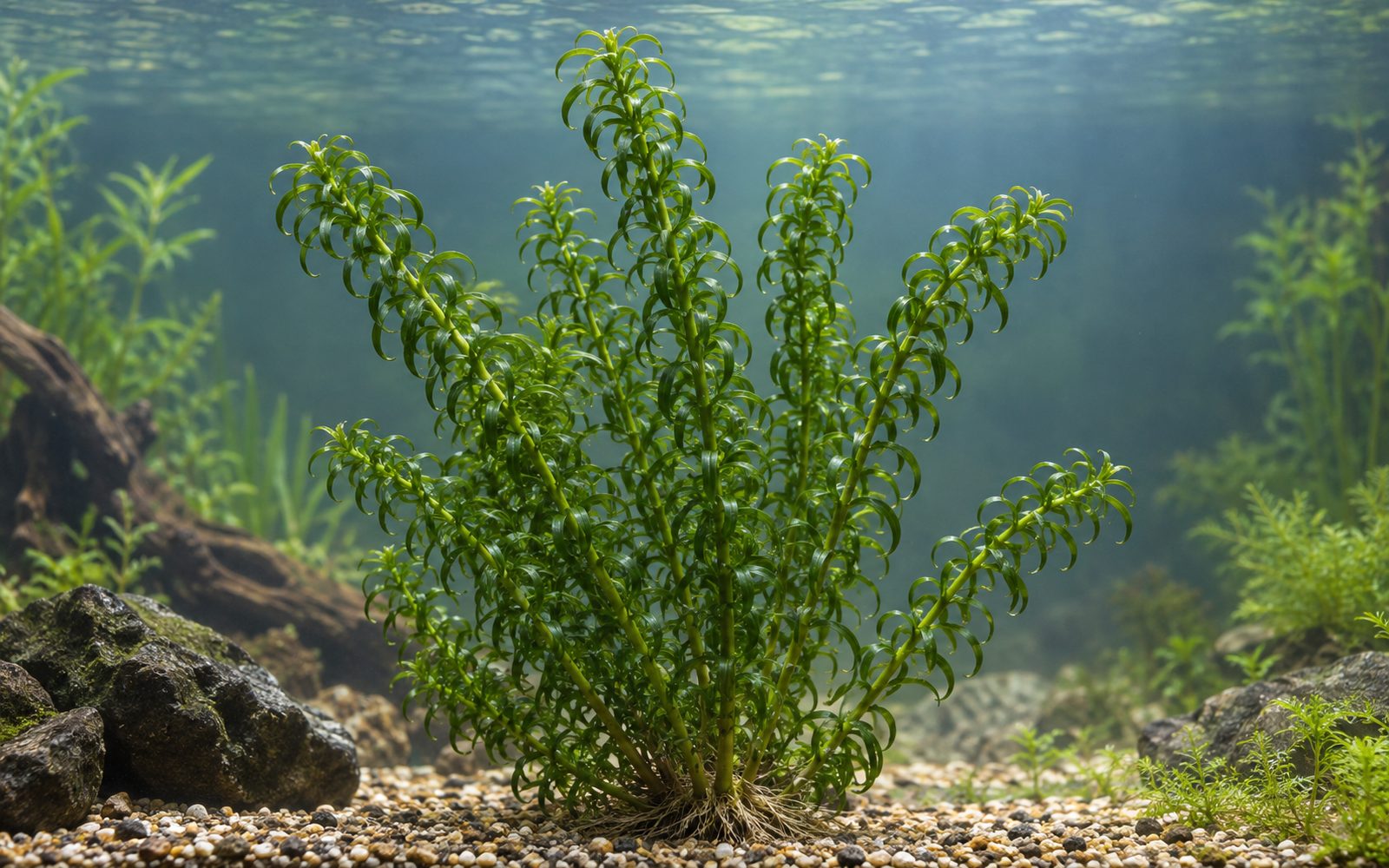
Lagarosiphon major is an aquatic plant native to southern Africa whose thick stems are covered with spirally arranged, distinctly recurved dark green leaves. For many years it was sold in the trade as "Elodea crispa." It likes cool, hard water; it grows quickly in unheated aquariums and ponds, but weakens at tropical temperatures. Although its structure resembles Egeria, its curled leaves make it easy to tell apart.
Invasive species: In New Zealand, Britain and many parts of Europe, where it has escaped into the wild, it is a serious invasive that covers lake surfaces. It is on the European Union's list of invasive species, and its sale is banned in EU countries. Trimmings must never be dumped into natural waters.
Planting and Placement
- Stems are buried 4–5 cm deep in groups of 3–5; they can be held down with a weight in the first weeks.
- It is used in the background or in the shallow zones along pond edges.
Care and Fertilization
- Light: Medium; in strong light it grows even faster.
- CO₂: Not required; it can use the carbonate in hard water.
- Temperature: Cool water; it should be kept below 24 °C.
- Fertilizer: Usually not needed.
- Trimming: Because it grows fast, it is thinned out regularly.
Propagation
Common Problems
Hobbyist notes
Things you won't find in books, learned by trial and error. The most helpful ones are on top.
Change history and contributors
- Page created · October 16, 2026