
Water parameters
Temperature22–28°C
pH6–7.5
General hardness (GH)2–12 dGH
Recommended range
Overview
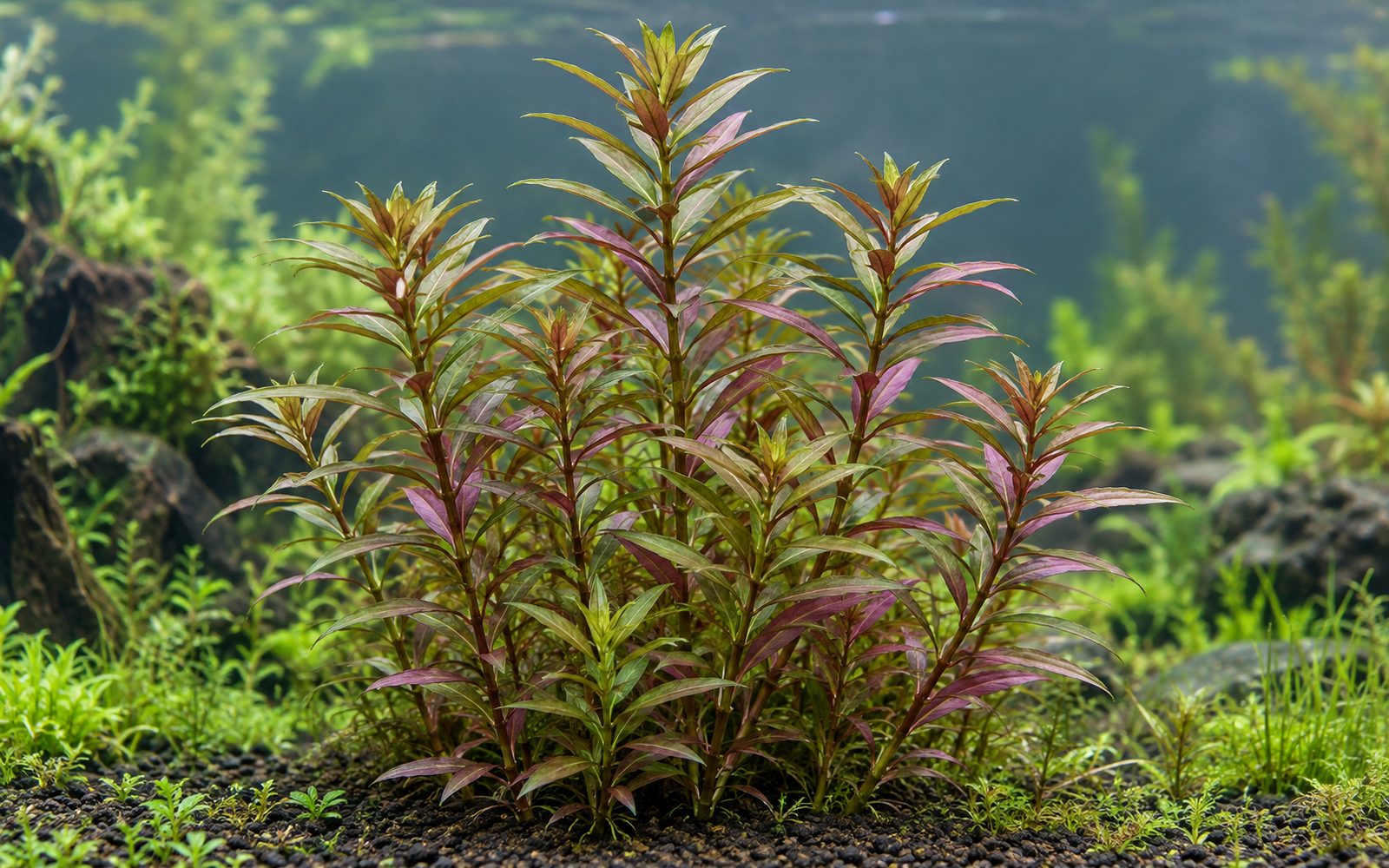
Limnophila hippuridoides is a Southeast Asian species that resembles Limnophila aromatica, but its leaves are arranged in whorls along the stem. In strong light the lance-shaped leaves turn olive green-bronze on top and purple-pink underneath; seen from above, the leaf whorls look like stars. It survives in medium light, but stays green and its internodes lengthen.
Planting and Placement
- Stems are planted one by one with 3 cm between them, 3–4 cm deep.
- The color transition looks best when it is planted in the background in clusters of 5–7 stems.
Care and Fertilization
- Light: Medium; the purple tones become distinct in strong light.
- CO₂: Not required, but beneficial.
- Fertilizer: Iron and micronutrient supplementation supports the color.
- Trimming: Cut from the top; the cluster is made denser by replanting the cut tops.
Propagation
This section has not been written yet. How is it propagated?
Be the first to write it
Common Problems
This section has not been written yet. Problems such as melting, yellowing and algae, and how to fix them.
Be the first to write it
Hobbyist notes
Things you won't find in books, learned by trial and error. The most helpful ones are on top.
No notes yet. If you have experience with this species, leave the first note.
Was this page helpful?
Change history and contributors
- Page created · October 16, 2026