
Water parameters
Overview
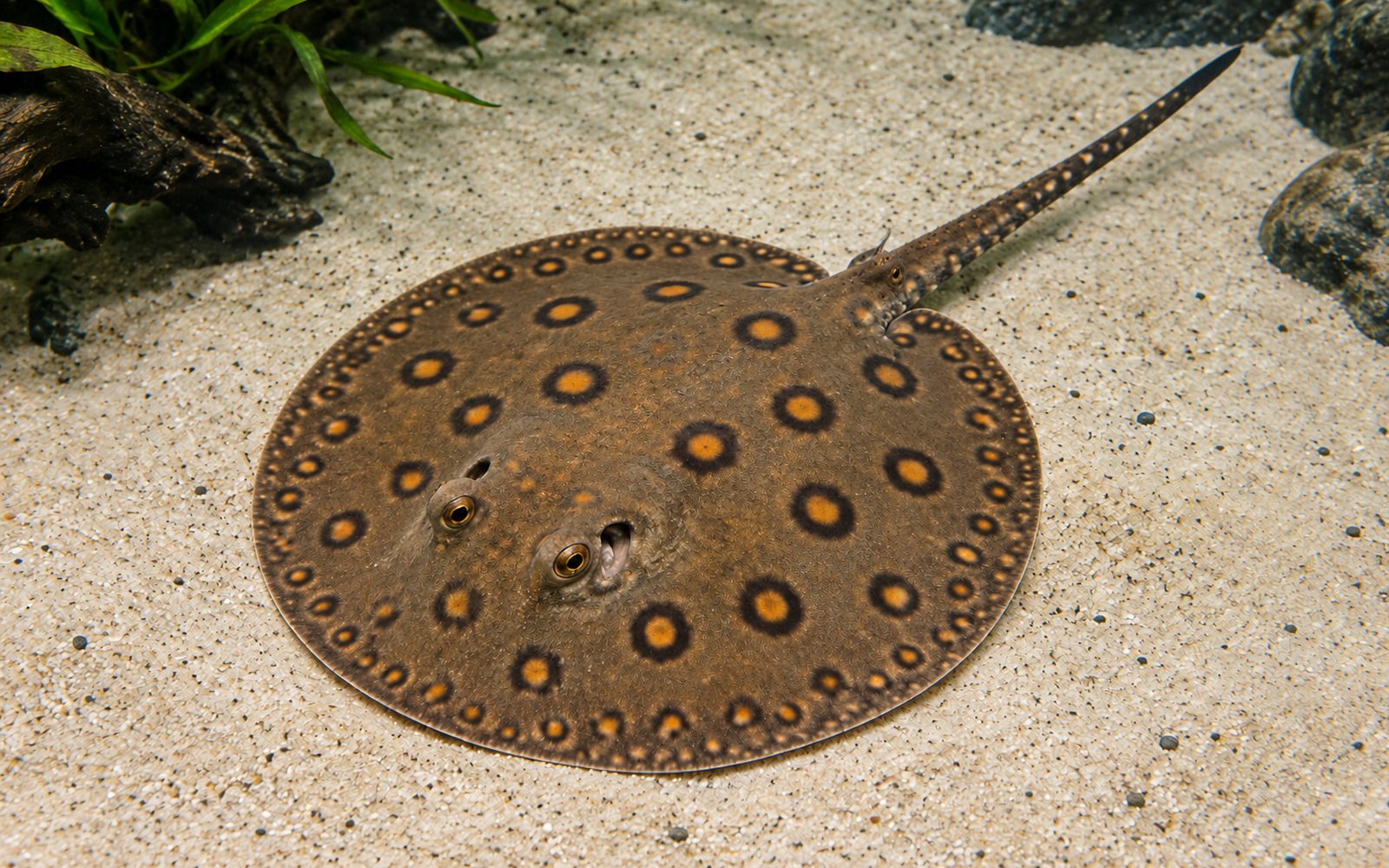
The motoro stingray is recognized by the orange-yellow ringed eyespots on its brown disc. It is a cartilaginous fish related to sharks and belongs to one of the few groups of rays that live entirely in fresh water in the wild. It recognizes its owner and comes up to the surface at feeding time; but its disc reaches 35–45 cm across, and keeping one is a serious responsibility.
Safety: The spine on its tail is venomous and causes extremely painful injuries that carry a risk of infection. Be careful when putting your hand in the tank and never handle the stingray; applying hot water to a sting relieves the pain, and you must always see a doctor.
Legal status: In some countries the import and sale of freshwater stingrays requires a permit; check local regulations before buying.
Natural Habitat
It lives in the large rivers of South America, in sandy, slow-flowing stretches, burying itself in the sand.
Tank Setup
- Volume: Footprint matters more than volume: at least a 240 × 90 cm footprint for an adult motoro (roughly 1000 liters or more). A height of 50 cm is enough.
- Substrate: fine, soft sand or a bare bottom; no sharp decor. Heaters must be guarded (stingrays can burn themselves by touching a heater).
- Water: Flawless water quality: zero ammonia and nitrite, very low nitrate; a powerful filter and frequent water changes. It is very sensitive to sudden changes.
Diet
Carnivorous. Shrimp, mussels, squid, fish fillet, worms and stingray pellets. Juveniles are fed 2–3 times a day, adults 1–2 times. Loss of appetite is a serious warning sign.
Behavior and Compatibility
Peaceful, but it eats anything on the bottom that fits in its mouth (small fish, shrimp, snails).
Good companions: calm fish that live in the middle and upper layers and are too big to fit in its mouth: large tetras, silver dollars, Geophagus species (with caution).
Avoid: bottom dwellers and plecos that may latch onto the stingray's skin, small fish, shrimp.
Group and Colony Structure
It can be kept singly, but stingrays are social and, given enough space, are more comfortable as a pair or a small group. Each adult needs additional footprint.
Breeding
A livebearer: gestation lasts a few months and the female gives birth to a few pups each time; the pups are fully developed at birth and start feeding immediately. During mating the male holds the female by biting her; the female may be injured.
Health and Common Problems
- Loss of appetite and curling of the disc edges: the first signs of poor water quality or stress.
- Medication sensitivity: it is very sensitive to many medications, especially some antiparasitics; using medication requires expert advice.
Sexing
Easy to tell apart: males have mating organs (claspers) behind their pelvic fins; females do not.
Tank mates
This list is calculated automatically from the species profile and grows as new species are added to the catalog. Try it in the planner for a definite answer.
Usually compatible
 Chocolate Cichlid
 Geophagus altifrons
 Geophagus surinamensis
 Pearl Cichlid
 Threadfin Acara
 Redhead Cichlid
 Cryptocoryne Parva
 Gold Spot Pleco (L001)
African Brown Knifefish
Gold Spot Pleco (L001)
African Brown Knifefish
 Weeping Moss
Should not be kept together









Hobbyist notes
Things you won't find in books, learned by trial and error. The most helpful ones are on top.
Change history and contributors
- Page created · October 16, 2026