
Water parameters
Overview
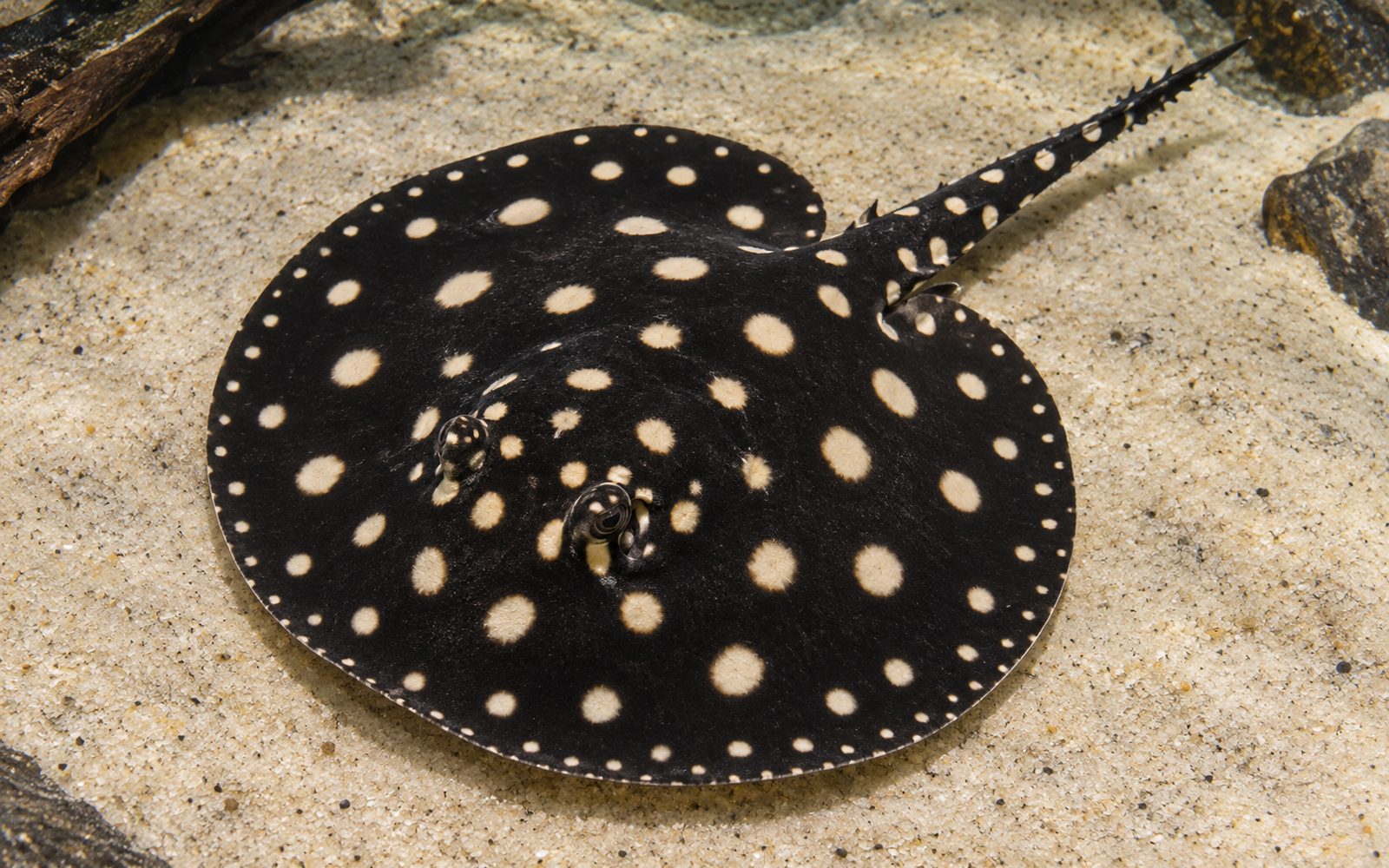
With white to cream spots on its jet-black disc, the polka dot stingray is one of the most sought-after freshwater stingrays. In the wild it lives only in the Xingu River basin in Brazil. The disc usually reaches 35–40 cm in diameter; females are larger than males.
Safety: The spine on its tail is venomous and causes very painful wounds that carry a risk of infection. Be careful when putting your hand in the aquarium and do not handle the stingray; seek medical help if injured.
Legal status: Wild collection and import of freshwater stingrays are subject to quotas or permits in some countries. Today most of the fish on the market come from breeders in Asia and Europe; check local regulations before buying. Similar-looking hybrids are also common.
Natural Habitat
It lives over rocky and sandy bottoms in the clear, warm, flowing waters of the Xingu River.
Tank Setup
- Volume: floor area matters more than volume: at least a 200 × 80 cm footprint for one adult (about 1000 liters). A height of 50 cm is enough.
- Substrate: fine, soft sand or a bare bottom; no sharp decor. Heaters must be guarded.
- Water: flawless water quality: ammonia and nitrite at zero, nitrate very low. Strong filtration and a 30–50% water change weekly. It is very sensitive to sudden changes.
- Temperature: it likes slightly warmer water than other stingrays (27–29°C).
Diet
Carnivorous. Shrimp, mussels, squid, worms, fish fillet and stingray pellets. Juveniles are fed 2–3 times a day, adults 1–2 times. Newly arrived fish may take days to start eating; loss of appetite is a serious warning sign.
Behavior and Compatibility
Peaceful, but it eats anything on the bottom that fits in its mouth.
Good companions: calm mid- and upper-level fish too big for its mouth: silver dollars, large tetras, arowanas (in a very large aquarium), Geophagus species (with caution).
Avoid: plecos that may latch onto the stingray's disc, bottom-dwellers, small fish, shrimp, snails.
Group and Colony Structure
A single fish can be kept; with enough floor area it also lives as a pair or a small group. Each adult requires additional floor area.
Breeding
A livebearer: gestation lasts several months, and the female gives birth to a few fully developed pups each time. Breeding takes experience; during mating the male holds the female by biting and may injure her.
Health and Common Problems
- Loss of appetite and curling of the disc edge: the first signs of poor water or stress.
- Medication sensitivity: very sensitive to many medications, especially some parasite treatments; seek expert advice.
- Heater burns: in stingrays that touch an unguarded heater.
Sexing
Easy: males have mating organs (claspers) behind the pelvic fins; females do not.
Tank mates
This list is calculated automatically from the species profile and grows as new species are added to the catalog. Try it in the planner for a definite answer.
Usually compatible
 Altum Angelfish
 Chocolate Cichlid
 Discus
 Geophagus altifrons
 Geophagus surinamensis
 Pearl Cichlid
 Threadfin Acara
 Blood Parrot
 Redhead Cichlid
 Cryptocoryne Parva
Should not be kept together









Hobbyist notes
Things you won't find in books, learned by trial and error. The most helpful ones are on top.
Change history and contributors
- Page created · October 16, 2026