
Water parameters
Overview
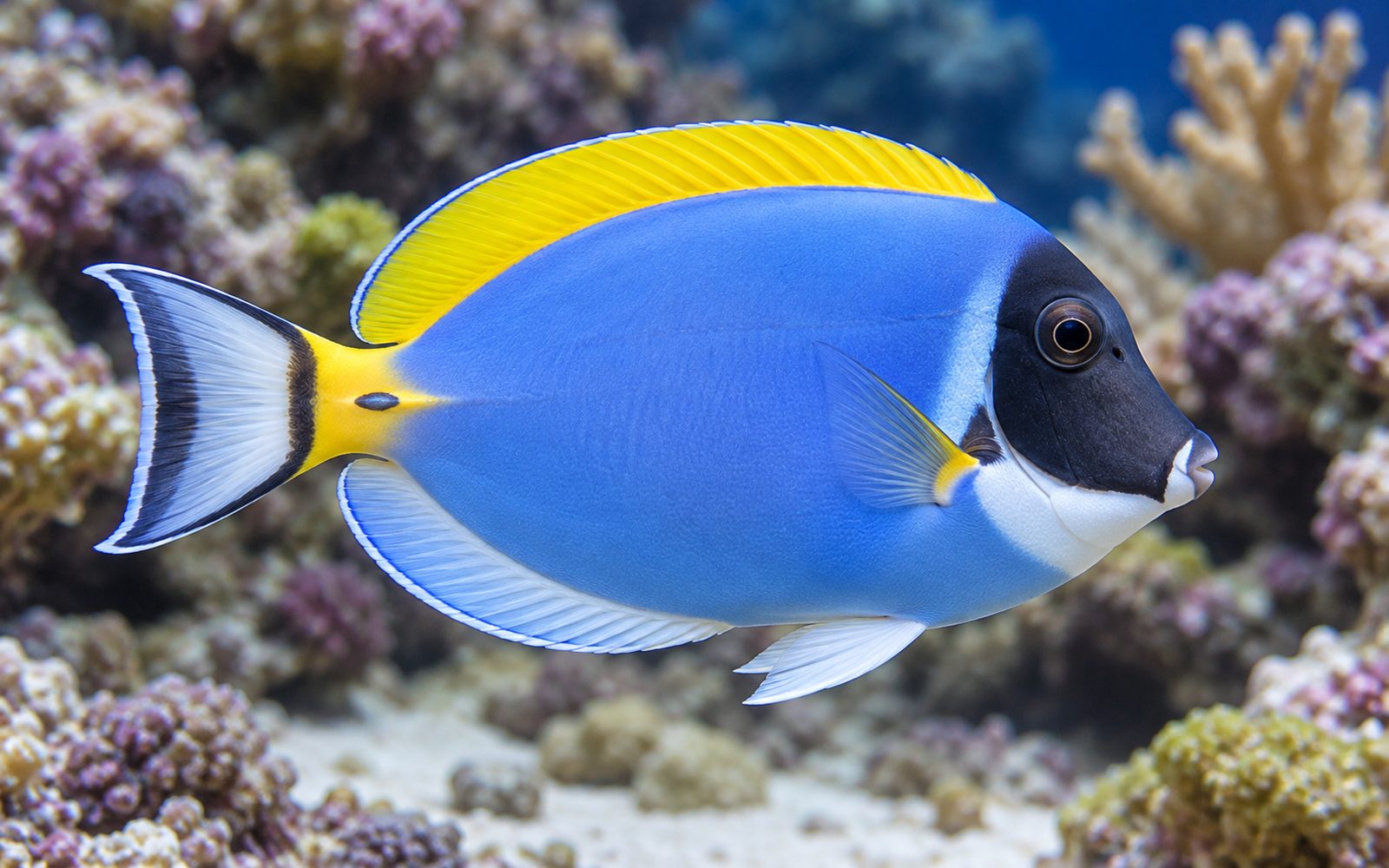
With its light blue body, black head and white throat, the powder blue tang is one of the most eye-catching surgeonfish of Indian Ocean reefs. "Leucosternon" in its name means white breast. Within the yellow area on the tail base there is a sharp scalpel spine.
Despite its beauty, it is a difficult species. All specimens are wild-collected, it handles the stress of shipping poorly, and it is perhaps the most prone of all tangs to marine white spot. It is not recommended for a newly set-up aquarium, for someone without marine aquarium experience, or for systems where quarantine will not be done. A healthy specimen has bright, vivid color; pale, blotchy fish with a sunken belly are stressed and should not be bought.
Natural Habitat
It lives on the shallow, wave-washed reef flats and upper slopes of the Indian Ocean; in the wild it grazes on fine algae in large groups.
Tank Setup
- Volume: At least 600 liters and 180 cm in length. It needs plenty of open swimming space and strong flow.
- Water: Salinity specific gravity 1.023–1.026, pH 8.1–8.4, temperature 24–27°C. Oxygen-rich, very clean and stable water.
- Maturity: An aquarium that has been running for at least 6 months, with live rock covered in plenty of algae.
- Reef compatibility: Reef-safe; it leaves corals and invertebrates alone.
- Maintenance: A 10% water change weekly or 20% every two weeks; sudden swings in temperature and salinity trigger disease in this species.
Diet
Herbivorous. Dried seaweed (nori), spirulina and granules and flakes containing seaweed should be the staple, supplemented with frozen mysis and brine shrimp. It should be fed small amounts at least 3 times a day; a specimen that goes hungry quickly loses condition and becomes vulnerable to disease.
Behavior and Compatibility
Shy in a new environment, dominant once it has settled in. It attacks its own kind, other tangs of the genus Acanthurus and similarly colored fish. It usually gets along with other fish.
Good companions: Clownfish, anthias, fairy wrasses, cardinalfish, gobies; in a very large aquarium, a single tang of a different genus (e.g. yellow tang), provided the powder blue is added last.
Avoid: Other Acanthurus species (e.g. powder brown tang), a second powder blue, large triggerfish, aggressive species that overcrowd the aquarium.
Group and Colony Structure
Kept as a single specimen in the aquarium. The large schools seen in the wild cannot be recreated in an aquarium; two specimens wear each other down.
Breeding
A pelagic spawner; in the wild it releases eggs into the water column in large groups. It does not breed in the aquarium.
Health and Common Problems
- Marine white spot (Cryptocaryon irritans): The biggest problem for this species. Always quarantine for 4–6 weeks; treatment is carried out in the quarantine tank with copper or hyposalinity.
- Velvet (Amyloodinium): Progresses quickly; death is common when the gills are affected.
- Wasting and HLLE: With insufficient and monotonous feeding.
Sexing
Cannot be distinguished externally.
Tank mates
This list is calculated automatically from the species profile and grows as new species are added to the catalog. Try it in the planner for a definite answer.
Hobbyist notes
Things you won't find in books, learned by trial and error. The most helpful ones are on top.
Change history and contributors
- Page created · October 16, 2026