
Water parameters
Overview
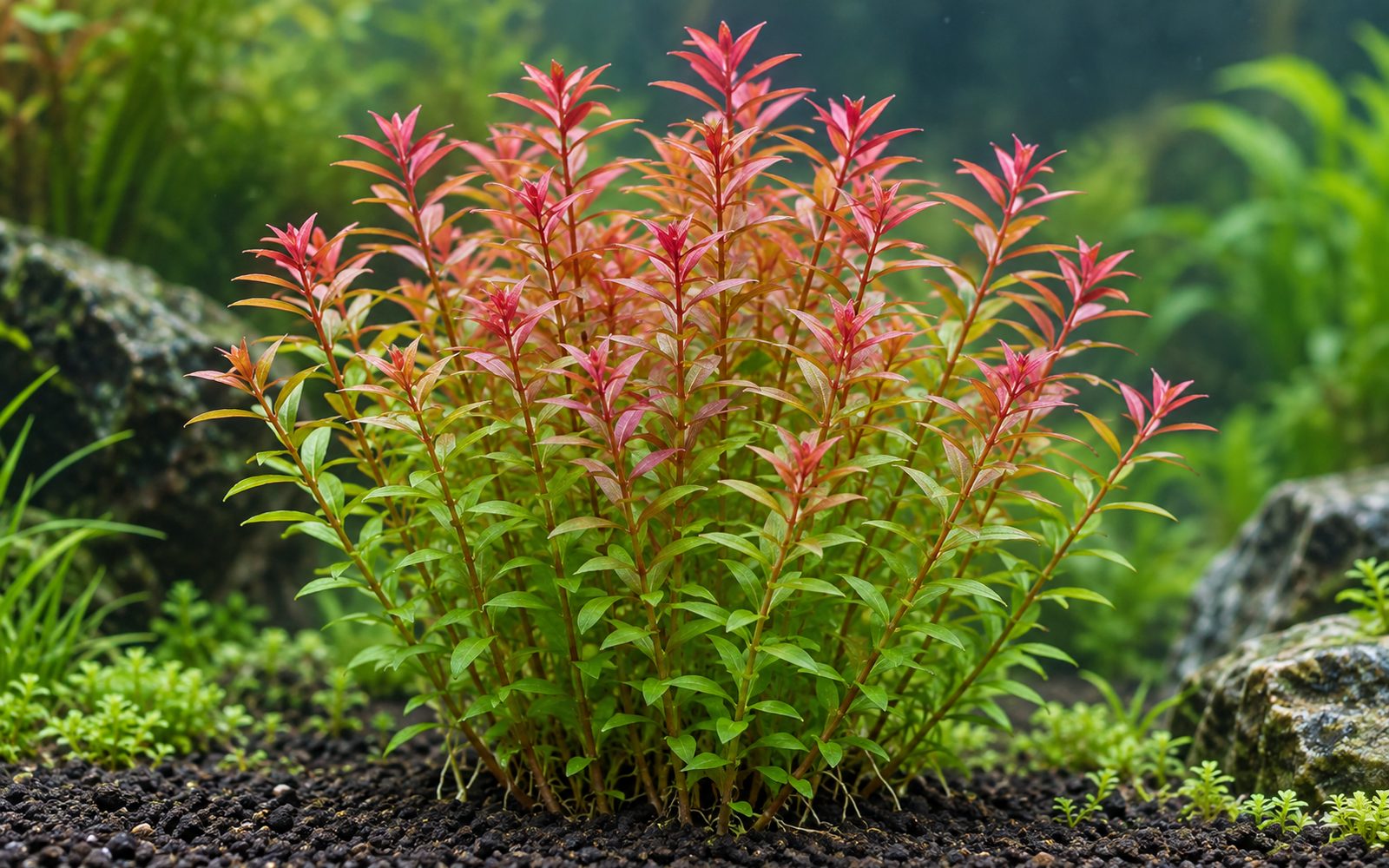
Rotala rotundifolia is one of the most commonly used stem plants in aquariums. The "round leaf" in its name describes the plant's emersed form: on stems from the nursery, the leaves are round and dark green. As it adapts to life underwater, thin, lance-shaped, soft leaves grow in their place. As light increases, the shoot tips turn from pink to orange-red; this color gradient is very striking when the plant is grown in dense clusters.
Because it grows fast, it uses up excess nutrients in the water and competes with algae. It also grows without CO₂; with CO₂ and strong light it branches more densely and its colors deepen. In the trade it is sometimes sold labeled as Rotala indica; the true R. indica is a separate species that is rarely found in the hobby.
Planting and Placement
- The pot, rock wool and lead strip are removed completely; the stems are separated one by one.
- The lower 2–3 leaf pairs of each stem are pinched off and the stem is buried 3–4 cm deep.
- The stems are planted in clusters of 5–10, leaving 2–3 cm between them. Planting too densely shades the lower parts.
- It looks best in the background and corners; it adds a color accent among green plants.
Care and Fertilization
- Light: Medium light is enough; red and orange tones become distinct in strong light.
- CO₂: Not required, but it gives a clear benefit: the stems become denser and the colors deepen.
- Fertilizer: Regular liquid fertilizer and iron supplementation; a nutrient-rich substrate supports growth.
- Trimming: Stems that reach the surface are cut from the top, 10–15 cm long. Two or three side shoots grow from the cut point and the cluster becomes bushier.
Propagation
It is easily propagated by replanting the cut tops directly. The lower stem in the substrate also produces side shoots. The cluster is renewed by occasionally pulling out old stems with bare lower parts and planting fresh tops in their place.
Common Problems
- Lower leaves dropping: Seen when the top of the cluster becomes too dense and the lower part is left in shade. Trim more often or renew the cluster with fresh tops.
- The plant staying green: Light is weak or nitrate in the water is too high. Increasing the light and balancing fertilization brings out the color.
- Horizontal growth: In very strong light, newly planted stems may spread parallel to the substrate for a while; they straighten up once rooted.
- Pale, yellowish new leaves at the tips: Usually a sign of iron deficiency.
Hobbyist notes
Things you won't find in books, learned by trial and error. The most helpful ones are on top.
Change history and contributors
- Page created · October 16, 2026